















Na era da conectividade de alta velocidade, transceptores ópticos 10G funcionam como a espinha dorsal para uma transmissão de dados contínua através de redes empresariais, centros de dados e sistemas de telecomunicações. LINK-PP, um fabricante de referência no setor das soluções de fibra ótica, oferece um vasto portfólio de transceptores óticos de 10G concebidos para responder às mais diversas necessidades de rede. Este guia explora os tipos, as características e os critérios de seleção para LINK-PP 10G SFP+, permitindo-lhe tomar decisões informadas relativamente à sua infraestrutura.
Visão geral dos transceptores óticos LINK-PP de 10G
A transceptor óptico 10G converte sinais elétricos em sinais óticos (e vice-versa) para permitir a comunicação 10 Gigabit Ethernet (10GbE) através de cabos de fibra ótica. Os módulos 10G da LINK-PP foram concebidos para oferecer elevado desempenho, baixa latência e compatibilidade com as principais marcas de equipamentos de rede. Compatíveis com uma vasta gama de formatos, comprimentos de onda e distâncias de transmissão, estes transceptores destinam-se a aplicações que vão desde ligações de curto alcance em centros de dados até redes metropolitanas de longo alcance.
Tipos de transceptores óticos LINK-PP de 10G
LINK-PP oferece uma gama abrangente de transceptores de 10G para dar resposta a diversas arquiteturas de rede. Segue-se uma descrição detalhada dos principais tipos e dos seus casos de utilização:
Fator de Forma | Comprimento de onda | Distância Máxima | Tipo de fibra | Aplicações |
|---|---|---|---|---|
SFP+ | 850 nm/1310 nm/1550 nm | 300 m–120 km | MM/SM | Centros de dados, redes empresariais |
XFP | 850 nm/1310 nm/1550 nm | 300 m–80 km | MM/SM | Telecomunicações, redes metropolitanas/centrais |
X2/XENPAK | 1310 nm/1550 nm | 10 km–80 km | SM | Atualizações de infraestrutura legada |
BIDI SFP+ | Tx 1490 nm/Rx 1550 nm | Até 80 km | SM | Ligações bidirecionais de fibra única |
SFP+ CWDM/DWDM | 1270–1610 nm | 40 km–120 km | SM | Multiplexação de comprimentos de onda de alta densidade |
1. Módulos SFP+
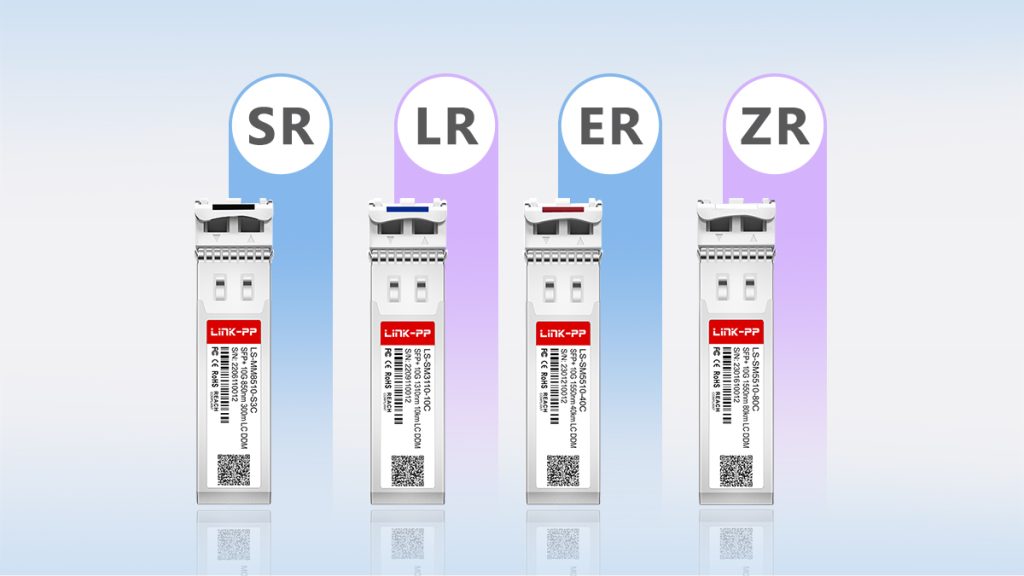
10G SR SFP+: Funciona a 850 nm em fibra multimodo (OM3/OM4) para aplicações de curto alcance (até 300 m). Ideal para conectividade dentro do rack.
SFP+ 10G LR: Utiliza 1310 nm através de fibra monomodo (SMF) para distâncias até 10 km, sendo ideal para redes de campus.
SFP+ 10G ER/ZR: Emite comprimentos de onda de 1550 nm para um alcance alargado (40 km–120 km), sendo adequado para redes metropolitanas.
2. Módulos XFP
Semelhantes aos módulos SFP+, mas com um formato maior, os módulos XFP são ideais para implementações de alta densidade que exigem transmissão de longo alcance (até 80 km).
3. Transceptores BIDI
LINK-PP’s Módulos BIDI (bidirecionais) permite a comunicação bidirecional através de um único fio de fibra, reduzindo os custos da infraestrutura de fibra. Disponível nos formatos SFP+ e XFP.
4. Módulos CWDM/DWDM
LINK-PP’s CWDM (Multiplexação por Divisão de Comprimento de Onda Grossa) and Transceptores DWDM (WDM denso) maximizar a capacidade da fibra através da multiplexação de vários comprimentos de onda num único par de fibras. Estas são fundamentais para redes de telecomunicações e na nuvem escaláveis.
Atualize a sua rede
Explore já o portfólio de transceptores de 10G da LINK-PP
Principais vantagens dos transceptores LINK-PP 10G
Ampla Compatibilidade: Conforme com o MSA e rigorosamente testados quanto à interoperabilidade com a Cisco, a Juniper, a Huawei e mais de 200 outras marcas.
Formatos versáteis: Compatível com as configurações SFP+, XFP, X2, XENPAK, BIDI e CWDM/DWDM.
Opções de alcance alargado: Abrange aplicações de curto alcance (SR: 300 m) a ultralongo alcance (ZR: 120 km).
Diagnósticos Avançados: Integrado DDM/DOM para monitoramento em tempo real de temperatura, tensão e potência óptica.
Durabilidade industrial: Funciona em temperaturas extremas (de -40 °C a 85 °C) e em ambientes adversos.
Eficiência de custo: Poupança de até 70% em comparação com os módulos OEM, sem comprometer a qualidade.
Como escolher o transceptor ótico LINK-PP 10G adequado
Passo 1: Avaliar os requisitos de rede
Distância: Adapte o alcance do transceptor às suas necessidades:
SR (300 m): Interligações entre centros de dados.
LR (10 km): Redes de campus ou metropolitanas.
ER/ZR (40 km–120 km): Ligações de telecomunicações de longo alcance.
Tipo de fibra: Multimodo (MMF) para links curtos com boa relação custo-benefício; monomodo (SMF) para uma boa audibilidade a longa distância.
Passo 2: Verificar a compatibilidade
Verifique os formatos suportados pelo seu switch ou router (SFP+, XFP, etc.) e certifique-se de que o comprimento de onda está alinhado.
Passo 3: Considere as funcionalidades avançadas
BIDI: Opte por módulos de fibra única para reduzir para metade o consumo de fibra.
CWDM/DWDM: Ideal para maximizar a capacidade existente da rede de fibra ótica.
Suporte DOM: Essencial para uma gestão proativa da rede.
Passo 4: Avaliar o custo total de propriedade
Embora o custo inicial seja importante, dê prioridade aos módulos com garantias alargadas (até 5 anos) e assistência técnica 24 horas por dia, 7 dias por semana.
Principais recomendações de transceptores LINK-PP 10G
Model | Type | Comprimento de onda | Distância | Caso de uso |
|---|---|---|---|---|
SFP+ SR | 850nm | 300 m | Racks para centros de dados | |
SFP+ LR | 1310 nm | 10km | Redes de campus | |
SFP+ ER | 1550 nm | 40 km | Agregação da rede de metro | |
BIDI SFP+ | 1490 nm/1550 nm | 80 km | Ligações de rede principal de fibra única | |
SFP+ CWDM | CWDM 1550 nm | 40 km | Redes empresariais | |
SFP+ DWDM | DWDM 1552,52 nm | 40 km | Roteamento por comprimento de onda de alta capacidade |
Dicas finais para uma seleção ideal
Verifique sempre as especificações com a lista de compatibilidade do fornecedor do seu equipamento.
Para aplicações industriais, dê prioridade aos módulos com gama de temperaturas alargada.
Alavancagem Transceptores CWDM/DWDM para evitar uma implantação de fibra ótica dispendiosa.
Ao selecionar Transceptores óticos LINK-PP 10G, garante uma combinação de desempenho, fiabilidade e poupança de custos. Explore a gama completa de produtos da LINK-PP Módulos 10G SFP+, Transceptores BIDI, and Soluções DWDM para construir uma rede preparada para os desafios do futuro.
Perguntas Frequentes
1. Qual é a diferença entre módulos óticos monomodo e multimodo?
Os módulos monomodo transmitem dados a longas distâncias utilizando um feixe de luz estreito. Os módulos multimodo funcionam melhor em distâncias curtas e utilizam um feixe de luz mais largo. Escolha em função dos requisitos de distância da sua rede.
💡 Dica: Utilize fibra monomodo para distâncias superiores a 500 metros e multimodo para ligações mais curtas.
2. Como posso saber se um módulo ótico é compatível com o meu equipamento?
Verifique as especificações do módulo para saber o tipo de conector, o formato e a compatibilidade dos cabos. Certifique-se de que cumpre as normas da indústria, como a IEEE 802.3. A realização de testes com o seu hardware permite confirmar a compatibilidade.
3. Posso utilizar módulos óticos de outros fabricantes com o meu equipamento de rede?
Sim, muitos módulos de terceiros funcionam bem com equipamentos de marca. No entanto, verifique a compatibilidade e certifique-se de que o módulo satisfaz as suas necessidades de desempenho. Alguns fabricantes podem anular as garantias caso sejam utilizados módulos de terceiros.
4. Como posso manter o desempenho do meu módulo ótico?
Mantenha o módulo limpo e monitorize a sua temperatura de funcionamento. Utilize ferramentas de monitorização ambiental para garantir que esta se mantém dentro do intervalo recomendado. Inspecione regularmente os cabos e os conectores para verificar se apresentam danos.
5. O que devo ter em conta ao escolher um módulo ótico?
Preste atenção à largura de banda, à distância e às necessidades ambientais da sua rede. Verifique a compatibilidade com o equipamento existente e tenha em conta os custos a longo prazo. Procure fornecedores fiáveis que ofereçam garantias sólidas e um bom serviço de assistência.
🔍 Observação: Avalie sempre as avaliações dos utilizadores e as opiniões dos especialistas antes de efetuar uma compra.
Veja Também
Junte-se à empolgante comunidade LINK-PP ainda hoje