
















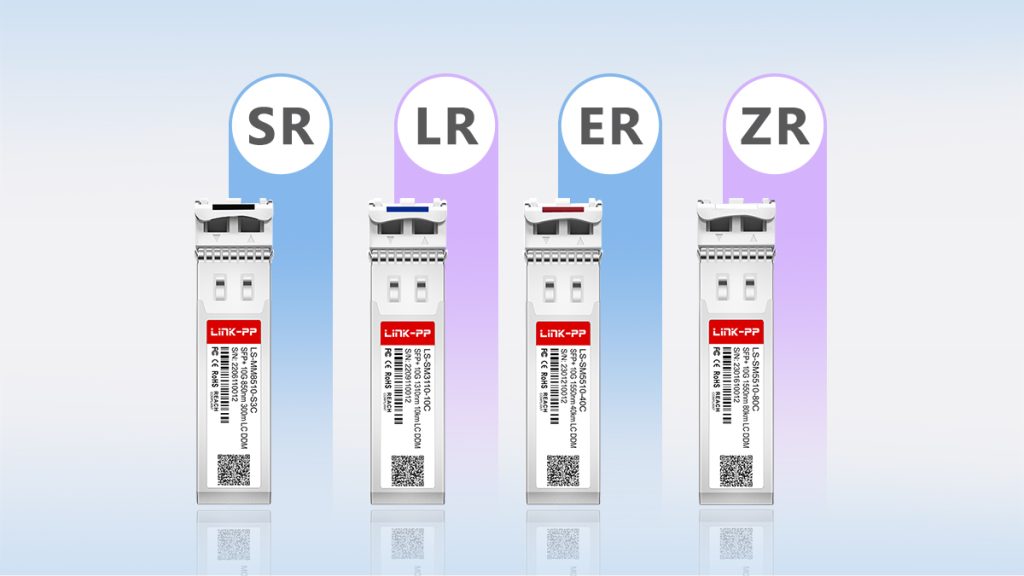
À l'ère de la connectivité haut débit, les émetteurs-récepteurs optiques 10G constituent l'épine dorsale d'une transmission fluide des données au sein des réseaux d'entreprise, des centres de données et des systèmes de télécommunications. LIEN-PP, fabricant de référence dans le domaine des solutions de fibre optique, propose une gamme complète d'émetteurs-récepteurs optiques 10G conçus pour répondre à divers besoins en matière de réseaux. Ce guide présente les différents types, les caractéristiques et les critères de sélection des LINK-PP 10G SFP+, ce qui vous permet de prendre des décisions éclairées concernant votre infrastructure.
Présentation des émetteurs-récepteurs optiques LINK-PP 10G
A transceiver optique 10G convertit les signaux électriques en signaux optiques (et inversement) afin de permettre la communication 10 Gigabit Ethernet (10GbE) via des câbles à fibre optique. Les modules 10G de LINK-PP sont conçus pour offrir des performances élevées, une faible latence et une compatibilité avec les principales marques d’équipements réseau. Prise en charge d’une large gamme de formats, de longueurs d’onde et de distances de transmission, ces émetteurs-récepteurs répondent aux besoins d’applications allant des liaisons à courte portée dans les centres de données aux réseaux métropolitains à longue distance.
Types d'émetteurs-récepteurs optiques LINK-PP 10G
LIEN-PP propose une gamme complète d'émetteurs-récepteurs 10G adaptés à diverses architectures réseau. Vous trouverez ci-dessous une présentation des principaux types et de leurs cas d'utilisation :
Facteur de forme | Longueur d’onde | Distance maximale | Type de fibre | Applications |
|---|---|---|---|---|
SFP+ | 850 nm/1 310 nm/1 550 nm | 300 m – 120 km | MM/SM | Centres de données, réseaux d'entreprise |
XFP | 850 nm/1 310 nm/1 550 nm | 300 m – 80 km | MM/SM | Télécommunications, réseaux métropolitains/centraux |
X2/XENPAK | 1310 nm/1550 nm | 10 km – 80 km | SM | les mises à niveau d’infrastructures héritées |
BIDI SFP+ | Émission 1 490 nm / Réception 1 550 nm | Jusqu’à 80 km | SM | Liaisons bidirectionnelles à fibre unique |
SFP+ CWDM/DWDM | 1 270–1 610 nm | 40 km – 120 km | SM | Multiplexage en longueur d'onde à haute densité |
1. Modules SFP+
SFP+ 10G SR: Fonctionne à 850 nm sur une fibre multimode (OM3/OM4) pour des applications à courte portée (jusqu'à 300 m). Idéal pour la connectivité intra-rack.
SFP+ 10 G LR: Utilise une longueur d'onde de 1 310 nm sur une fibre monomode (SMF) pour des distances allant jusqu'à 10 km, ce qui en fait la solution idéale pour les réseaux de campus.
SFP+ 10G ER/ZR: Émet des longueurs d'onde de 1 550 nm pour une portée étendue (40 km à 120 km), ce qui convient aux réseaux métropolitains.
2. Modules XFP
Semblables aux modules SFP+, mais dotés d'un format plus grand, les modules XFP sont parfaits pour les déploiements à haute densité nécessitant une transmission longue distance (jusqu'à 80 km).
3. Émetteurs-récepteurs BIDI
LINK-PP Modules BIDI (bidirectionnels) Permet une communication bidirectionnelle sur une seule fibre optique, ce qui réduit les coûts liés à l'infrastructure fibre optique. Disponible aux formats SFP+ et XFP.
4. Modules CWDM/DWDM
LINK-PP CWDM (multiplexage par répartition en longueurs d’onde grossière) and Émetteurs-récepteurs DWDM (WDM à densité élevée) optimiser la capacité des fibres en multiplexant plusieurs longueurs d'onde sur une seule paire de fibres. Ces technologies sont essentielles pour les réseaux de télécommunications et les réseaux cloud évolutifs.
Modernisez votre réseau
Découvrez dès maintenant la gamme d'émetteurs-récepteurs 10G de LINK-PP
Principaux avantages des émetteurs-récepteurs LINK-PP 10G
Grande compatibilité: modules conformes aux MSA et ont fait l'objet de tests rigoureux d'interopérabilité avec Cisco, Juniper, Huawei et plus de 200 autres marques.
Formats polyvalents: Prise en charge des configurations SFP+, XFP, X2, XENPAK, BIDI et CWDM/DWDM.
Options d'extension de portée: Couvre les applications allant du très courte portée (SR : 300 m) à l'ultra-longue portée (ZR : 120 km).
Diagnostic avancé: Intégré DDM/DOM Des fonctions DDM/DOM (Digital Diagnostic Monitoring / Digital Optical Monitoring) pour la surveillance en temps réel de la température, de la tension et de la puissance optique.
Résistance à l'usage industriel: Fonctionne à des températures extrêmes (de -40 °C à 85 °C) et dans des environnements difficiles.
Efficacité coût: Jusqu'à 70% d'économies par rapport aux modules d'origine, sans compromis sur la qualité.
Comment choisir le bon émetteur-récepteur optique LINK-PP 10G
Étape 1 : Évaluer les besoins en matière de réseau
Distance: Adaptez la portée de l'émetteur-récepteur à vos besoins :
SR (300 m): Interconnexions entre centres de données.
LR (10 km): Réseaux de campus ou de métro.
ER/ZR (40 km – 120 km): Liaisons de télécommunications à longue distance.
Type de fibre: Multimode (MMF) pour des liens courts à moindre coût ; fibre monomode (SMF) pour une clarté optimale sur de longues distances.
Étape 2 : Vérifier la compatibilité
Vérifiez les formats pris en charge par votre commutateur ou votre routeur (SFP+, XFP, etc.) et assurez-vous que les longueurs d'onde correspondent.
Étape 3 : Envisagez les fonctionnalités avancées
BIDI: Optez pour des modules à fibre unique afin de réduire de moitié la quantité de fibre utilisée.
CWDM/DWDM: Idéal pour optimiser la capacité de la fibre optique existante.
Prise en charge de la fonction DOM: Indispensable pour une gestion proactive du réseau.
Étape 4 : Évaluer le coût total de possession
Même si le coût initial est un facteur important, privilégiez les modules proposant des garanties prolongées (jusqu'à 5 ans) et une assistance technique disponible 24 h/24 et 7 j/7.
Meilleures recommandations d'émetteurs-récepteurs LINK-PP 10G
Modèle | Type | Longueur d’onde | Distance | Cas d’utilisation |
|---|---|---|---|---|
SFP+ SR | 850nm | 300 m | Racks de centre de données | |
SFP+ LR | 1310 nm | 10 km | Réseaux de campus | |
SFP+ ER | Requiert un câblage standard OS1 ou OS2 de fil à vide simple. | 40 km | Agrégation du réseau de métro | |
BIDI SFP+ | 1 490 nm/1 550 nm | 80 km | Liaisons de réseau fédérateur à fibre unique | |
SFP+ CWDM | CWDM 1 550 nm | 40 km | Réseaux d'entreprise | |
les modules DWDM SFP+ | DWDM 1 552,52 nm | 40 km | Routage par longueur d'onde à haute capacité |
Derniers conseils pour un choix optimal
Vérifiez toujours les caractéristiques techniques en les comparant à la liste de compatibilité fournie par votre fournisseur d'équipement.
Pour les applications industrielles, privilégiez les modules à plage de température étendue.
Effet de levier Émetteurs-récepteurs CWDM/DWDM pour éviter un déploiement coûteux de la fibre optique.
En sélectionnant Émetteurs-récepteurs optiques LINK-PP 10G, vous bénéficiez à la fois de performances, de fiabilité et de réductions de coûts. Découvrez la gamme complète de LINK-PP : Modules SFP+ 10G, Émetteurs-récepteurs BIDI, and Solutions DWDM pour mettre en place un réseau capable de relever les défis de demain.
FAQ
1. Quelle est la différence entre les modules optiques monomodes et multimodes ?
Les modules monomodes transmettent les données sur de longues distances à l'aide d'un faisceau lumineux étroit. Les modules multimodes sont plus adaptés aux courtes distances et utilisent un faisceau lumineux plus large. Faites votre choix en fonction des exigences de votre réseau en matière de distance.
💡
Conseil
: Utilisez la fibre monomode pour les distances supérieures à 500 mètres et la fibre multimode pour les liaisons plus courtes.
2. Comment savoir si un module optique est compatible avec mon équipement ?
Vérifiez les caractéristiques techniques du module pour connaître le type de connecteur, le format et la compatibilité des câbles. Assurez-vous qu’il respecte les normes industrielles telles que la norme IEEE 802.3. Effectuez des tests avec votre matériel pour vérifier la compatibilité.
3. Puis-je utiliser des modules optiques d'autres fabricants avec mon équipement réseau ?
Oui, de nombreux modules tiers fonctionnent bien avec les équipements de marque. Toutefois, vérifiez leur compatibilité et assurez-vous que le module répond à vos exigences en matière de performances. Certains fabricants peuvent annuler la garantie en cas d'utilisation de modules tiers.
4. Comment puis-je préserver les performances de mon module optique ?
Veillez à ce que le module reste propre et surveillez sa température de fonctionnement. Utilisez des outils de surveillance de l'environnement pour vous assurer qu'elle reste dans la plage recommandée. Vérifiez régulièrement que les câbles et les connecteurs ne présentent pas de dommages.
5. Quels sont les critères à privilégier lors du choix d'un module optique ?
Tenez compte de la bande passante, de la distance et des contraintes environnementales de votre réseau. Vérifiez la compatibilité avec les équipements existants et évaluez les coûts à long terme. Recherchez des fournisseurs fiables proposant des garanties solides et un service d'assistance de qualité.
🔍 Note: Pensez toujours à consulter les avis des utilisateurs et les avis d'experts avant d'effectuer un achat.
Voir aussi
Rejoignez dès aujourd’hui notre passionnante communauté LINK-PP
Comprendre le WDM : principales applications dans les réseaux optiques
Exploration de la TOSA dans les modules optiques et son importance