















En la era de la conectividad de alta velocidad, los transceptores ópticos de 10 G constituyen la columna vertebral para una transmisión de datos fluida a través de las redes empresariales, los centros de datos y los sistemas de telecomunicaciones. LINK-PP, un fabricante de confianza en soluciones de fibra óptica, ofrece una amplia gama de transceptores ópticos de 10G diseñados para satisfacer las diversas necesidades de las redes. Esta guía analiza los tipos, las características y los criterios de selección de LINK-PP 10G SFP+, lo que te permite tomar decisiones fundamentadas sobre tu infraestructura.
Descripción general de los transceptores ópticos LINK-PP de 10G
A transceptor óptico de 10 G Convierte señales eléctricas en señales ópticas (y viceversa) para permitir la comunicación 10 Gigabit Ethernet (10GbE) a través de cables de fibra óptica. Los módulos 10G de LINK-PP están diseñados para ofrecer un alto rendimiento, baja latencia y compatibilidad con las principales marcas de equipos de red. Compatibles con una amplia gama de formatos, longitudes de onda y distancias de transmisión, estos transceptores se adaptan a aplicaciones que van desde enlaces de corto alcance en centros de datos hasta redes metropolitanas de largo alcance.
Tipos de transceptores ópticos LINK-PP de 10G
LINK-PP Ofrece una amplia gama de transceptores de 10G para adaptarse a las distintas arquitecturas de red. A continuación se presenta un desglose de los tipos principales y sus casos de uso:
Formato | Longitud de onda | Distancia máxima | Tipo de fibra | Aplicaciones |
|---|---|---|---|---|
SFP+ | 850 nm / 1310 nm / 1550 nm | 300 m – 120 km | MM/SM | Centros de datos, redes empresariales |
XFP | 850 nm / 1310 nm / 1550 nm | 300 m–80 km | MM/SM | Telecomunicaciones, redes metropolitanas y centrales |
X2/XENPAK | 1310 nm/1550 nm | 10 km–80 km | SM | Actualizaciones de infraestructura heredada |
BIDI SFP+ | Emisión: 1490 nm / Recepción: 1550 nm | Hasta 80 km | SM | Enlaces bidireccionales de fibra única |
SFP+ CWDM/DWDM | 1270–1610 nm | 40 km–120 km | SM | Multiplexación de longitudes de onda de alta densidad |
1. Módulos SFP+
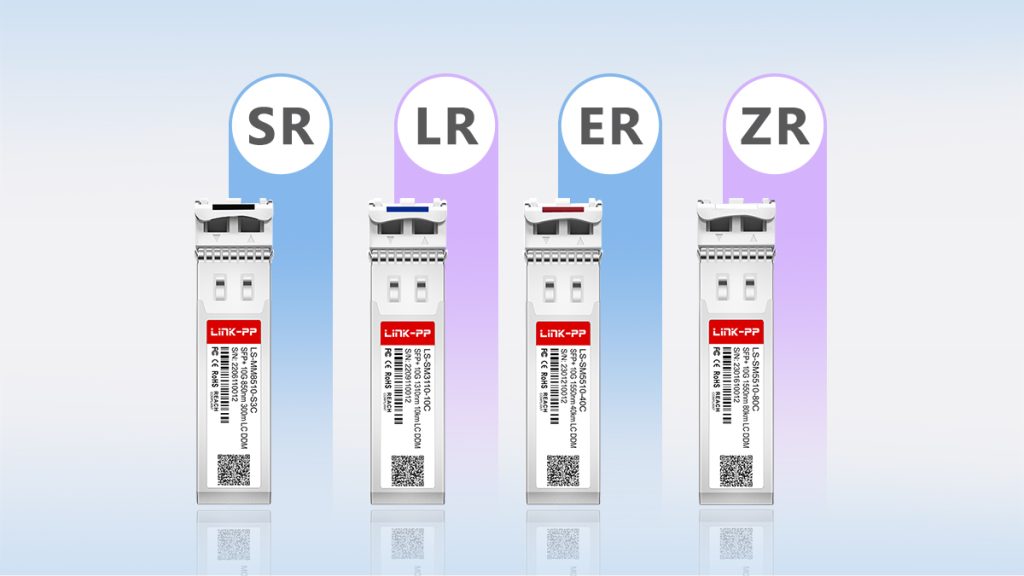
10G SR SFP+: Funciona a 850 nm a través de fibra multimodo (OM3/OM4) para aplicaciones de corto alcance (hasta 300 m). Ideal para la conectividad dentro del rack.
Mismo dispositivo, distinta conectividad: habilitada íntegramente por los módulos SFP.: Utiliza una longitud de onda de 1310 nm a través de fibra monomodo (SMF) para distancias de hasta 10 km, lo que lo hace ideal para redes de campus.
SFP+ 10G ER/ZR: Emite longitudes de onda de 1550 nm para un mayor alcance (40 km–120 km), lo que lo hace adecuado para redes metropolitanas.
2. Módulos XFP
Similares a los módulos SFP+, pero con un tamaño mayor, los módulos XFP son ideales para implementaciones de alta densidad que requieren transmisión de largo alcance (hasta 80 km).
3. Transceptores BIDI
LINK-PP's Módulos BIDI (bidireccionales) permite la comunicación bidireccional a través de un único hilo de fibra, lo que reduce los costes de infraestructura de fibra. Disponible en formatos SFP+ y XFP.
4. Módulos CWDM/DWDM
LINK-PP's CWDM (Multiplexación por división de longitud de onda gruesa) and Transceptores DWDM (WDM denso) Maximizar la capacidad de la fibra mediante la multiplexación de varias longitudes de onda en un único par de fibras. Esto resulta fundamental para las redes de telecomunicaciones y en la nube escalables.
Mejora tu red
Descubre ahora la gama de transceptores de 10G de LINK-PP
Ventajas clave de los transceptores LINK-PP de 10G
Amplia compatibilidad: módulos compatibles con el estándar MSA y se ha sometido a rigurosas pruebas de interoperabilidad con Cisco, Juniper, Huawei y más de 200 marcas adicionales.
Formatos versátiles: Compatible con configuraciones SFP+, XFP, X2, XENPAK, BIDI y CWDM/DWDM.
Opciones de alcance ampliado: Abarca aplicaciones desde corto alcance (SR: 300 m) hasta ultralarga distancia (ZR: 120 km).
Diagnóstico avanzado: Integrado DDM/DOM para supervisión en tiempo real de la temperatura, el voltaje y la potencia óptica.
Durabilidad industrial: Funciona a temperaturas extremas (de -40 °C a 85 °C) y en entornos adversos.
Eficiencia energética: Un ahorro de hasta 70% en comparación con los módulos originales, sin comprometer la calidad.
Cómo elegir el transceptor óptico LINK-PP 10G adecuado
Paso 1: Evaluar los requisitos de red
Distancia: Adapta el alcance del transceptor a tus necesidades:
SR (300 m): Interconexiones entre centros de datos.
LR (10 km): Redes de campus o de metro.
ER/ZR (40 km–120 km): Enlaces de telecomunicaciones de largo alcance.
Tipo de fibra: Multimodo (MMF) para enlaces cortos a buen precio; monomodo (SMF) para una mayor claridad en las llamadas de larga distancia.
Paso 2: Comprobar la compatibilidad
Comprueba los formatos compatibles con tu conmutador o router (SFP+, XFP, etc.) y asegúrate de que la longitud de onda coincida.
Paso 3: Ten en cuenta las funciones avanzadas
BIDI: Opta por módulos de una sola fibra para reducir a la mitad el consumo de fibra.
CWDM/DWDM: Ideal para aprovechar al máximo la capacidad de fibra existente.
Compatibilidad con DOM: Imprescindible para una gestión proactiva de la red.
Paso 4: Evaluar el coste total de propiedad
Aunque el coste inicial es importante, da prioridad a los módulos que ofrezcan garantías ampliadas (de hasta 5 años) y asistencia técnica las 24 horas del día, los 7 días de la semana.
Las mejores recomendaciones de transceptores LINK-PP de 10G
Modelo | Type | Longitud de onda | Distancia | Caso de uso |
|---|---|---|---|---|
SFP+ SR | 850nm | : Conector LC dúplex | Racks para centros de datos | |
SFP+ LR | 1310 nm | 10km | Redes universitarias | |
SFP+ ER | 1550 nm | 40km | Agregación de redes de metro | |
BIDI SFP+ | 1490 nm/1550 nm | 80 km | Enlaces troncales de fibra única | |
SFP+ CWDM | CWDM 1550 nm | 40km | Redes empresariales | |
SFP+ DWDM | DWDM 1552,52 nm | 40km | Enrutamiento por longitud de onda de alta capacidad |
Consejos finales para una selección óptima
Comprueba siempre las especificaciones con la lista de compatibilidad del proveedor de tu equipo.
Para aplicaciones industriales, da prioridad a los módulos con rango de temperatura ampliado.
Apalancamiento Transceptores CWDM/DWDM para evitar un costoso despliegue de fibra óptica.
Al seleccionar Transceptores ópticos LINK-PP de 10G, te aseguras una combinación de rendimiento, fiabilidad y ahorro de costes. Descubre la gama completa de LINK-PP de Módulos 10G SFP+, Transceptores BIDI, and Soluciones DWDM para crear una red preparada para los retos del futuro.
Preguntas frecuentes
1. ¿Cuál es la diferencia entre los módulos ópticos monomodo y multimodo?
Los módulos monomodo transmiten datos a largas distancias utilizando un haz de luz estrecho. Los módulos multimodo funcionan mejor a distancias cortas y utilizan un haz de luz más amplio. Elige en función de los requisitos de distancia de tu red.
💡 Consejo: Utiliza fibra monomodo para distancias superiores a 500 metros y fibra multimodo para conexiones más cortas.
2. ¿Cómo puedo saber si un módulo óptico es compatible con mi equipo?
Consulta las especificaciones del módulo para conocer el tipo de conector, el formato y la compatibilidad de los cables. Asegúrate de que cumple con los estándares del sector, como el IEEE 802.3. Realiza pruebas con tu hardware para confirmar la compatibilidad.
3. ¿Puedo utilizar módulos ópticos de otros fabricantes con mi equipo de red?
Sí, muchos módulos de terceros funcionan bien con equipos de marca. No obstante, comprueba la compatibilidad y asegúrate de que el módulo se ajuste a tus necesidades de rendimiento. Algunos fabricantes pueden anular la garantía si se utilizan módulos de terceros.
4. ¿Cómo puedo mantener el rendimiento de mi módulo óptico?
Mantén limpio el módulo y supervisa su temperatura de funcionamiento. Utiliza herramientas de supervisión ambiental para asegurarte de que se mantenga dentro del rango recomendado. Revisa periódicamente los cables y conectores para detectar posibles daños.
5. ¿Qué aspectos debo tener en cuenta a la hora de elegir un módulo óptico?
Ten en cuenta el ancho de banda, la distancia y los requisitos ambientales de tu red. Comprueba la compatibilidad con los equipos existentes y ten en cuenta los costes a largo plazo. Busca proveedores fiables que ofrezcan garantías sólidas y un buen servicio de asistencia.
🔍 Nota: Evalúa siempre las opiniones de los usuarios y las recomendaciones de los expertos antes de realizar una compra.
Véase también
Únase hoy mismo a la emocionante comunidad LINK-PP
Introducción al WDM: aplicaciones clave en las redes ópticas
Exploración del TOSA en los módulos ópticos y su importancia