
















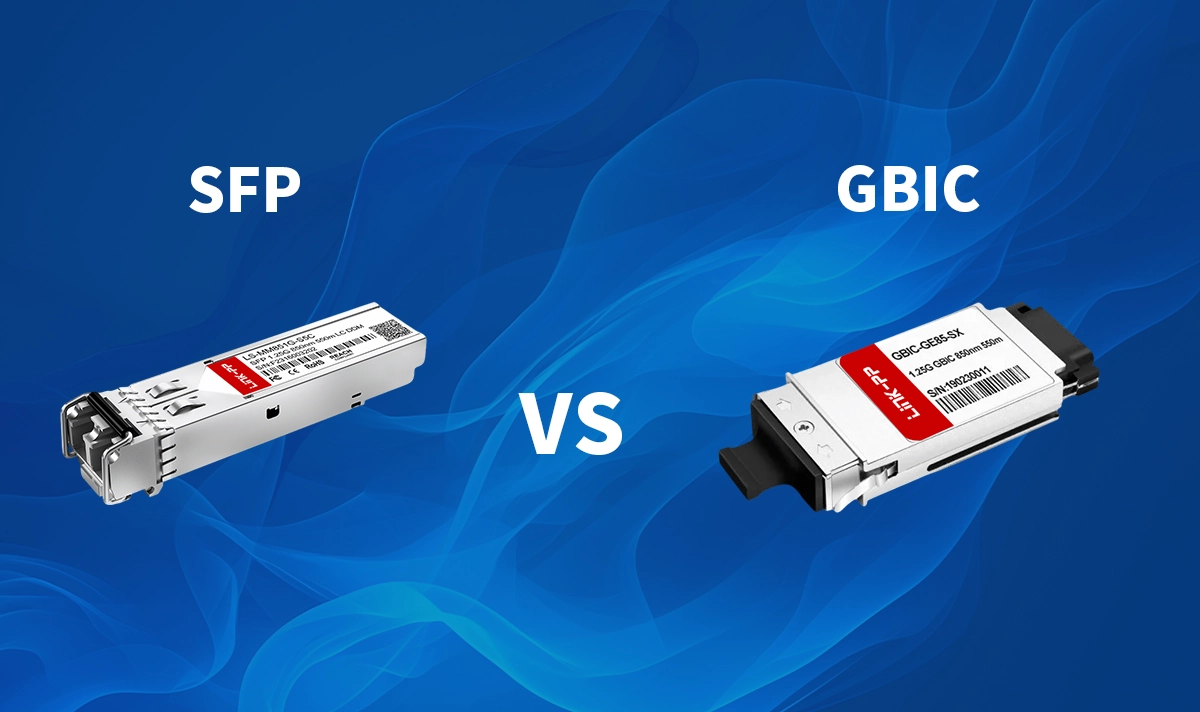
Understanding the building blocks of your network infrastructure is crucial. When dealing with fiber optic connections, GBIC (ตัวแปลงอินเทอร์เฟซกิกะบิต) และ SFP (โมดูลแบบเสียบได้ขนาดเล็ก) modules are fundamental components. While both serve the essential purpose of connecting network devices (like switches and routers) to fiber optic or copper cabling, they are distinct technologies with key differences impacting your network design. Let’s demystify SFP vs GBIC.
✦ Key Differences Between GBIC and SFP Modules
The primary distinctions lie in their physical design, performance, and evolution:
รูปทรงและขนาด (Form Factor & Density):
GBIC: Larger in size (roughly double the physical footprint of an SFP). This larger size limits the number of ports you can fit on a single switch or router line card.
SFP: Significantly smaller (“mini-GBIC” was an early nickname). This compact SFP form factor allows for much higher port density – you can fit far more SFP ports in the same space as GBIC ports. This is a major advantage in modern, space-constrained data centers.
ความเร็ว:
GBIC: Primarily designed for Gigabit Ethernet (1Gbps) applications. While some variants existed, 1G was its core domain.
SFP: Originally developed for 1Gbps, but the SFP specification evolved. SFP+ (SFP แบบปรับปรุง) supports 10Gbps, and SFP28 supports 25Gbps. The SFP form factor became the foundation for higher-speed standards.
การใช้พลังงาน:
GBIC: Generally consumes more power due to its older design and larger size.
SFP: Designed to be more power-efficient, especially important in high-density deployments and for reducing operational costs (OPEX).
Evolution & Modern Relevance:
GBIC: Largely obsolete. It was superseded by the SFP standard due to the need for higher density and support for faster speeds. Finding new GBIC modules or equipment with GBIC slots is increasingly difficult.
SFP: The dominant standard for 1G, 10G (via SFP+), and 25G (via SFP28) interfaces. It remains highly relevant and widely deployed. SFP technology paved the way for QSFP (Quad SFP) modules used for 40G, 100G, and beyond.
✦ SFP vs GBIC: Quick Comparison Table
คุณสมบัติ | GBIC (ตัวแปลงอินเทอร์เฟซกิกะบิต) | SFP (โมดูลแบบเสียบได้ขนาดเล็ก) |
|---|---|---|
รูปทรง (Form Factor) | ขนาดใหญ่กว่า | Smaller (“Mini-GBIC”) |
ความหนาแน่นของพอร์ต | Lower (Takes more space per port) | สูงกว่า (More ports per unit) |
Primary Speed | 1 Gigabit Ethernet (1G) | 1G, 10G (SFP+), 25G (SFP28) |
Power Usage | สูงกว่า | ต่ำกว่า |
Status | Largely Obsolete | Current Standard |
การใช้งานในปัจจุบัน | Rare, legacy equipment only | Very Common (1G, 10G, 25G) |
✦ Where Did GBICs Go? The Rise of SFP
The limitations of GBIC, particularly its size restricting port density, became apparent as networks demanded more connections in smaller spaces. The SFP standard was developed explicitly to address this, offering the same functionality (initially for 1G) in a much smaller package. This allowed manufacturers to create switches and routers with significantly more ports, crucial for scaling networks efficiently. The subsequent development of SFP+ cemented SFP’s dominance by enabling 10 Gigabit speeds within the same compact form factor.
✦ Applications: Legacy vs. Modern
GBIC: You’ll only encounter GBICs today in very old, ยังพึ่งพาโมดูล GBIC. Spare modules might be used for maintenance, but new deployments never specify GBIC.
SFP/SFP+: The standard workhorse for a vast range of applications:
SFP แบบ 1G: Connecting switches, routers, servers, and network appliances over fiber (e.g., ลิงก์-พีพี SFP-1G-SX for short-range multimode) or copper (e.g., ลิงก์-พีพี SFP-GE-T) at Gigabit speeds. Widely used in enterprise networks, industrial settings, and telecom access layers.
SFP+ แบบ 10G: High-speed connections for data center server access, switch uplinks, aggregation layers, and storage networking (e.g., ลิงก์-พีพี SFP-10G-SR for multimode, ลิงก์-พีพี โมดูล LR (ระยะไกล) ใช้ for single-mode long reach). Essential for modern high-bandwidth applications.
SFP28 25G: Increasingly common in next-generation data centers for high-density server connectivity, offering a smooth speed upgrade path.
✦ Choosing the Right Optical Module
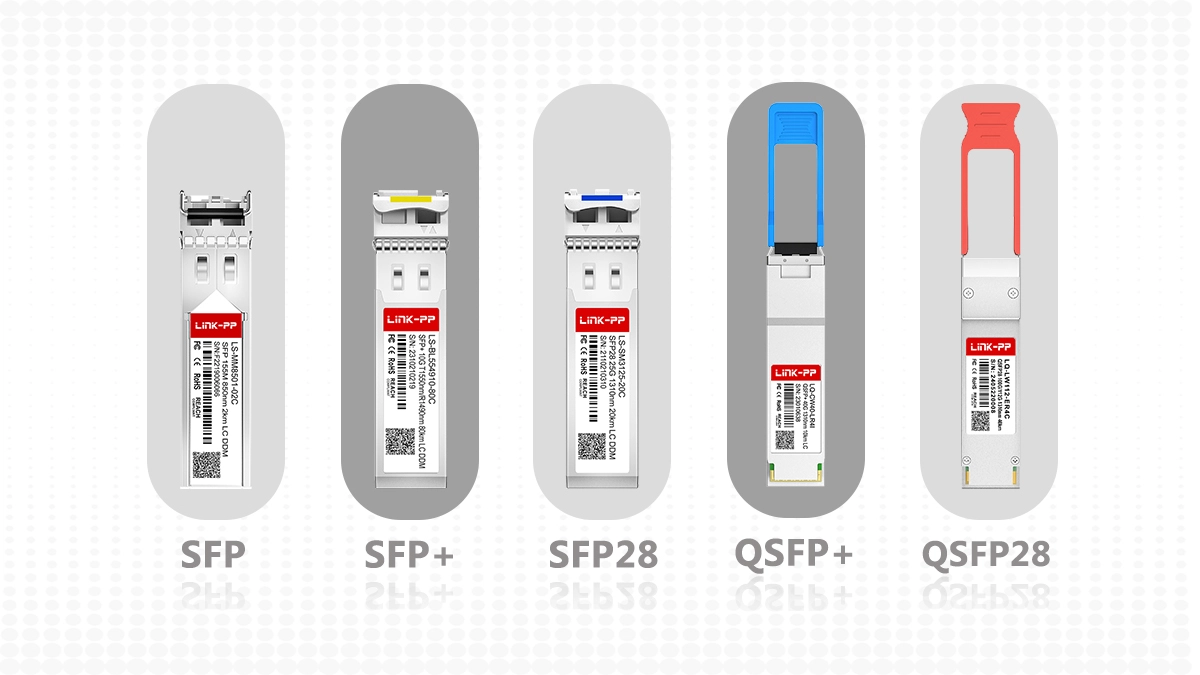
เมื่อเลือกใช้ โมดูลออปติก today, SFP (or SFP+/SFP28 for higher speeds) is overwhelmingly the standard choice. Compatibility is key:
Check Your Equipment: Always verify the specific module types (SFP, SFP+) and supported standards (e.g., 1000BASE-SX, 10GBASE-LR) listed in your switch, router, or server’s datasheet or compatibility matrix.
Match the Cable & Distance: Choose a module (e.g., SR, LR, ER, ZR) compatible with your fiber type (Multimode OM3/OM4/OM5 หรือ ไฟเบอร์ซิงเกิลโหมด) and required transmission distance.
Consider Quality & Compatibility: While third-party โมดูลแสงขั้นสูง เช่น ที่ผลิตโดย ลิงก์-พีพี offer significant cost savings over OEM brands, ensure they come from reputable manufacturers guaranteeing full compatibility and reliability. ลิงก์-พีพี modules undergo rigorous testing for broad interoperability.
ความต้องการความเร็ว: Select SFP for 1G, SFP+ for 10G, or SFP28 for 25G applications.
✦ Conclusion
The transition from GBIC to SFP marked a significant evolution in โมดูลออปติก technology, driven by the relentless demand for higher port density and faster speeds. While GBICs served a purpose in early Gigabit networks, their larger size and limitation to primarily 1G speeds rendered them obsolete. SFP, and its faster variants SFP+ and SFP28, became the dominant standards, offering compact size, higher density, lower power consumption, and support for modern network speeds up to 25G per lane.
When working with fiber optic networking today, you are almost certainly dealing with SFP-based modules. Understanding the difference between SFP and GBIC helps clarify why modern networks look the way they do and ensures you select the correct, compatible ของผู้ผลิตรายบุคคลที่น่าเชื่อถือ เช่น ที่ผลิตโดย ลิงก์-พีพี for optimal performance and reliability.
Ready to upgrade your network optics? Ensure compatibility and maximize value with high-performance SFP+, SFP28, or standard SFP modules from LINK-PP.
✦ Frequently Asked Questions (FAQ)
Q: Can I plug an SFP module into a GBIC port?
A: No. GBIC and SFP ports are physically different and incompatible. They have distinct slot sizes and electrical interfaces. You cannot interchange them.
Q: Can I plug a GBIC module into an SFP port?
A: No. The physical size difference prevents a GBIC from fitting into the smaller SFP port. The interfaces are also electrically incompatible.
Q: Is GBIC obsolete?
A: Yes, largely. GBIC technology has been superseded by SFP/SFP+/SFP28 for many years due to SFP’s advantages in size, density, power efficiency, and support for higher speeds (10G, 25G). New equipment uses SFP ports.
Q: What is a Mini-GBIC?
A: Mini-GBIC is simply another name for SFP. The term was used early on to highlight that the SFP was a smaller alternative to the existing GBIC standard. “SFP” is the universally accepted term now.
Q: Are SFP modules hot-swappable?
A: Yes! Both GBIC and SFP modules were designed to be สามารถเปลี่ยนชิ้นส่วนได้ขณะใช้งาน. This means you can insert or remove them from a compatible port without needing to power down the networking equipment, facilitating easier maintenance and upgrades.
Q: What does SFP stand for?
A: SFP stands for Small Form-factor Pluggable. It emphasizes its compact size and pluggable nature.
Q: What does GBIC stand for?
A: GBIC stands for Gigabit Interface Converter. It reflects its primary use for Gigabit Ethernet connections.
Q: Are there different types of SFP modules?
A: Absolutely. SFP modules come in various types based on speed (SFP 1G, SFP+ 10G, SFP28 25G), medium (fiber optic – Multimode/Singlemode, or copper), wavelength, and transmission distance (e.g., SR, LR, ER, ZR). Choosing the right optical module type มีความสำคัญอย่างยิ่ง.
✦ ดูเพิ่มเติม
LINK-PP: ผู้นำระดับโลกด้านองค์ประกอบโทรคมนาคมและเครือข่ายแบบแม่เหล็ก
เข้าใจความแตกต่างระหว่างตัวรับส่งสัญญาณแสง SFP, SFP+, SFP28, QSFP+ และ QSFP28