















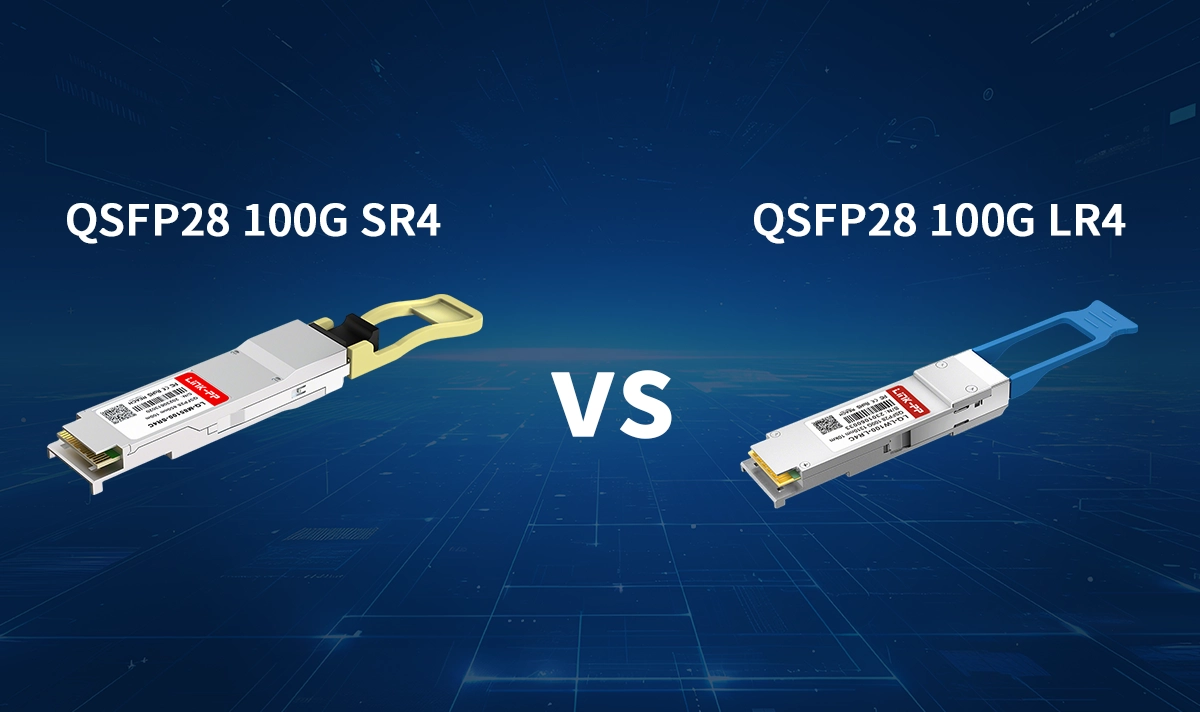
Deploying 100G Ethernet is essential for modern data centers and high-speed networks, but selecting the right transceiver is critical. The QSFP28 form factor dominates 100G, with SR4 and LR4 being two prevalent types. While both deliver blazing 100Gbps speeds, their underlying technology, application scenarios, and cost structures differ significantly. Understanding the distinctions between the QSFP28 100G SR4 transceiver และ QSFP28 100G LR4 transceiver ensures optimal network performance, cost-efficiency, and future scalability. This guide dives deep into their specs, use cases, and helps you decide which 100G ออปติคัล best fits your infrastructure needs, highlighting reliable solutions like ตัวส่งสัญญาณ LINK-PP.
➤ การทำความเข้าใจเทคโนโลยีหลัก
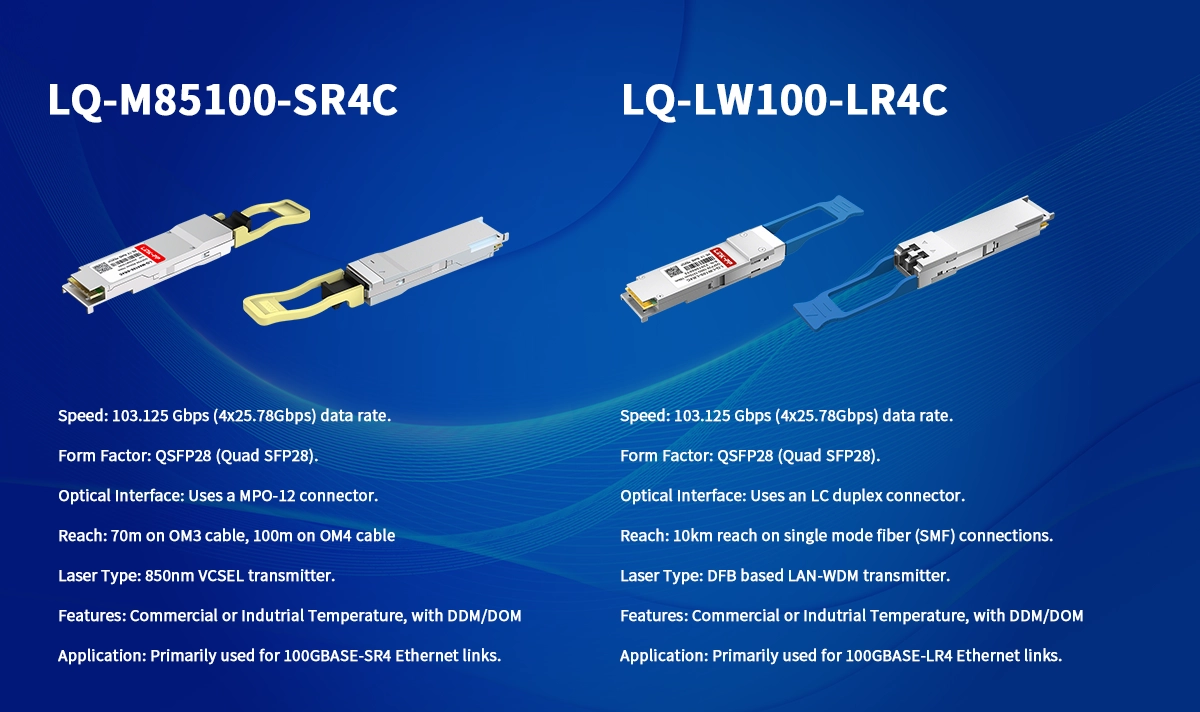
QSFP28 100G SR4 Transceiver:
เทคโนโลยี: ใช้ เลเซอร์แบบ VCSEL (Vertical Cavity Surface Emitting Laser) lasers operating at 850nm wavelength.
ชนิดของเส้นใย: ที่ประมาณ 1.1 วัตต์ จึงมีประสิทธิภาพด้านพลังงานสำหรับการติดตั้งบนสวิตช์จำนวนมาก เส้นใยหลายโหมด (MMF), specifically OM3 or OM4.
การเชื่อมต่อ: Utilizes an MPO-12/MTP® connector. It transmits and receives over 4 parallel lanes in each direction (4x25G).
Key Application: Short-reach, high-density connections within a data center or between adjacent racks (Top-of-Rack to Aggregation/Spine switches).
LINK-PP Model Example: ลิงก์-พีพี LQ-M85100-SR4C (Compliant with QSFP28 MSA, 100m over OM4).
QSFP28 100G LR4 Transceiver:
เทคโนโลยี: ใช้ DFB (Distributed Feedback) operating at four LWDM wavelengths (around 1295nm, 1300nm, 1305nm, 1310nm).
ชนิดของเส้นใย: ที่ประมาณ 1.1 วัตต์ จึงมีประสิทธิภาพด้านพลังงานสำหรับการติดตั้งบนสวิตช์จำนวนมาก และเลเซอร์ความยาวคลื่น 1310 นาโนเมตร สำหรับระยะทางสูงสุด 10 กิโลเมตร จำเป็นสำหรับการเชื่อมต่อระยะไกล แต่เส้นใย SMF และโมดูล LR มักมีราคาสูงกว่าเส้นใย MMF และโมดูล SR ให้เลือกใช้ SR สำหรับการเชื่อมต่อภายในศูนย์ข้อมูลที่คุ้มค่า, specifically OS2.
การเชื่อมต่อ: Utilizes a standard duplex LC connector. It multiplexes the four wavelengths onto a single fiber pair (WDM technology).
Key Application: Long-reach connections between data centers (DCI), campus backbones, service provider networks, and Metro access.
LINK-PP Model Example: ลิงก์-พีพี LQ-LW100-LR4C (Compliant with QSFP28 MSA, up to 10km over SMF).
➤ Head-to-Head Comparison: QSFP28 SR4 vs LR4
The following table summarizes the critical differences:
คุณสมบัติ | QSFP28 100G SR4 Transceiver | QSFP28 100G LR4 Transceiver |
|---|---|---|
ระยะทางการส่งสัญญาณ (Reach) | Up to 70m (OM3) | สูงสุด 10 กิโลเมตร |
Up to 100m (OM4) | (Standard LR4 specification) | |
ชนิดของไฟเบอร์ | เส้นใยแสงแบบมัลติโหมด (OM3/OM4) | เส้นใยแสงแบบซิงเกิลโหมด (OS2) |
ขั้วต่อ | MPO-12/MTP® | Duplex LC |
ความยาวคลื่น | 850 นาโนเมตร (4 ช่อง) | LWDM (4 lanes: ~1295-1310nm) |
ประเภทเลเซอร์ | สื่อกลาง | DFB |
การมอดูเลต | NRZ | NRZ |
กำลังไฟฟ้าที่ใช้โดยทั่วไป | ~3.5 วัตต์ | ~3.5 วัตต์ – 4.5 วัตต์ |
ค่าใช้จ่ายสัมพัทธ์ | ต่ำกว่า | สูงกว่า |
กรณีการใช้งานหลัก | Data Center Inter-Rack Connectivity, High-Density Short Reach | Data Center Interconnect (DCI), Campus/Metro Networks, Long Reach |
ข้อได้เปรียบหลัก | Cost-effective for short distances, leverages existing MMF cabling | Long reach over SMF, standard duplex LC compatibility |
➤ Key Differences Explained
Reach & Fiber Type: This is the most significant difference. SR4 is strictly for short distances within a data center using MMF. LR4 excels at distances up to 10km over SMF. Choosing the wrong โมดูลไฟเบอร์ออปติก
for your distance requirement will result in link failure.Connector & Cabling: SR4 requires MPO/MTP®-terminated MMF trunks (often 8 or 12 fiber). LR4 uses standard LC duplex patch cords on SMF, offering simpler cable management and leveraging ubiquitous LC infrastructure.
Technology & Cost: SR4 uses simpler VCSEL lasers and parallel optics over MMF, making it generally มีต้นทุนต่ำกว่า for short reach. LR4 employs more complex WDM optics and DFB lasers on SMF, increasing its price point but enabling long reach.
Power & Heat: While both are within the QSFP28 power envelope, LR4 modules often consume slightly more power (especially over temperature/distance) than SR4 modules. Consider thermal design in dense chassis.
Application Focus: SR4 is the workhorse for intra-data center 100G links. LR4 is essential for connecting geographically separate locations or long campus runs.
➤ How to Choose Between QSFP28 100G SR4 and QSFP28 100G LR4 Transceiver
When to Choose QSFP28 100G SR4
You need to connect switches within the same rack or adjacent racks.
Your existing cabling plant is OM3 or OM4 multimode fiber.
Your link distances are 100 meters or less.
Cost optimization for high-density, short-reach deployments is critical.
You require compatibility with 100G SR4 optical modules for ToR (Top-of-Rack) aggregation.
When to Choose QSFP28 100G LR4
You need to connect switches between different buildings or data centers.
Your existing cabling plant is OS2 single-mode fiber.
Your link distances are between 100m and 10km.
You need the flexibility and future-proofing of SMF infrastructure.
You require compatibility with standard LC patch panels and cabling for long-distance 100G connectivity.
➤ Why Choose LINK-PP 100G Transceivers?
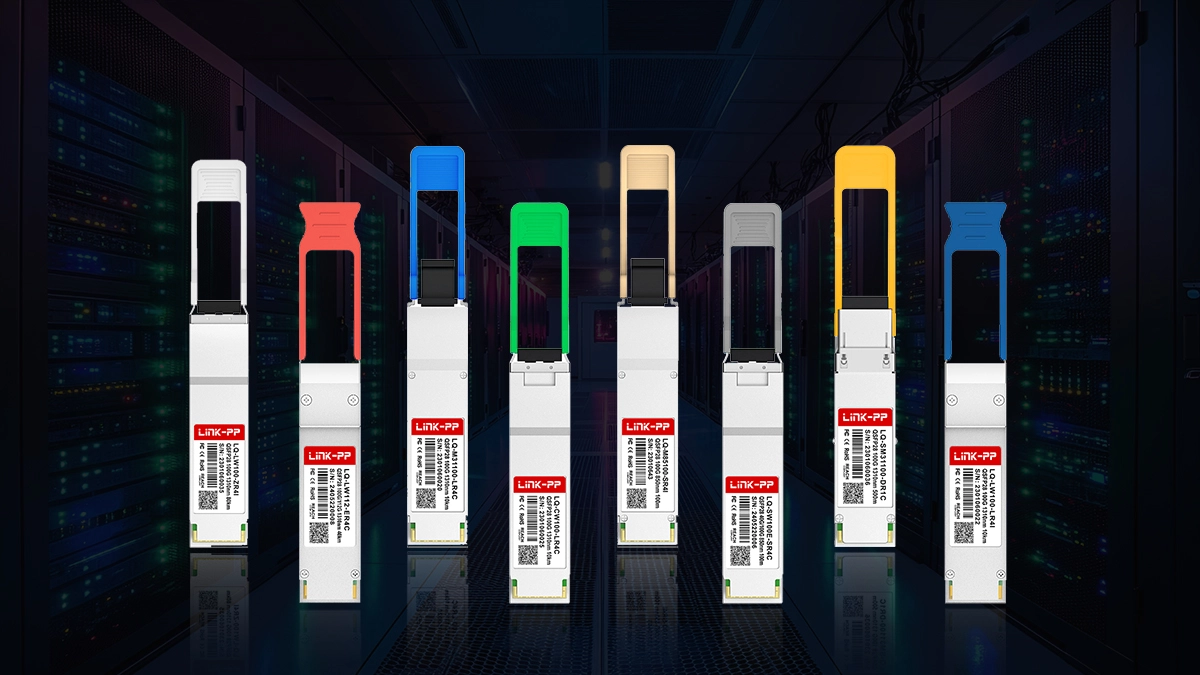
ลิงก์-พีพี มอบสมรรถนะสูงและสอดคล้องตามมาตรฐาน MSA โมดูล QSFP28 ความเร็ว 100G, including both SR4 and LR4 variants, rigorously tested for interoperability and reliability. Our optics offer:
การประหยัดต้นทุน: ประหยัดค่าใช้จ่ายอย่างมากเมื่อเทียบกับโมดูล OEM.
การรับประกันความเข้ากันได้: Extensive testing ensures seamless operation with major switch brands (Cisco, Juniper, Arista, Dell, HPE, etc.).
คุณภาพและความน่าเชื่อถือ: Rigorous quality control processes ensure low failure rates and long-term performance.
รับประกันตลอดอายุการใช้งานและการสนับสนุน: Backed by expert technical support. Upgrade your network infrastructure cost-effectively with reliable LINK-PP optics today.
➤ สรุป
การเลือกระหว่าง QSFP28 100G SR4 และ QSFP28 100G LR4 transceiver boils down to two fundamental factors: required transmission distance และ existing fiber optic cabling type. For cost-effective, high-density connections within 100 meters leveraging multimode fiber, the SR4 optical module is the clear choice. For versatile, long-reach connectivity up to 10 kilometers over single-mode fiber, the LR4 transceiver is indispensable.
Understanding these differences ensures you invest in the right 100G fiber optic transceiver technology, optimizing both performance and budget. Don’t compromise on reliability for your critical 100G links.
Ready to deploy reliable, high-performance 100G connectivity?
Explore LINK-PP’s extensive range of MSA-compliant QSFP28 100G SR4 and LR4 transceivers today.
➤ FAQ: QSFP28 100G SR4 vs LR4
Q: Can I use an SR4 transceiver over single-mode fiber?
A: No, absolutely not. SR4 is designed เท่านั้น for multimode fiber (OM3/OM4). Attempting to use it over SMF will fail immediately or cause severe errors. Always match the optical module type to the fiber type.Q: Can I use an LR4 transceiver over multimode fiber?
A: No. LR4 requires single-mode fiber (OS2). Using it over MMF will not achieve the required distance or performance.Q: What is the maximum distance for QSFP28 LR4?
คำตอบ: The standard specification for QSFP28 100G LR4 is up to 10 kilometers over OS2 single-mode fiber. Ensure your optical budget (link loss) supports the required distance.Q: Are SR4 and LR4 transceivers interoperable?
คำตอบ: No, they are not directly interoperable with each other. An SR4 module must connect to another SR4 module over MMF. An LR4 module must connect to another LR4 module over SMF. They use fundamentally different optical technologies and fiber paths.Q: What about ER4 or ZR4 modules?
คำตอบ: These are variants for even longer distances than LR4. ER4 typically reaches ~40km, and ZR4 reaches ~80km. They consume significantly more power and cost more than LR4. LR4 (10km) covers the vast majority of campus and metro DCI needs.
➤ ดูเพิ่มเติม
ทำความเข้าใจทรานส์ซีเวอร์ 100G LR4 สำหรับเครือข่ายยุคใหม่
เปิดใช้งานตัวรับส่งสัญญาณ QSFP28 100G SR4 ความเร็วสูงจาก LINK-PP – รุ่น LQ-M85100-SR4C
คู่มือฉบับสมบูรณ์เกี่ยวกับรูปแบบโมดูลตัวรับ-ส่งสัญญาณแสง 100G
เหตุใดจึงควรเลือกตัวส่งสัญญาณแสง 100G ของ LINK-PP สำหรับการเชื่อมต่อความเร็วสูง