















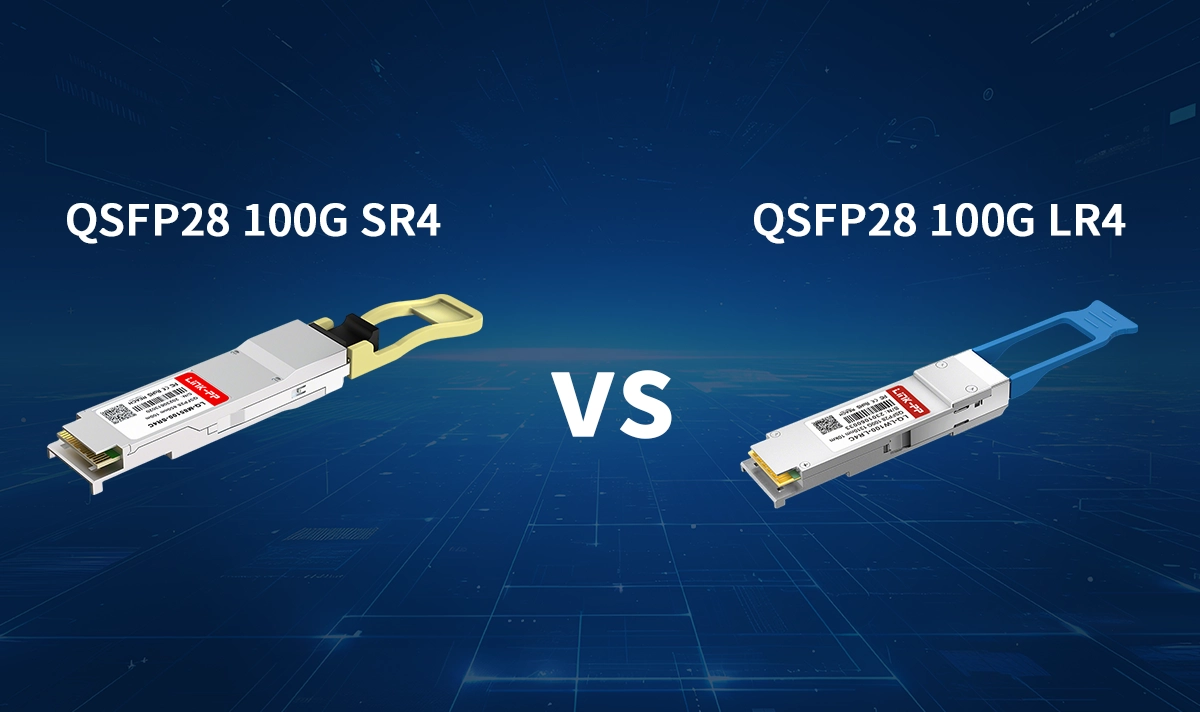
A implementação da Ethernet de 100G é essencial para os centros de dados modernos e para as redes de alta velocidade, mas a escolha do transceptor adequado é fundamental. O formato QSFP28 domina o segmento de 100G, sendo o SR4 e o LR4 os dois tipos mais comuns. Embora ambos ofereçam velocidades impressionantes de 100 Gbps, a sua tecnologia subjacente, os cenários de aplicação e as estruturas de custos diferem significativamente. Compreender as distinções entre o Transceptor QSFP28 100G SR4 e o Transceptor QSFP28 100G LR4 garante um desempenho ideal da rede, rentabilidade e escalabilidade futura. Este guia analisa em profundidade as suas especificações e casos de utilização, e ajuda-o a decidir qual módulo óptico 100G que melhor se adapta às suas necessidades de infraestrutura, destacando soluções fiáveis como Transceptores LINK-PP.
➤ Compreendendo as tecnologias principais
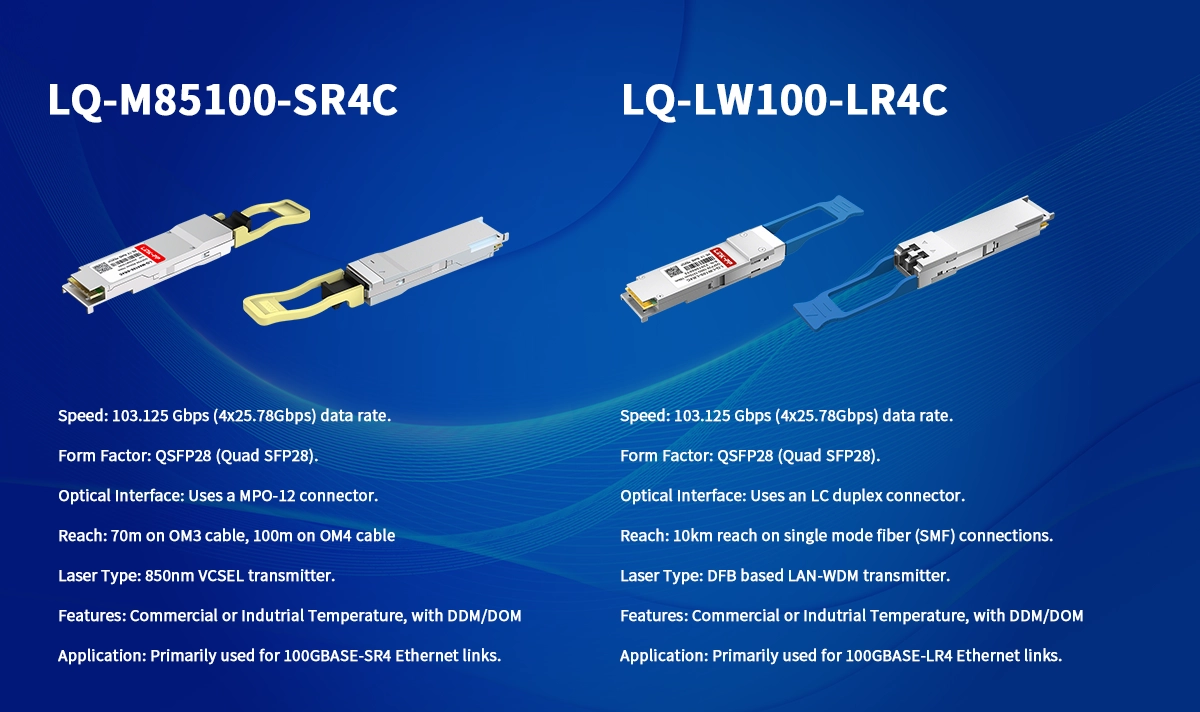
Transceptor QSFP28 100G SR4:
Tecnologia: Uses VCSEL (Laser de Cavidade Vertical com Emissão na Superfície) lasers que funcionam com um comprimento de onda de 850 nm.
Tipo de fibra: Projetada para fibra multimodo (MMF), nomeadamente OM3 ou OM4.
Conectividade: Utiliza um conector MPO-12/MTP®. Transmite e recebe dados através de 4 vias paralelas em cada sentido (4x25G).
Aplicação principal: Ligações de curto alcance e alta densidade dentro de um centro de dados ou entre racks adjacentes (de Top-of-Rack para switches de agregação/spine).
Exemplo do modelo LINK-PP: LINK-PP LQ-M85100-SR4C (Em conformidade com a MSA QSFP28, 100 m em OM4).
Transceptor QSFP28 100G LR4:
Tecnologia: Uses lasers DFB (Realimentação Distribuída) que funciona em quatro comprimentos de onda LWDM (cerca de 1295 nm, 1300 nm, 1305 nm e 1310 nm).
Tipo de fibra: Projetada para fibra monomodo (SMF), mais concretamente o OS2.
Conectividade: Utiliza um conector LC duplex padrão. Multiplexa os quatro comprimentos de onda num único par de fibras (Tecnologia WDM).
Aplicação principal: Ligações de longo alcance entre centros de dados (DCI), redes principais de campus, redes de prestadores de serviços e acesso metropolitano.
Exemplo do modelo LINK-PP: LINK-PP LQ-LW100-LR4C
(Em conformidade com a MSA QSFP28, até 10 km em fibra monomodo).
➤ Comparação direta: QSFP28 SR4 vs LR4
A tabela seguinte resume as diferenças essenciais:
Recurso | Transceptor QSFP28 100G SR4 | Transceptor QSFP28 100G LR4 |
|---|---|---|
Alcance | Até 70 m (OM3) | Até 10km |
Até 100 m (OM4) | (Especificações padrão do LR4) | |
Tipo de fibra | Fibra Multimodo (OM3/OM4) | Fibra Monomodo (OS2) |
Conector | MPO-12/MTP® | LC Duplex |
Comprimento de onda | 850 nm (4 canais) | LWDM (4 canais: ~1295-1310 nm) |
🔹 Tipos de Laser e Comprimentos de Onda | Tipo de Laser | DFB |
🔹 Técnicas de Modulação | NRZ | NRZ |
Consumo Típico de Energia | ~3,5 W | ~3,5 W – 4,5 W |
Custo Relativo | Lower | Maior |
Caso de Uso Primário | Conectividade entre racks em centros de dados, alta densidade e curto alcance | Interligação de Centros de Dados (DCI), Redes de Campus/Metro, Longo Alcance |
Vantagem principal | É económico para distâncias curtas e tira partido do cabeamento MMF já existente | Alcanço alargado em SMF, compatibilidade com LC duplex padrão |
➤ Explicação das principais diferenças
Alcance e tipo de fibra: Esta é a diferença mais significativa. A SR4 destina-se exclusivamente a distâncias curtas dentro de um centro de dados utilizando MMF. O LR4 destaca-se em distâncias até 10 km através do SMF. Escolher o errado De fibra óptica pois o cumprimento do requisito de distância resultará na falha da ligação.
Conectores e cablagem: A norma SR4 requer troncos de fibra multimodo (MMF) com terminações MPO/MTP® (geralmente de 8 ou 12 fibras). A norma LR4 utiliza cabos de ligação duplex LC padrão em fibra monomodo (SMF), proporcionando uma gestão de cabos mais simples e tirando partido da infraestrutura LC generalizada.
Tecnologia e custos: O SR4 utiliza lasers VCSEL mais simples e uma ótica paralela em MMF, o que o torna, em geral, mais econômicos para curto alcance. O LR4 utiliza componentes óticos WDM mais complexos e lasers DFB em fibra monomodo (SMF), o que aumenta o seu preço, mas permite um longo alcance.
Energia e aquecimento: Embora ambos se enquadrem nos limites de consumo energético do QSFP28, os módulos LR4 costumam consumir um pouco mais de energia (especialmente em condições de temperatura elevada ou a longas distâncias) do que os módulos SR4. É importante ter em conta o design térmico em chassis densos.
Foco da aplicação: O SR4 é o cavalo de batalha para ligações de 100G dentro do centro de dados. O LR4 é essencial para ligar locais geograficamente separados ou longas corridas pelo campus.
➤ Como escolher entre o transceptor QSFP28 100G SR4 e o transceptor QSFP28 100G LR4
Quando escolher o QSFP28 100G SR4
É necessário ligar os switches dentro do mesmo rack ou em racks adjacentes.
A sua infraestrutura de cablagem atual é composta por fibra multimodo OM3 ou OM4.
As distâncias dos teus links são 100 metros ou menos.
A otimização de custos para implementações de alta densidade e curto alcance é fundamental.
É necessária compatibilidade com Módulos óticos 100G SR4 para agregação ToR (Top-of-Rack).
Quando escolher o QSFP28 100G LR4
É necessário ligar os comutadores entre diferentes edifícios ou centros de dados.
A sua infraestrutura de cablagem atual é constituída por fibra monomodo OS2.
As distâncias dos teus links são entre 100 m e 10 km.
Precisa da flexibilidade e da capacidade de adaptação ao futuro que a infraestrutura SMF oferece.
É necessária compatibilidade com painéis de ligação LC padrão e cablagem para conectividade de longa distância de 100G.
➤ Por que escolher os transceptores LINK-PP 100G?
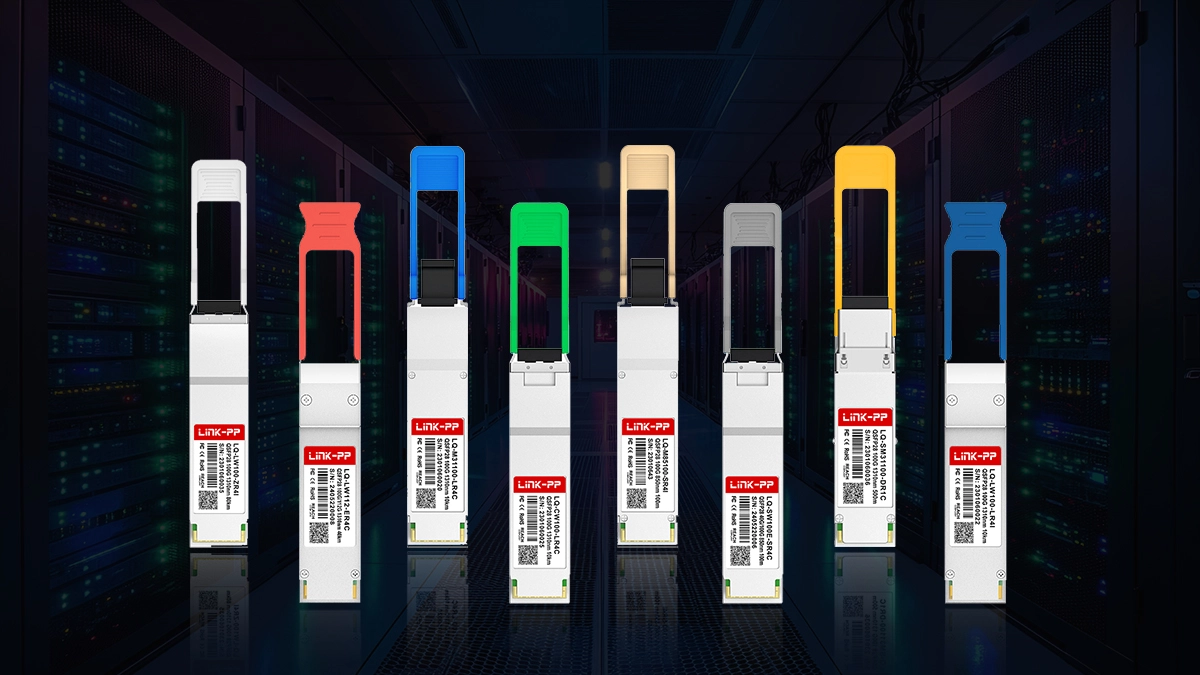
LINK-PP fornece módulos ópticos SFP+ de alto desempenho e compatíveis com o padrão MSA módulos 100G QSFP28, incluindo as variantes SR4 e LR4, rigorosamente testadas quanto à interoperabilidade e fiabilidade. Os nossos componentes óticos oferecem:
Economia de custos: Economia significativa em comparação com módulos OEM.
Compatibilidade Garantida: Testes exaustivos garantem um funcionamento sem falhas com as principais marcas de switches (Cisco, Juniper, Arista, Dell, HPE, etc.).
Qualidade e confiabilidade: Processos rigorosos de controlo de qualidade garantem baixas taxas de avaria e um desempenho a longo prazo.
Garantia vitalícia e suporte: Com o apoio de um serviço de assistência técnica especializado. Atualize hoje mesmo a sua infraestrutura de rede de forma económica com os módulos óticos LINK-PP de fiabilidade comprovada.
➤ Conclusão
Escolher entre um QSFP28 100G SR4 e uma Transceptor QSFP28 100G LR4 resume-se a dois fatores fundamentais: distância de transmissão necessária and tipo de cablagem de fibra ótica existente. Para ligações económicas e de alta densidade num raio de 100 metros, utilizando fibra multimodo, o Módulo ótico SR4 é a escolha óbvia. Para uma conectividade versátil e de longo alcance, até 10 quilómetros através de fibra monomodo, o Transceptor LR4 é indispensável.
Compreender estas diferenças garante que invista no produto certo Transceptor de fibra ótica de 100G tecnologia, otimizando tanto o desempenho como o orçamento. Não comprometa a fiabilidade das suas ligações críticas de 100G.
Está pronto para implementar uma conectividade 100G fiável e de alto desempenho?
Explore hoje mesmo a vasta gama de transceptores QSFP28 100G SR4 e LR4 da LINK-PP, em conformidade com a norma MSA.
➤ Perguntas frequentes: QSFP28 100G SR4 vs LR4
P: Posso utilizar um transceptor SR4 numa fibra monomodo?
R: Não, de modo algum. O SR4 foi concebido only para fibra multimodo (OM3/OM4). A tentativa de a utilizar em fibra monomodo (SMF) falhará imediatamente ou provocará erros graves. Certifique-se sempre de que a de módulo óptico conforme o tipo de fibra.P: Posso utilizar um transceptor LR4 em fibra multimodo?
R: Não. O LR4 requer fibra monomodo (OS2). A sua utilização com fibra multimodo (MMF) não permitirá atingir a distância nem o desempenho exigidos.P: Qual é a distância máxima para o QSFP28 LR4?
R: A especificação padrão para o QSFP28 100G LR4 é até 10 quilómetros através de fibra monomodo OS2. Certifique-se de que o seu orçamento ótico (perda de ligação) suporta a distância necessária.P: Os transceptores SR4 e LR4 são interoperáveis?
R: Não, não são diretamente interoperáveis entre si. Um módulo SR4 tem de se ligar a outro módulo SR4 através de MMF. Um módulo LR4 tem de se ligar a outro módulo LR4 através de SMF. Utilizam tecnologias óticas e percursos de fibra fundamentalmente diferentes.P: E quanto aos módulos ER4 ou ZR4?
R: Estas são variantes para distâncias ainda maiores do que a LR4. A ER4 atinge normalmente cerca de 40 km e a ZR4 atinge cerca de 80 km. Consumem significativamente mais energia e são mais caras do que a LR4. A LR4 (10 km) cobre a grande maioria das necessidades de DCI no campus e na área metropolitana.
➤ Veja Também
Entendendo o Transceptor 100G LR4 para Redes Modernas
Desbloqueie o transceptor QSFP28 100G SR4 de alta velocidade da LINK-PP — LQ-M85100-SR4C
Um guia abrangente sobre os formatos de módulos transceptores ópticos de 100 G
Por que Escolher os Transceptores de 100G da LINK-PP para Conectividade de Alta Velocidade