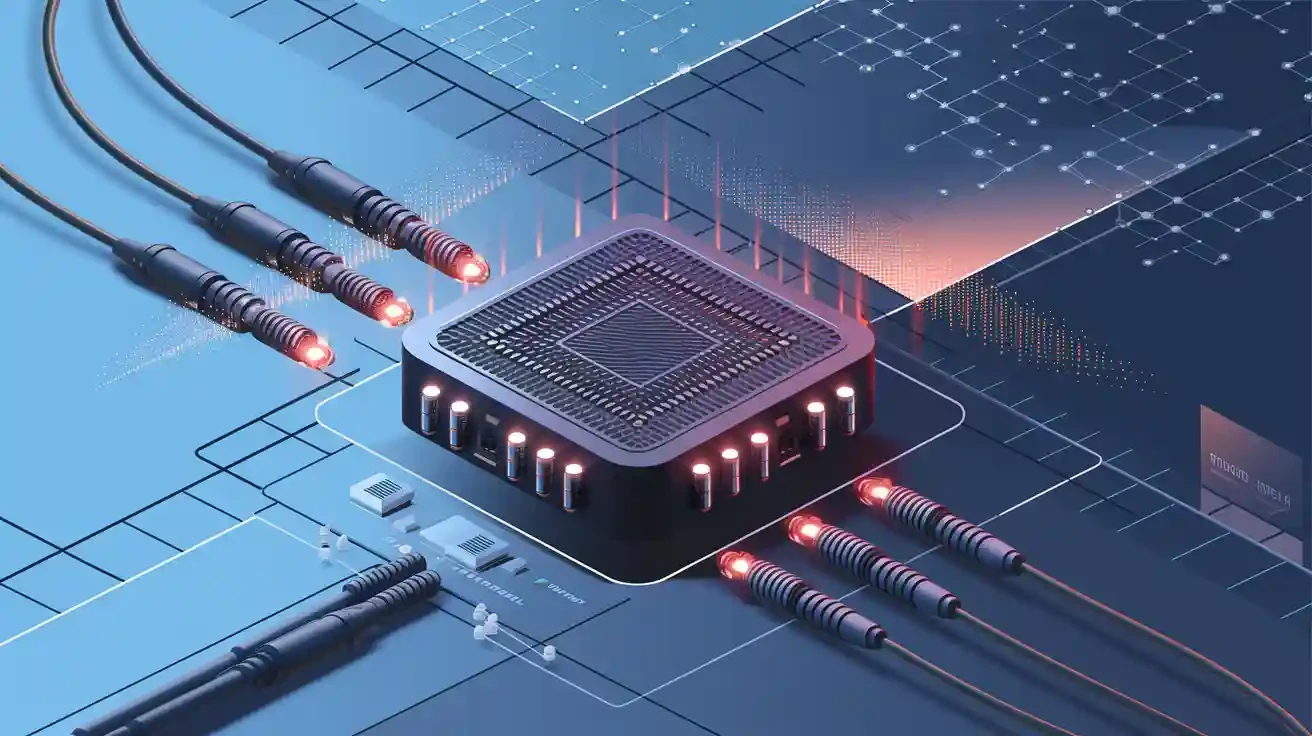
















Optical modulation changes how light waves act to carry information. This lets devices send lots of data fast and without mistakes. This process dynamically alters properties of an optical carrier wave—such as amplitude, phase, frequency, or polarization—to embed data. Its inverse, demodulation, extracts this information at the receiving end. Today’s networks use optical modulation to make data move faster. They use methods like PSK en QAM. These methods let many bits travel together in the same space. People want faster internet because of 5G, cloud computing, and new digital tools. This has made the optical modulators market grow quickly. New improvements in optical modulation have doubled how much fiber optic cables can carry at important times. This helps many areas, like telecommunications and healthcare.
➤ Belangrijkste conclusies
Optical modulation changes light waves to send data quickly and clearly. This helps fiber optic networks work at high speeds.
There are three main types of optical modulation. These are direct, external, and all-optical. Each type works best for certain speeds and distances.
Modern modulators like Mach-Zehnder and electro-absorption devices send data very fast. They also help keep errors low.
Performance metrics like modulation index and amplitude show how well signals are sent. They help check if the signals are strong and clear.
New materials and designs make optical modulators smaller and faster. They also use less energy. This helps new technology like 5G and AI.
➤ What is Optical Modulation
Optical modulation is when we change parts of light to send information. Scientists and engineers use it to move data through fiber optic cables and other systems. The main parts that can be changed are amplitude, phase, or polarization of the light. Changing these parts lets devices put digital data onto a light wave. Amplitude modulation changes how bright the light is. Phase modulation changes the timing of the wave. Polarization modulation changes the way the light moves.
There are two main ways to do optical modulation. Direct modulation changes the current going to a laser, which then changes the light. This way is simple but works best for slower data speeds. External modulation uses special modulators to change the light after it leaves the laser. These modulators can work at higher speeds and give more control. Some common modulators are electro-optic modulators, which use electric fields to change the phase of light, and electro-absorption modulators, which block or let light pass like a shutter.
Note: The type of modulation and device used changes how fast and well data moves in a network.
➤ Optical Parameters Modulated: The Core Taxonomy
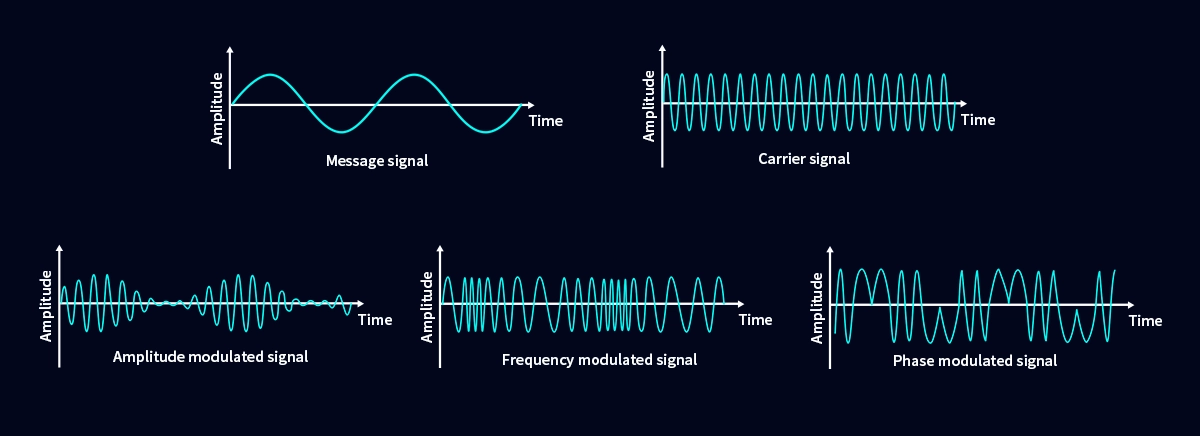
The modulated parameter defines the scheme’s fundamental behavior:
Modulatietype | Parameter Altered | Belangrijke toepassingen |
|---|---|---|
Amplitude Modulation | Intensity/Amplitude | Analog audio, legacy systems |
Phase Modulation | Phase relative to reference carrier | High-sensitivity coherent systems |
Frequency Modulation | Frequentie | Radio-over-fiber, noise-resistant links |
Polarization Modulation | Polarization state/ellipticity | Quantum encryption, sensing |
Spatial Modulation | Beam shape/mode patterns | Mode-division multiplexing (MDM) |
🔍 Why it matters: The choice dictates spectral efficiency, complexity, and compatibility with optische transceiver hardware like LINK-PP’s 100G QSFP28 modules.
➤ Digital vs. Analog Modulation: Choosing the Right Approach
Analog Modulation
Continuously varies carrier properties to mirror analog signals (e.g., voice):
Amplitude Modulation (AM): Carrier amplitude ∝ message signal.
Frequency Modulation (FM): Carrier frequency shifts with signal amplitude.
Phase Modulation (PM): Carrier phase shifts relative to reference.
Geschikt voor: Broadcast, legacy systems.
Digital Modulation
Uses discrete states to represent binary data, ideal for computer networks:
Amplitudeverschuivingssleuteling (ASK): Two amplitudes = 0s and 1s.
Frequentieverschuivingsmodulatie (FSK): Two frequencies = binary states.
Faseverschuivingssleuteling (PSK): Phase shifts encode bit patterns.
Binary PSK (BPSK): 0° or 180° phase shifts (1 bit/symbol).
Kwadratuur-PSK (QPSK): 0°, 90°, 180°, 270° phases (2 bits/symbol).
Differential PSK (DPSK): Phase shifts relative to prior symbol.
💡 Belangrijk inzicht: Digital schemes like QPSK dominate modern optische transceiver designs due to superior noise resilience and spectral efficiency.
➤ Direct vs. External Modulation: Implementation Trade-offs
Methode | Hoe het werkt | Voordelen | Nadelen |
|---|---|---|---|
Direct Modulation | Message signal drives laser/LED current | Low cost, simple integration | Limited bandwidth, high chirp |
External Modulation | Constant laser + separate modulator (e.g., LiNbO₃) | High speed, low noise | Higher cost, complex assembly |
External modulators enable high-performance solutions like LINK-PP’s 400G coherent modules, leveraging QPSK for long-haul data center interconnects.
➤ The Physics Behind Modulation: How Materials Make It Possible
Modulation relies on altering a material’s optical susceptibility:
Refractive Modulation: Changes real susceptibility → alters refractive index (e.g., Pockels effect in LiNbO₃).
Absorptive Modulation: Changes imaginary susceptibility → controls absorption (e.g., Franz-Keldysh effect in semiconductors).
Physical mechanisms enabling this include:
Electro-optic effect: Electric field → refractive index change.
Acousto-optic effect: Sound waves → refractive index shifts.
Electro-absorption: Electric field → absorption coefficient tuning.
➤ Why Modulation Matters in Optical Transceivers
Modern optische transceiver designs leverage advanced modulation like QPSK or 16-QAM to push data rates beyond 400G. For example:
LINK-PP’s 800G OSFP DR8 uses PAM4 (Pulse Amplitude Modulation 4-level) for short-reach data centers.
LINK-PP’s coherent CFP2-DCO employs DP-QPSK (Dual-Polarization QPSK) for subsea cables.
These techniques maximize spectral efficiency while minimizing power consumption—critical for sustainable scaling.
➤ Future Trends & Industry Outlook
Coherent Dominance: QAM formats (16-QAM, 64-QAM) will drive 1.6T+ transceivers.
Integrated Photonics: Silicon-based modulators will shrink costs and power needs.
Quantum Modulation: Polarization encoding for ultra-secure networks.
🚀 Klaar om uw netwerk te upgraden?
Verken LINK-PP’s industry-leading optical transceiver solutions, engineered for tomorrow’s modulation demands. Request for a customized consultation ➞
➤ Conclusie
Optical modulation techniques—from basic AM to coherent DP-QPSK—enable the high-speed backbone of global communication. As optische transceiver technology evolves, understanding these principles becomes essential for designing efficient, scalable networks. Brands like LINK-PP integrate cutting-edge modulation into products like their 200G transceivers, ensuring optimal performance for 5G, cloud, and AI-driven infrastructure.
➤ Zie ook
De rol en betekenis van TOSA in optische modules
Why Digital Diagnostics Monitoring Matters In Optical Transceivers
WDM-technologie en haar toepassingen in optische netwerken onderzoeken