















When planning a 100G network upgrade, you’ll quickly encounter two crucial protocols: OTU4 and 100GE (100 Gigabit Ethernet). While they both operate at the same nominal speed, they serve fundamentally different purposes in the networking world. Choosing the wrong one can lead to inefficiency, incompatibility, and unnecessary cost.
Understanding the distinction between the transport-oriented OTU4 and the data-centric 100GE is key to building a robust, scalable, and cost-effective network. This article will demystify these protocols, compare them head-to-head, and guide you toward the right choice for your specific use case.
➤ Core Concepts: The Definition Behind Each Protocol
What is 100 Gigabit Ethernet (100GE)?
100GE, defined by the IEEE 802.3ba 표준, is the workhorse of modern data centers and enterprise networks. It’s designed for switching and routing packetized data—the kind of traffic generated by servers, storage, and internet applications. Its primary goal is to provide high-bandwidth connectivity for LAN, 데이터센터 상호 연결 (DCI), and internet access. Think of it as the universal language for data traffic.
What is OTU4?
OTU4 (Optical Channel Transport Unit 4) is a standard from the ITU-T G.709 specification, often called “Digital Wrapper” technology. It’s the backbone of Optical Transport Networks (OTN). OTU4’s job is to provide a robust, telco-grade, and fault-managed way to transport diverse client signals (like 100GE, 40GbE, or even legacy SAN protocols) over long distances on DWDM networks. It adds 정방향 오류 정정 (FEC) and management overhead, making it the “long-haul trucker” of data.
➤ Head-to-Head: OTU4 vs 100GE – A Technical Showdown
The key difference lies in their layer in the network stack and their inherent capabilities. The following table summarizes the critical distinctions:
기능 | 100 Gigabit Ethernet (100GE) | OTU4 (G.709) |
|---|---|---|
ITU(국제) | IEEE (802.3ba) | ITU-T (G.709) |
주요 용도 | Data Networking & Packet Switching | Transport & Aggregation |
일반적인 사용 사례 | Data Center, Enterprise Core | Metropolitan/Long-Haul DWDM Links |
SDH 프레임 | 이더넷 프레임 | Digitally Wrapped OTN Frames |
순방향 오류 정정(FEC) | Optional (e.g., RS-FEC) | 필수적 (Stronger SD-FEC) |
성능 모니터링 | Limited (Ethernet OAM) | 고급 (TCM, PM, BER) |
Client Signal Transparency | 없음 | 있음 (Can carry 100GE, FC, etc.) |
지연 시간 | 낮음 | Slightly Higher (due to FEC & wrapping) |
➤ Choosing the Right Protocol: A Practical Guide
귀하의 선택은 어느 쪽이 “더 낫다”는 것에 대한 것이 아니라, 어느 쪽이 right for the job.
✅ Choose 100 Gigabit Ethernet (100GE) if:
You are building or upgrading a 데이터센터 네트워크 (e.g., connecting switches to servers or other switches).
Your primary traffic is 이더넷/IP.
You need the lowest possible latency for financial trading or HPC clusters.
Your links are relatively short (intra-data center or campus).
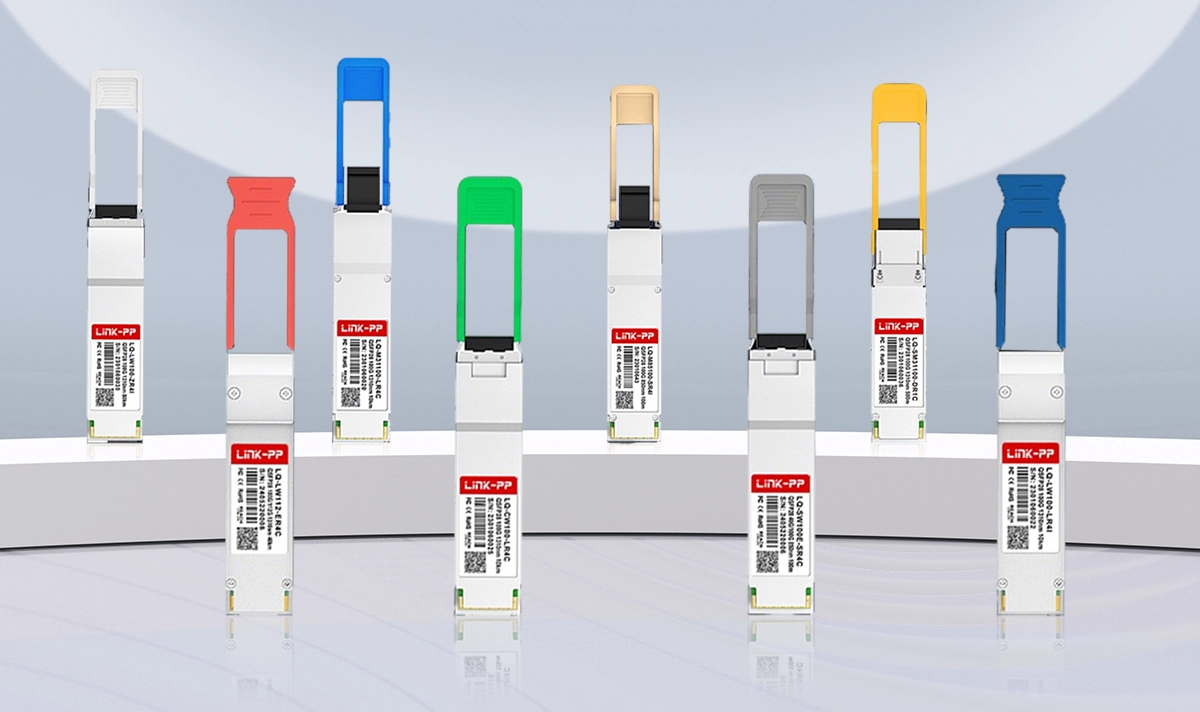
For these scenarios, a standard 100G QSFP28 transceiver like the LINK-PP LQ-M85100-SR4C for multimode or the LINK-PP QSFP-100G-LR4 for single-mode up to 10km is the perfect, cost-effective solution.
✅ Choose OTU4 if:
대규모 데이터센터를 운영하거나 service provider or large enterprise building a DWDM network.
귀하는 다음을 필요로 합니다: transport a 100G client signal over long distances with maximum reliability.
You require advanced performance monitoring and fault isolation across multiple network domains.
You need to aggregate and transparently carry multiple client protocols over a single wavelength.
This is where a purpose-built OTU4 CFP2 또는 CFP4 optical module is essential. For instance, the CFP2-100G-OTU4-LR module is engineered specifically for high-performance, long-reach OTU4 applications, providing the necessary G.709 compliance and robust FEC.
➤ The Bridge: How 100GE and OTU4 Work Together
It’s not always an either/or situation. Often, they work in tandem. A common architecture involves:
A data center generates native 100GE traffic.
This traffic is handed off to a service provider.
The provider maps the 100GE signal into an OTU4 frame for transport across their robust, managed DWDM backbone.
목적지에서 OTU4 프레임이 끝나고, 원래 100GE 클라이언트 신호가 추출되고 전달됩니다.
이 과정은 캐리어들이 기업 고객들에게 보안성과 신뢰성을 제공할 수 있도록 합니다. 100G 파라미터 네트워크 서비스를 제공합니다.
➤ 결론과 핵심 요약
100GE 네트워크 내 및 데이터 센터 간 데이터 전송을 위한 데이터 전송입니다. 장거리에서 데이터(또는 다른 데이터 유형)를 광신호망을 통해 효율적으로 전송합니다. 간단하고 저지연을 고려합니다. 간단하고 저지연을 고려합니다. 신뢰성, 관리 및 투명성을 고려합니다. 선택된 적절한 프로토콜은 네트워크 성능과 호환성에 큰 영향을 미칩니다. 원격 100GE 또는 OTU4 전송을 위한 적절한 선택은 매우 중요합니다..
OTU4 네트워크 내 및 데이터 센터 간 데이터 전송을 위한 데이터 전송입니다. 장거리에서 데이터(또는 다른 데이터 유형)를 광신호망을 통해 효율적으로 전송합니다. 간단하고 저지연을 고려합니다. 아직 100G 배포的最佳 경로에 대해 확신이 되어 있지 않으신가요? 🔍 우리 전문가들은 이 선택을 어떻게 해야 할지 도와드릴 수 있습니다..
100GE 네트워크에 적합한 다양한 고급 광신호 전송 장치를 제공합니다.
OTU4 100G 광신호 전송 장치는 Ethernet 및 OTN 응용에서 모두 호환성과 품질, 신뢰성을 제공합니다.
➡️ 광 트랜스시버, 오늘 저희 팀과 연락하여 맞춤형 조율 및 제품에 대해 더 자세히 알아보세요.
➤ 자주 묻는 질문 광신호 전송 장치의 주요 차이점은 무엇인가요?
OTU4 vs 100GE: 어떤 고속 프로토콜이 네트워크에 가장 적합한가요? LINK-PP OTU4 vs 100GE: 속도, 신뢰성 및 사용 사례를 비교하여 네트워크의 현재 및 미래 성장을 고려하여 가장 적절한 고속 프로토콜을 선택하는 방법을 알려드립니다. 100G 광학 트랜스시버를 제공합니다. for both Ethernet and OTN applications.
➡️ [Contact our team today] for a personalized consultation and to explore our products
➤ 자주 묻는 질문(FAQ)
What is the main difference between OTU4 and 100GE?
당신은 OTU4가 장거리와 강한 오류 보정을 위해 최적화되어 있는지, 100GE가 짧거나 중간 거리에서 빠른 속도를 제공하는지에 대한 주요 차이를 확인할 수 있습니다. 각 프로토콜은 네트워크 요구 사항에 맞게 사용됩니다.
하나의 네트워크에서 OTU4와 100GE를 동시에 사용할 수 있습니까?
네, 사용할 수 있습니다. 많은 네트워크는 장거리에서 100GE 신호를 전송하기 위해 OTU4를 사용합니다. 이 설정은 빠른 속도와 신뢰성을 동시에 제공합니다.
데이터 센터에서 어떤 프로토콜을 선택해야 할까요?
대부분의 데이터 센터에서 100GE를 선택하는 것이 좋습니다. 높은 속도, 간단한 업그레이드 및 일반적인 하드웨어와 잘 작동하는 데 이점을 제공합니다. OTU4는 장거리 링크에서 더 적합합니다.
OTU4는 100GE보다 비용이 더 Expensive한가요?
OTU4 장치는 장거리와 강한 오류 보정을 처리하기 위해 비용이 더 Expensive합니다. 100GE 장치는 짧은 링크에서 더 저렴하고 설치가 더 쉬운 경우가 많습니다.
어떻게 네트워크에 맞게 선택할 수 있습니까?
네트워크의 크기, 거리, 신뢰성 요구 사항을 확인하세요. 장거리 및 캐리어 기반 링크에서는 OTU4를 선택하세요. 데이터 센터나 사무소에서 빠른, 유연한 연결을 위해 100GE를 선택하세요.