















🔹 Pendahuluan
Optical modulators play a central role in high-speed fiber optic communication systems. They are the key components that encode electrical data into optical signals for transmission across optical fibers. As data rates surge beyond 400G and 800G, a new generation of Silicon Photonic Modulators (Si-Ph Modulators) has emerged to replace traditional bulk optical modulators, reshaping how data centers and telecom networks handle bandwidth and power efficiency.
This article explores what silicon photonic modulators are, how they differ from conventional optical modulators, and why they are transforming the optical transceiver landscape.
🔹 What Is an Optical Modulator?
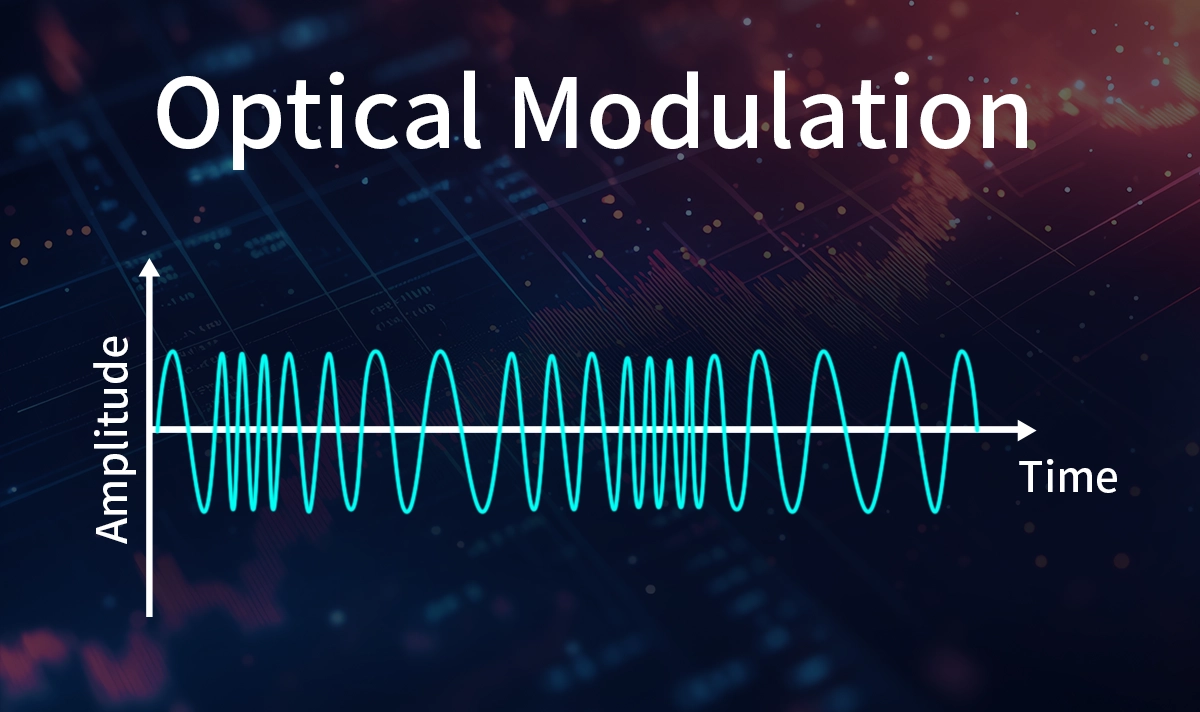
An optical modulator is a device that modifies one or more properties of a light wave—typically amplitude, phase, or frequency—in response to an electrical signal.
Its core purpose is to encode data onto a light carrier, enabling digital communication through optical fibers.
Traditional optical modulators have long relied on electro-optic crystals seperti lithium niobate (LiNbO₃) or compound semiconductors like InP or GaAs. These materials exhibit the Pockels effect, where an applied electric field directly changes the refractive index, allowing precise, linear, and high-speed modulation.
🔹 What Is a Silicon Photonic Modulator?
A Silicon Photonic Modulator integrates light modulation directly onto a silicon chip, leveraging CMOS-compatible fabrication processes. Instead of using the Pockels effect, silicon uses the free-carrier plasma dispersion effect, where injecting or depleting charge carriers changes the refractive index of silicon.
This mechanism enables compact, low-cost, and power-efficient devices ideal for large-scale photonic integration in data centers, *Fronthaul* 5G, and AI interconnects.
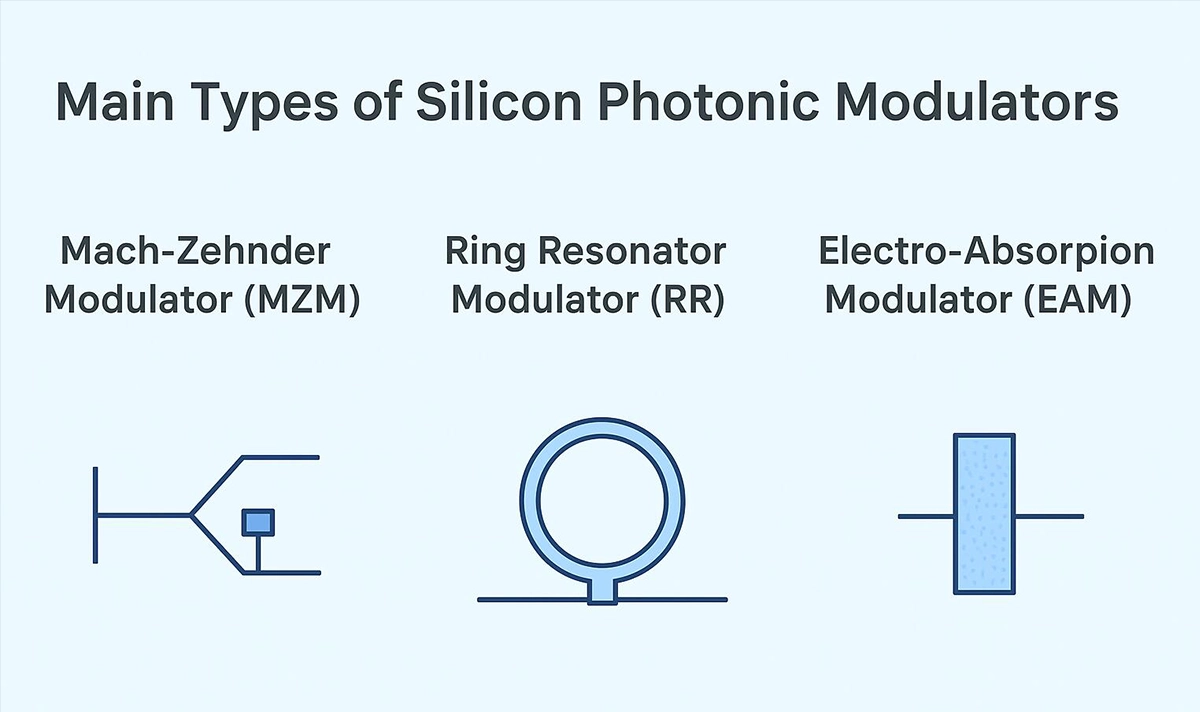
Main Types of Silicon Photonic Modulators
Mach–Zehnder Modulator (MZM)
Uses interference between two light paths. By changing the phase difference through electrical signals, it modulates the light intensity.
→ Supports ultra-high-speed modulation up to 100+ Gbps per channel.Ring Resonator Modulator (RR)
Based on a small ring-shaped resonant cavity that shifts its resonant wavelength when the voltage changes.
→ Compact footprint and low power consumption.Electro-Absorption Modulator (EAM)
Changes the light absorption properties under electric fields.
→ Offers fast response and high integration density.
🔹 Key Differences: Silicon vs Traditional Optical Modulators
Aspek | Silicon Photonic Modulator | |
|---|---|---|
Bahan | Silicon (Si), SiO₂ | LiNbO₃, InP, GaAs |
Modulation Mechanism | Free-carrier effect | Electro-optic (Pockels) effect |
Manufaktur | CMOS-compatible, easy integration | Custom photonic process |
Size & Power | Compact, low power | Large footprint, higher power |
Lebar Pita | >100 GHz (with driver co-integration) | Excellent linearity, high precision |
Integrasi | Easy to co-package with drivers and photodiodes | Limited integration |
Biaya | Lower, scalable | Higher, complex manufacturing |
Kasus Penggunaan | Data centers, AI/ML interconnects, short-reach links | Long-haul telecom, defense, research |
🔹 Why Silicon Photonic Modulators Are the Future
As optical systems scale toward optik terkemas bersama (co-packaged optics/CPO) and chiplet-based architectures, silicon photonic modulators offer critical advantages:
⚡ High-speed operation compatible with PAM4 and coherent modulation formats (DP-QPSK, 16-QAM).
💡 Monolithic integration with photodiodes, lasers (via hybrid bonding), and transimpedance amplifiers (TIA).
🧠 CMOS co-packaging allows electronics and photonics to coexist on the same substrate.
♻️ Lower power consumption and smaller footprint, ideal for hyperscale data centers.
🧩 Mass production scalability, reducing costs and improving reliability.
These factors make silicon photonics the foundation of next-generation 800G, 1.6T, and beyond transceiver optik.
🔹 Future Trends in Silicon Photonic Modulators
Heterogeneous Integration:
Combining silicon with III–V materials for integrated laser and EAMs on the same die.Advanced Modulation Formats:
Dukungan untuk DP-QPSK, PAM4, and QAM enables higher data throughput per wavelength.AI and HPC Interconnects:
Fotonika silikon enables low-latency optical interconnects for AI accelerators and HPC clusters.Cost-Effective Co-Packaged Optics (CPO):
Replacing pluggable modules with embedded photonic engines.
🔹 Kesimpulan
Traditional optical modulators paved the way for optical communications with their precision and linearity. However, modulator fotonik silikon are redefining the future—combining scalability, cost-efficiency, and integration into a single platform.
As the demand for higher bandwidth and lower power consumption continues to rise, fotonika silikon stands as the most promising path forward for next-generation optical transceivers.
🔹 Recommended Reading