
















When planning a 100G network upgrade, you’ll quickly encounter two crucial protocols: OTU4 and 100GE (100 Gigabit Ethernet). While they both operate at the same nominal speed, they serve fundamentally different purposes in the networking world. Choosing the wrong one can lead to inefficiency, incompatibility, and unnecessary cost.
Understanding the distinction between the transport-oriented OTU4 and the data-centric 100GE is key to building a robust, scalable, and cost-effective network. This article will demystify these protocols, compare them head-to-head, and guide you toward the right choice for your specific use case.
➤ Core Concepts: The Definition Behind Each Protocol
What is 100 Gigabit Ethernet (100GE)?
100GE, defined by the Norma IEEE 802.3ba, is the workhorse of modern data centers and enterprise networks. It’s designed for switching and routing packetized data—the kind of traffic generated by servers, storage, and internet applications. Its primary goal is to provide high-bandwidth connectivity for LAN, centros de datos (DCI), and internet access. Think of it as the universal language for data traffic.
What is OTU4?
OTU4 (Optical Channel Transport Unit 4) is a standard from the ITU-T G.709 specification, often called “Digital Wrapper” technology. It’s the backbone of Optical Transport Networks (OTN). OTU4’s job is to provide a robust, telco-grade, and fault-managed way to transport diverse client signals (like 100GE, 40GbE, or even legacy SAN protocols) over long distances on DWDM networks. It adds corrección de errores hacia adelante (FEC) and management overhead, making it the “long-haul trucker” of data.
➤ Head-to-Head: OTU4 vs 100GE – A Technical Showdown
The key difference lies in their layer in the network stack and their inherent capabilities. The following table summarizes the critical distinctions:
Característica | 100 Gigabit Ethernet (100GE) | OTU4 (G.709) |
|---|---|---|
Carrocería estándar | IEEE (802.3ba) | ITU-T (G.709) |
Finalidad principal | Data Networking & Packet Switching | Transport & Aggregation |
Caso de uso típico | Data Center, Enterprise Core | Metropolitan/Long-Haul DWDM Links |
Estructura del bastidor | Tramas Ethernet | Digitally Wrapped OTN Frames |
Corrección de errores por adelantado (FEC) | Optional (e.g., RS-FEC) | Obligatorio (Stronger SD-FEC) |
Supervisión del rendimiento | Limited (Ethernet OAM) | Avanzado (TCM, PM, BER) |
Client Signal Transparency | No | Yes (Can carry 100GE, FC, etc.) |
Latencia | Lower | Slightly Higher (due to FEC & wrapping) |
➤ Choosing the Right Protocol: A Practical Guide
Your choice isn’t about which is “better,” but which is right for the job.
✅ Choose 100 Gigabit Ethernet (100GE) if:
You are building or upgrading a red de centros de datos (e.g., connecting switches to servers or other switches).
Your primary traffic is Ethernet/IP.
You need the lowest possible latency for financial trading or HPC clusters.
Your links are relatively short (intra-data center or campus).
For these scenarios, a standard QSFP28 de 100 G transceiver like the LINK-PP LQ-M85100-SR4C for multimode or the LINK-PP QSFP-100G-LR4 for single-mode up to 10km is the perfect, cost-effective solution.
✅ Choose OTU4 if:
Eres un service provider or large enterprise building a DWDM network.
Tienes que transport a 100G client signal over long distances with maximum reliability.
You require advanced performance monitoring and fault isolation across multiple network domains.
You need to aggregate and transparently carry multiple client protocols over a single wavelength.
This is where a purpose-built OTU4 CFP2 or CFP4 optical module is essential. For instance, the CFP2-100G-OTU4-LR module is engineered specifically for high-performance, long-reach OTU4 applications, providing the necessary G.709 compliance and robust FEC.
➤ The Bridge: How 100GE and OTU4 Work Together
It’s not always an either/or situation. Often, they work in tandem. A common architecture involves:
A data center generates native 100GE traffic.
This traffic is handed off to a service provider.
The provider maps the 100GE signal into an OTU4 trama para transporte a través de su sólido y gestionado backbone DWDM.
En el destino, la trama OTU4 se termina y la señal cliente 100GE original se extrae y entrega.
Este proceso permite a los operadores ofrecer servicios seguros y confiables Longitud de onda de 100G a sus clientes empresariales.
➤ Conclusión y puntos clave
100GE es para redes datos dentro y entre centros de datos. Se trata de conmutación.
OTU4 es para transporte de esos datos (y otros tipos de datos) a largas distancias en redes ópticas. Se trata de transporte.
100GE prioriza la simplicidad y baja latencia.
OTU4 prioriza la robustez, gestión y transparencia.
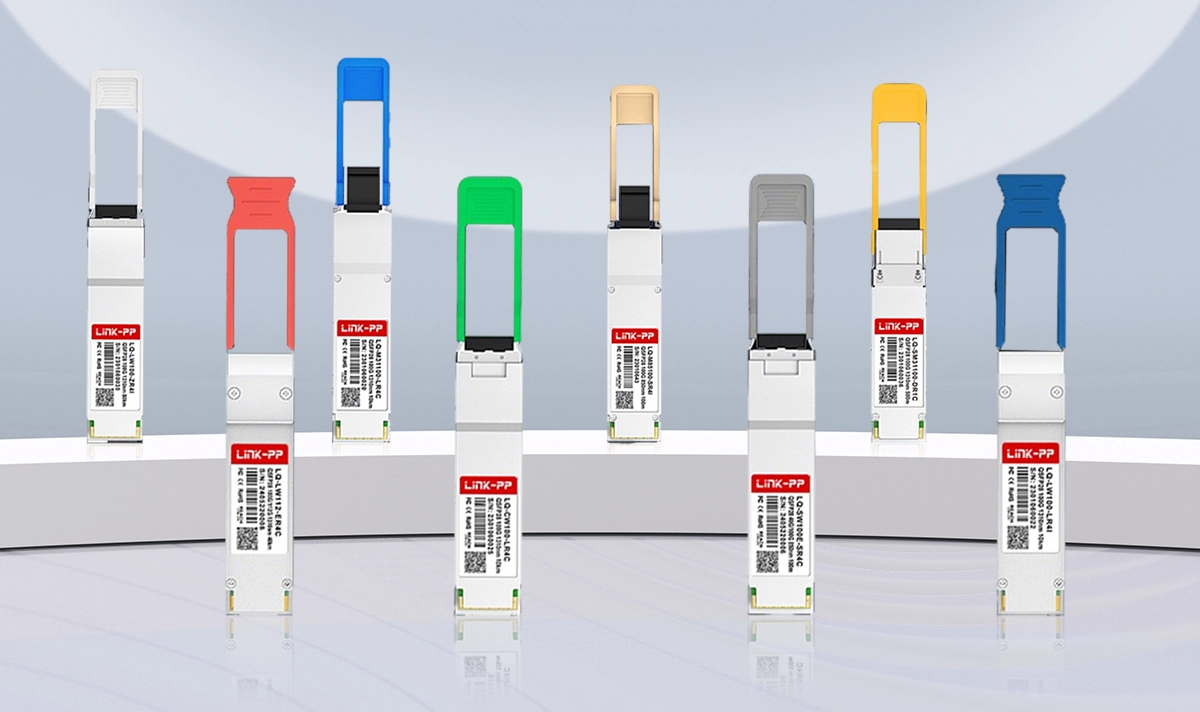
La selección correcta de transceptor óptico, la trama, ya sea para transporte nativo de 100GE u OTU4, es crítica para el rendimiento y compatibilidad de la red.
¿Todavía no está seguro sobre el mejor camino para su implementación de 100G? 🔍
Nuestros expertos en LINK-PP están aquí para ayudarlo a navegar estas opciones. Ofrecemos una amplia gama de transceptores ópticos de 100G transceptores ópticos de 100G compatibles, de alta calidad y confiables para aplicaciones tanto de Ethernet como de OTN.
➡️ [Contáctenos hoy] para una consulta personalizada y explorar nuestros productos
➤ Preguntas frecuentes
¿Cuál es la principal diferencia entre OTU4 y 100GE?
Notará que OTU4 funciona mejor para largas distancias y una fuerte corrección de errores. 100GE le ofrece velocidades rápidas para distancias cortas o medias. Cada protocolo se adapta a diferentes necesidades de red.
¿Puedo usar OTU4 y 100GE juntos en una misma red?
Sí, puede hacerlo. Muchas redes utilizan OTU4 para transportar señales 100GE a largas distancias. Esta configuración le brinda velocidad y confiabilidad.
¿Qué protocolo debo elegir para un centro de datos?
Debe elegir 100GE para la mayoría de los centros de datos. Ofrece alta velocidad, actualizaciones fáciles y funciona bien con hardware común. OTU4 es mejor para enlaces de larga distancia.
¿Cuesta más OTU4 que 100GE?
El equipo OTU4 suele costar más porque maneja largas distancias y una fuerte corrección de errores. El hardware 100GE es más asequible y fácil de instalar para enlaces cortos.
¿Cómo decido qué protocolo se adapta a mi red?
Check your network’s size, distance, and reliability needs. Use OTU4 for long-haul, carrier-grade links. Choose 100GE for fast, flexible connections in data centers or offices.