















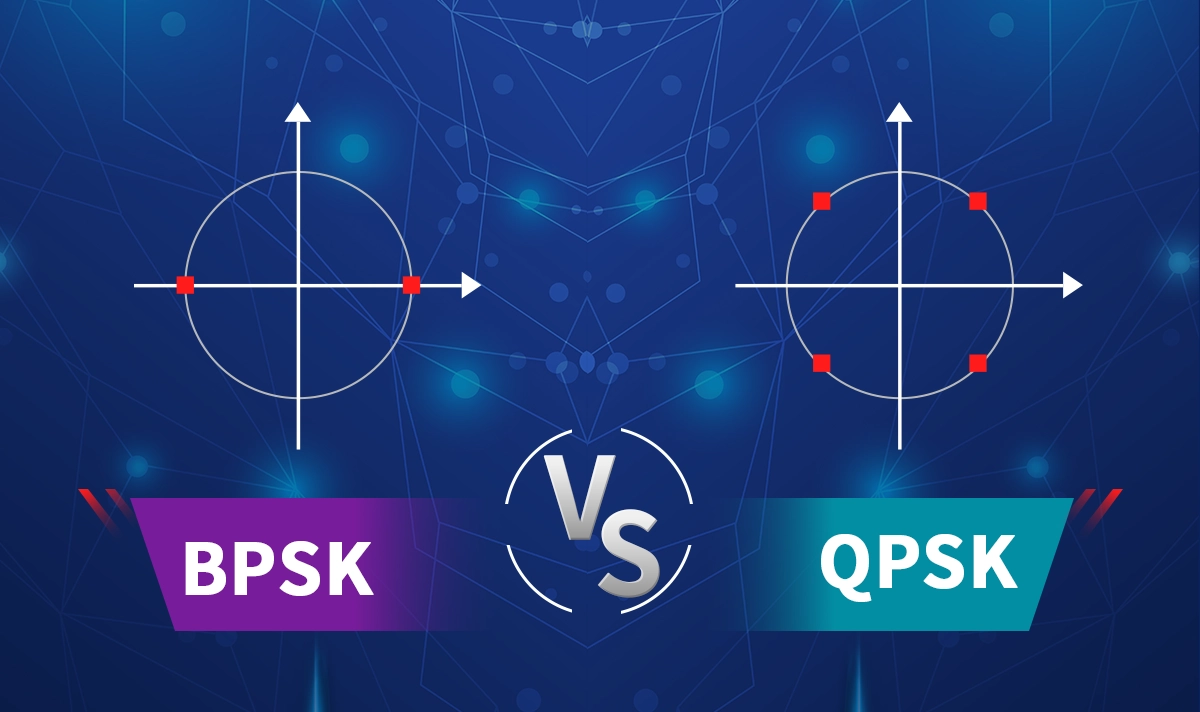
En el vasto e invisible mundo de la transmisión de datos, cada bit de información —cada correo electrónico, cada transmisión de vídeo y cada página web— viaja en forma de señal cuidadosamente elaborada. El método que consiste en superponer estos datos digitales a una onda portadora se denomina , y es el lenguaje fundamental de la conectividad moderna, desde tu router Wi-Fi hasta las cámaras submarinas transcontinentales., y es el lenguaje fundamental que utilizan las máquinas para comunicarse. Entre las diversas técnicas de modulación, destacan dos esquemas básicos: – forma más simple: (Modulación por desplazamiento de fase binaria) and QPSK (Modulación por desplazamiento de fase en cuadratura).
Comprender la diferencia entre BPSK y QPSK es fundamental para cualquier persona que trabaje en el sector de las telecomunicaciones, las redes o Ingeniería de radiofrecuencia. Este artículo desentrañará estos dos gigantes, comparará sus puntos fuertes y débiles, y explicará su papel fundamental en tecnologías como óptica coherente y de alta velocidad transceptores ópticos.
⚔️ Conclusiones clave
El BPSK funciona bien en entornos con mucho ruido. Es capaz de soportar el ruido y requiere un hardware sencillo.
El QPSK transmite dos bits con cada símbolo. Esto permite transmitir más datos. Es una buena opción cuando no se dispone de mucho ancho de banda.
Elige BPSK si quieres que funcione bien y sea fácil de configurar. Úsalo cuando la velocidad de transmisión de datos no sea lo más importante.
Elige QPSK si quieres enviar datos rápidamente. No consume más ancho de banda.
⚔️ ¿Qué es el BPSK (modulación por desplazamiento de fase binaria)? La «rampa de acceso» al mundo digital
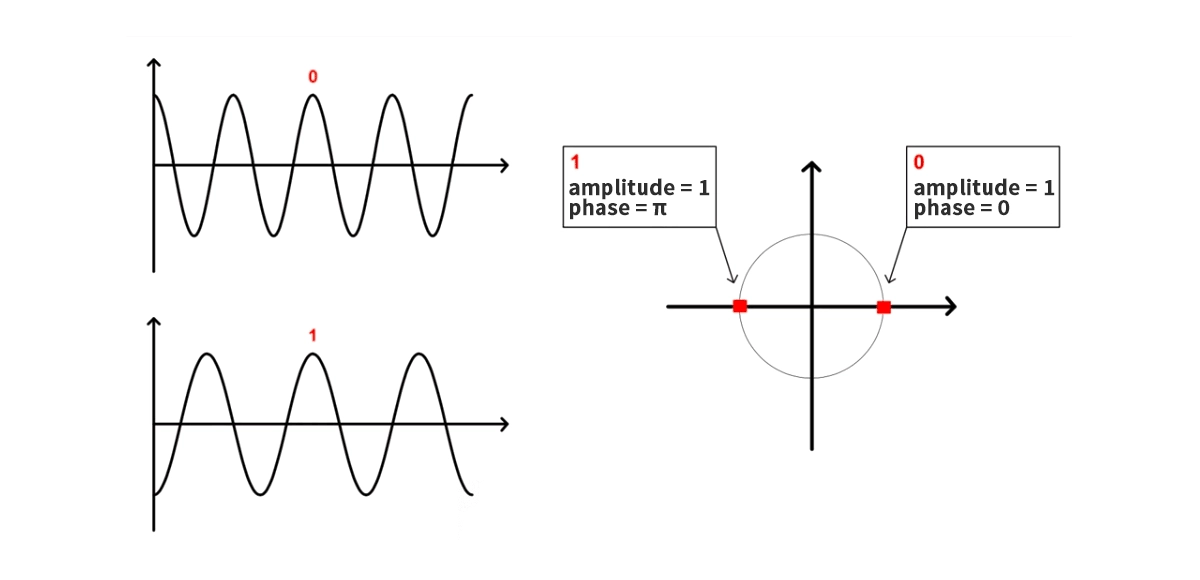
– forma más simple: Es la forma más sencilla de modulación por desplazamiento de fase. Utiliza dos estados de fase distintos, separados por 180 grados, para representar datos binarios.
Fase 0°: Representa un valor binario 0
Fase de 180°: Representa un valor binario 1
Esta modulación, robusta y sin florituras, es increíblemente resistente al ruido y a la degradación de la señal (una propiedad conocida como alta diagrama de constelaciones resiliencia). Debido a su sencillez, se utiliza a menudo en situaciones en las que la integridad de la señal es más importante que la velocidad pura, como en las comunicaciones en el espacio profundo y en algunos comunicación inalámbrica normas.
⚔️ ¿Qué es la modulación QPSK (modulación por desplazamiento de fase en cuadratura)? Duplicar la capacidad de la autopista de datos
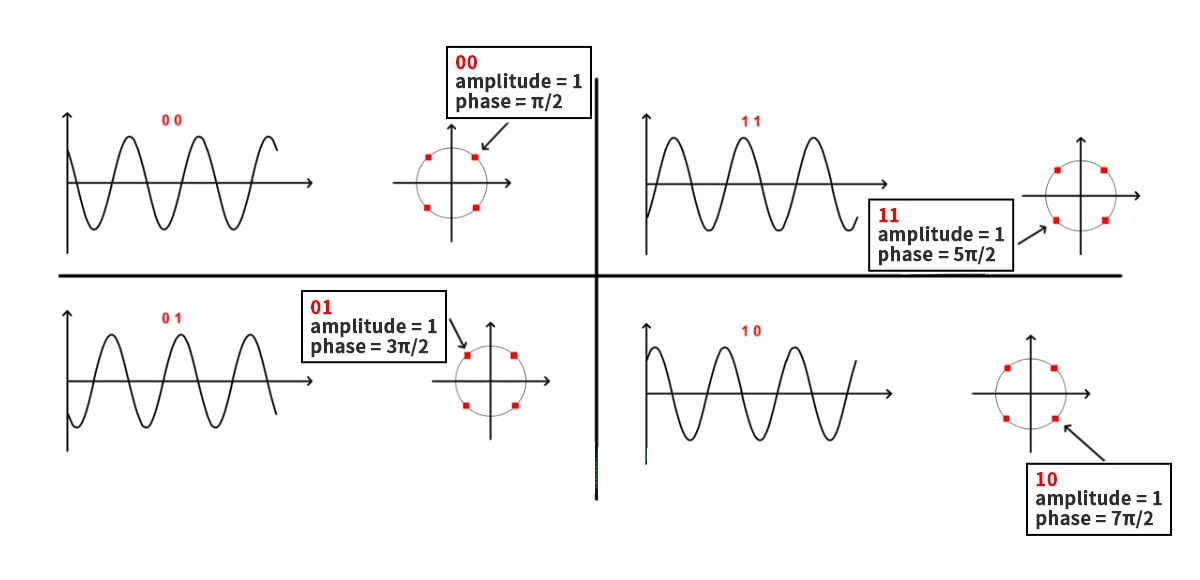
QPSK es una evolución del BPSK que duplica la eficiencia espectral. Para ello, utiliza cuatro estados de fase distintos (45, 135°, 225° y 315°) para representar dos bits de datos por símbolo, en lugar de uno.
00: Fase de 45°
01: Fase 135°
11: Fase 225°
10: Fase 315°
Al transmitir dos bits a la vez, el QPSK duplica efectivamente la velocidad de transmisión de datos dentro del mismo ancho de banda que el BPSK. Esto lo convierte en una opción muy utilizada para aplicaciones modernas como las comunicaciones por satélite, el Wi-Fi y la radiodifusión de vídeo digital.
⚔️ Cara a cara: el duelo entre BPSK y QPSK
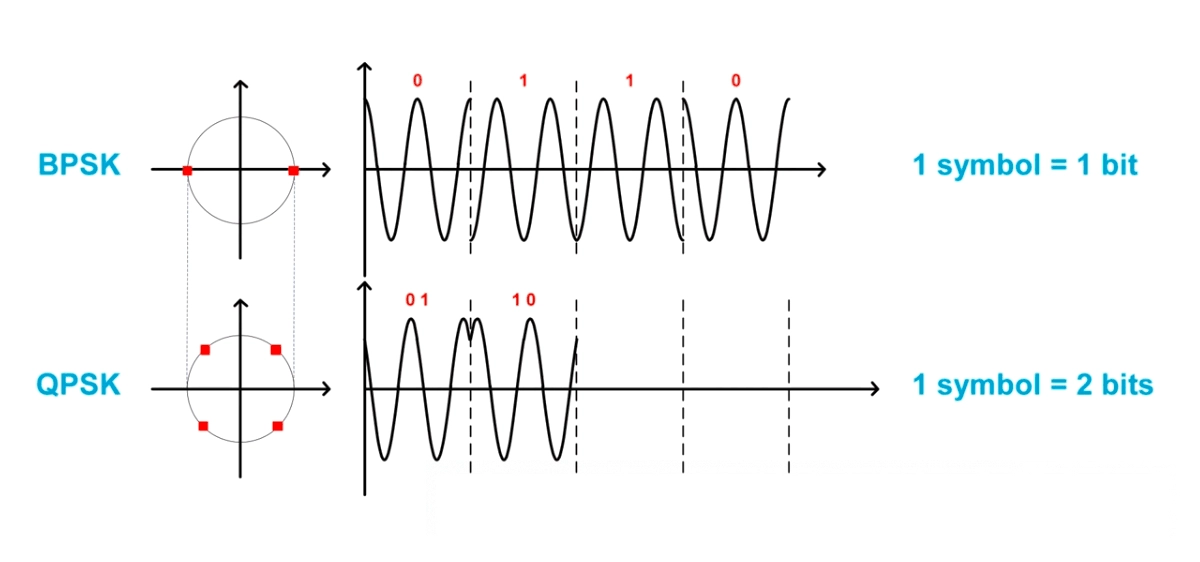
La disyuntiva fundamental entre estos dos sistemas constituye un dilema clásico de la ingeniería: Robustez frente a eficiencia.
Característica | BPSK (modulación por desplazamiento de fase binaria) | QPSK (modulación por desplazamiento de fase en cuadratura) |
|---|---|---|
Bits por símbolo | 1 | 2 |
Desfases | 2 (0°, 180°) | 4 (45°, 135°, 225°, 315°) |
Simple, bajo costo RF | Lower | Más alta (el doble que la del BPSK) |
Robustez (BER) | Superior (Más resistente al ruido) | Más bajo (más susceptible al ruido) |
Larga Distancia, Núcleo Metropolitano | Ventaja Clave | Moderada |
Aplicaciones comunes | Comunicaciones en el espacio profundo, RFID, proyectos piloto de OFDM | Televisión por satélite, Wi-Fi, CDMA, Redes 4G/5G |
Conclusión clave: Elige BPSK para situaciones difíciles, con baja...SNR entornos en los que la conexión no debe fallar. Elige QPSK para sistemas de alta capacidad en los que el ancho de banda sea limitado y sea necesario maximizar el rendimiento de datos.
⚔️ La conexión óptica: BPSK, QPSK y óptica coherente
Los principios de BPSK y QPSK no se limitan a las comunicaciones inalámbricas; constituyen la base de la moderna transmisión óptica coherente. Coherente tecnología DSP avanzada utiliza estos formatos de modulación para transmitir enormes cantidades de datos a través de cables de fibra óptica a distancias increíbles.
In Multiplexación densa por división de longitud de onda (DWDM) sistemas, Modulación QPSK es un componente fundamental de los transceptores coherentes de 100G. Otros esquemas más avanzados, como DP-QPSK (QPSK de polarización dual) se utilizan para alcanzar velocidades aún mayores mediante la transmisión de dos señales QPSK independientes en polarizaciones ortogonales de la luz.
En este caso, contar con un hardware de alto rendimiento es imprescindible. Por ejemplo, el 100G CFP2-DCO El módulo óptico coherente aprovecha la tecnología avanzada Modulación QPSK para ofrecer un rendimiento excepcional y bajo para redes de metro y de larga distancia. A la hora de evaluar ópticos., comprender el esquema de modulación subyacente es fundamental para elegir el producto adecuado para tu infraestructura de red.
⚔️ Conclusión: elegir la herramienta adecuada para cada tarea
No hay un “ganador” en el debate entre BPSK y QPSK. Cada esquema de modulación es una herramienta de precisión diseñada para una tarea específica. El BPSK es el caballo de batalla, robusto y fiable, para los trabajos más exigentes. El QPSK es el motor eficiente y de gran capacidad que impulsa nuestro mundo, ávido de ancho de banda. Juntos, y en sus variantes más complejas (como el 8-QAM, el 16-QAM, etc.), forman la columna vertebral invisible de nuestras vidas digitales conectadas.
A medida que se dispara la demanda de datos, el papel de la modulación sofisticada en de redes ópticas de alta velocidad. no hará más que crecer. Es fundamental elegir al socio tecnológico adecuado.
¿Estás listo para optimizar el rendimiento de tu red con la tecnología de modulación adecuada? 🔗
Explorar LINK-PP‘su gama completa de módulos ópticos coherentes, fiables y de alto rendimiento, entre los que se incluyen nuestros 200 G QPSK and 400G 16-QAM variantes, diseñadas para los más exigentes Interconexiones entre centros de datos (DCI) y las redes de proveedores de servicios.
⚔️ Preguntas frecuentes (FAQ)
¿Cuál es la principal diferencia entre BPSK y QPSK?
El BPSK transmite un bit mediante dos fases. El QPSK transmite dos bits mediante cuatro fases. El QPSK permite transmitir más datos en el mismo espacio.
¿Qué tipo de modulación es mejor para entornos ruidosos?
El BPSK es mejor si hay mucho ruido. Sus símbolos están más separados entre sí, por lo que es más fácil distinguirlos. Esto resulta útil cuando hay interferencias.
¿Cuándo debería utilizar QPSK en lugar de BPSK?
Utiliza QPSK si necesitas enviar grandes cantidades de datos. El QPSK funciona bien en redes inalámbricas de alta velocidad y en la televisión digital. Aprovecha mejor el ancho de banda que el BPSK.
¿Requiere el QPSK un hardware más complejo que el BPSK?
Sí, el QPSK requiere hardware para cuatro fases. El hardware del BPSK es más sencillo, ya que solo utiliza dos fases. Es posible que necesites un equipo de mayor calidad para el QPSK.
¿Puedo pasar fácilmente de BPSK a QPSK?
Depende de tu sistema. Es posible que tengas que actualizar el transmisor y el receptor para que sean compatibles con QPSK. Asegúrate de que tu hardware admita ambas funciones antes de realizar el cambio.