
















In high-speed Ethernet systems, electrical interfaces determine how data flows between a host device and an optical transceiver. Two widely referenced interfaces in 40G and 100G network architectures are XLPPI and XLAUI. While they may appear similar on the surface—both defining multi-lane electrical signaling—they serve different purposes, originate from different standards bodies, and support different performance generations.
This article provides a structured, authoritative comparison of XLPPI vs. XLAUI, clarifying how each interface fits into modern optical module ecosystems, especially QSFP+, QSFP28
, and QSFP56 modules widely deployed in data centers.
The Foundation: IEEE 802.3ba and the 40G Architecture
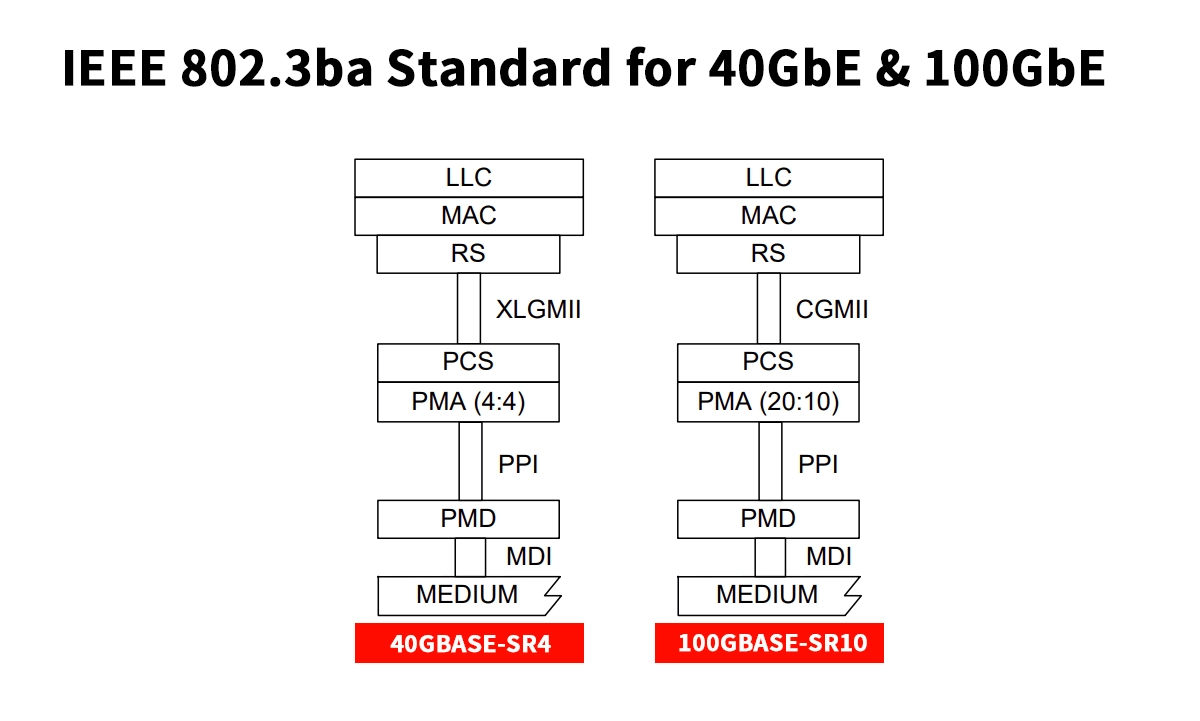
Before diving into the differences, we must understand the common ground. Both XLAUI and XLPPI are defined under the IEEE 802.3ba tiêu chuẩn for 40 Gigabit Ethernet.
The “XL” in both acronyms represents the Roman numeral for 40. Both interfaces utilize a 4-lane parallel architecture, where each lane operates at 10,3125 Gbps.
Total Bandwidth: 41.25 Gbps (including 64b/66b coding overhead).
Effective Data Rate: 40 Gbps.
However, their placement within the OSI Physical Layer (PHY) hierarchy is where they diverge.
What Is XLAUI? (40G Attachment Unit Interface)
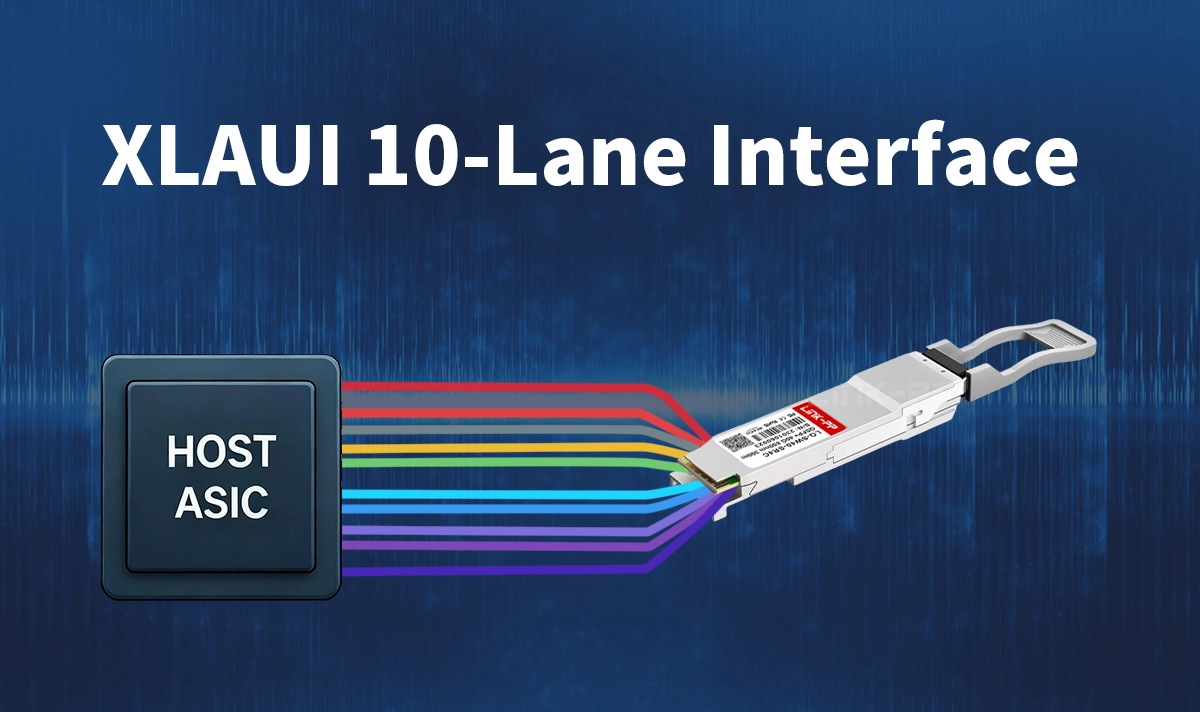
XLAUI (40G Attachment Unit Interface) is an IEEE-defined electrical interface introduced in IEEE 802.3ba cho Ethernet 40 Gigabit (40GbE). It operates using:
4 đường dẫn điện
10.3125 Gbps per lane
64B/66B line coding
NRZ signaling
▷ Purpose of XLAUI in 40G Ethernet
XLAUI acts as an internal electrical link between:
MAC ⇆ PHY
MAC ⇆ PMA/PMD
PHY ⇆ internal optical engine (in fixed-optics platforms)
It is not directly used at the pluggable module interface. Instead, XLAUI is part of the internal signal path of switches, routers, and network cards.
▷ Where XLAUI Is Used
XLAUI is associated primarily with:
40GBASE-SR4 (MPO-12 fiber)
40GBASE-LR4 (4×10G λ WDM)
40GBASE-CR4 (DAC cables)
While these modules use four 10G lanes, the XLAUI interface is typically implemented inside the host, not at the QSFP+ connector.
What Is XLPPI? (Extended Low-Power/Low-Voltage Parallel Interface)
XLPPI (Extended Low-Power/Low-Voltage Parallel Interface) is an MSA-defined electrical interface used between:
Host PHY/ASIC ⇆ Pluggable QSFP family optical modules
Unlike XLAUI (limited to 40G), XLPPI covers multiple Ethernet generations and multiple QSFP form factors.
Supported Speeds and Modulation
XLPPI supports:
Ethernet Generation | Loại mô-đun | Lanes | Lane Rate | Điều chế |
|---|---|---|---|---|
Yêu cầu cáp sợi quang và có thể đầu tư ban đầu cao hơn, nhưng mở rộng hiệu quả hơn cho sự phát triển mạng trong tương lai. | 4 | Không bị ảnh hưởng bởi nhiễu điện từ, đảm bảo hiệu suất ổn định trong môi trường khắc nghiệt. | NRZ | |
100G | 4 | 25G | NRZ | |
200G | 4 | 50G | PAM4 | |
400G | 8 | 50G PAM4 | PAM4 | |
800G | QSFP-DD800 | 8 | PAM4 100G | PAM4 |
Purpose of XLPPI
XLPPI ensures:
Low-voltage, low-power parallel signaling
Reliable host-to-module high-speed electrical connectivity
Compatibility across all QSFP generations
Stable operation across short PCB traces with tight signal integrity (SI) requirements
This makes XLPPI the dominant electrical interface behind modern pluggable optics.
XLPPI vs. XLAUI — Key Differences
The two interfaces operate in different parts of the Ethernet architecture and serve different design goals.
Different Standards Bodies
Giao diện | Defined By | Primary Scope |
|---|---|---|
XLAUI | MAC ⇆ PHY internal interface | |
XLPPI | QSFP/QSFP-DD MSA | Host ⇆ Pluggable optical module |
XLPPI is tied closely to the QSFP family, while XLAUI is tied to the internal logical layers of Ethernet.
Different Application Layers
Lớp | ||
|---|---|---|
Interface Location | Inside switch/router | At module connector |
Users | MAC, PHY, PMA/PMD | ASIC/PHY ⇆ QSFP module |
Exposure to hardware engineers | Internal silicon design | PCB design for pluggable transceivers |
Use in pluggable optics | Indirect | Trực tiếp |
Different Supported Speeds
XLAUI is fixed at:
4 × 10.3125 Gbps (40G)
XLPPI scales from 40G → 800G, depending on module form factor and SerDes generation.
Signaling Technologies
Đặc tính | XLAUI | XLPPI |
|---|---|---|
Phương thức truyền tín hiệu | NRZ | |
Điện áp | Tiêu chuẩn | Low-voltage / power-optimized |
SI Optimization | Đã lỗi thời | Advanced, QSFP-specific |
Khả năng nâng cấp trong tương lai | No (40G only) | Yes (40G–800G) |
Why Modern QSFP Modules Use XLPPI Instead of XLAUI
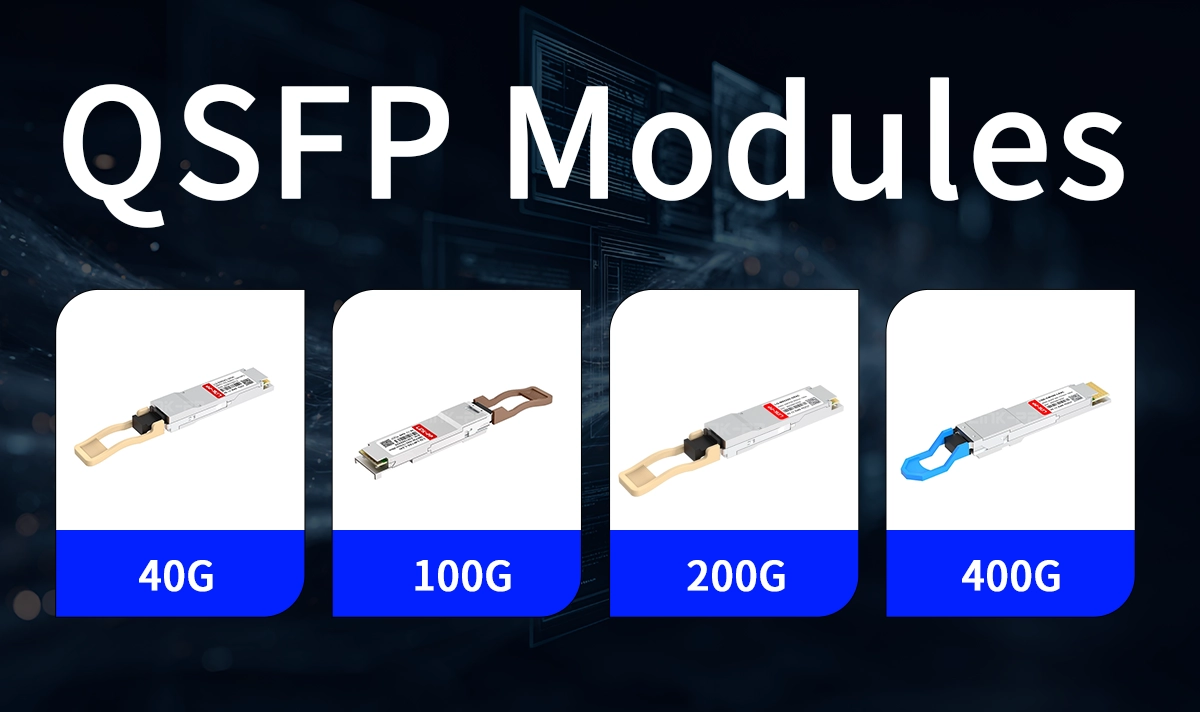
Because XLPPI:
Hỗ trợ các mô-đun có thể thay thế nóng
Optimizes tiêu thụ điện năng
Maintains độ toàn vẹn tín hiệu at higher speeds
Scales to PAM4 transmission required by 200G/400G/800G
Matches the mechanical and electrical constraints of QSFP connectors
All modern pluggable optics—SFP+/SFP28, QSFP+/QSFP28
, QSFP56, QSFP-DD—use MSA-defined low-voltage interfaces, including XLPPI.
Use Case Relevance for LINK-PP Customers
For customers selecting high-speed optical modules from LINK-PP, understanding XLPPI and XLAUI helps clarify:
Why QSFP+ and QSFP28 modules rely on XLPPI
How electrical interfaces affect module interoperability
Which types of modules support 10G, 25G, 50G, or 100G lane rates
XLPPI vs. XLAUI — Summary Table
Danh mục | ||
|---|---|---|
Tiêu chuẩn | MSA | IEEE |
Ethernet Generations | 40G–800G | 40G only |
Lane Speeds | 10G / 25G / 50G / 100G | Không bị ảnh hưởng bởi nhiễu điện từ, đảm bảo hiệu suất ổn định trong môi trường khắc nghiệt. |
Điều chế | NRZ & PAM4 | NRZ |
Interface Location | Host ⇆ Pluggable module | MAC ⇆ PHY (internal) |
Used In | Internal silicon | |
Future Scalability | Cao | Không có |
Kết luận
Both XLPPI and XLAUI are critical components of Ethernet’s electrical architecture, but they address fundamentally different requirements. XLPPI is the interface behind modern QSFP optical transceivers, enabling scalable, power-efficient, and high-density networking from 40G to 800G. XLAUI, meanwhile, remains an important IEEE interface within 40G Ethernet’s internal logic but is not used at the pluggable module connector.
Understanding these differences helps network engineers choose the right hardware—and helps organizations ensure stability and forward compatibility across their optical infrastructure.