











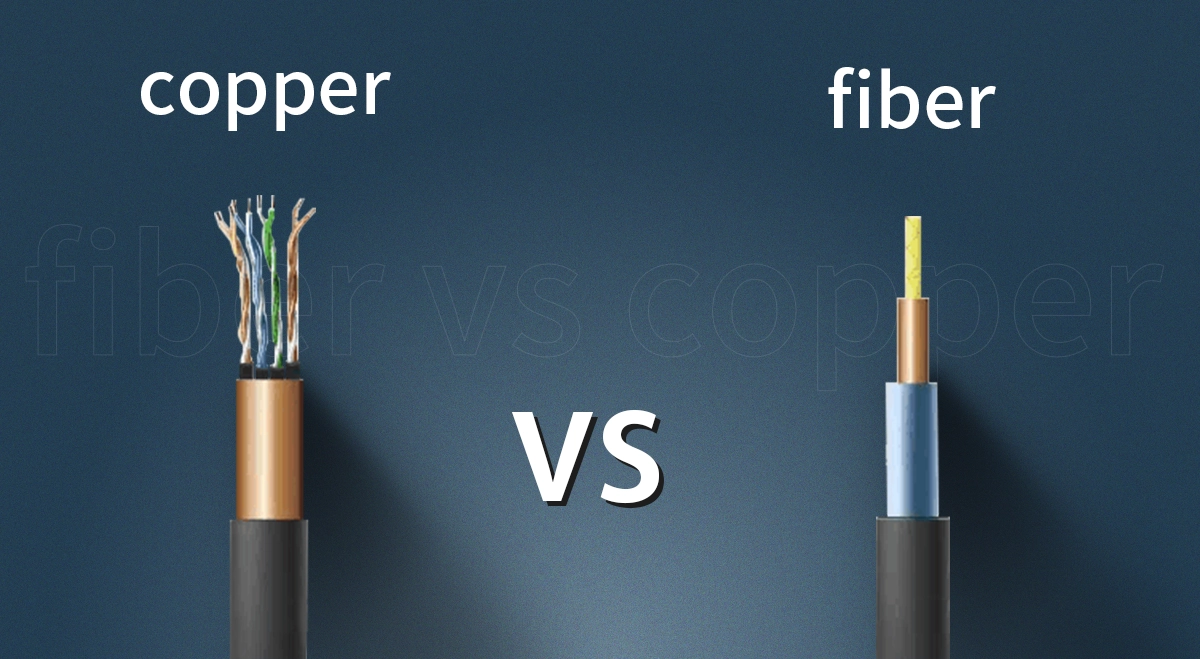
In the digital backbone of modern business, the choice between cáp quang and cáp đồng trục remains fundamental. While both transmit data, their underlying technologies, capabilities, and ideal applications differ dramatically. Selecting the right medium impacts bandwidth, distance, latency, security, cost, and ultimately, your network’s performance and scalability. Let’s dissect this critical infrastructure decision.
Understanding the Core Technologies
Copper Cable (e.g., Twisted Pair – Cat6, Cat6a, Cat7): Relies on electrical signals transmitted over metal wires (typically copper). Common types include Unshielded Twisted Pair (UTP) and Cáp xoắn đôi có bọc chắn (STP)
. Performance is measured in categories (Cat ratings).Fiber Optic Cable: Transmits data as pulses of light through incredibly thin strands of glass or plastic (core), surrounded by cladding that reflects light inward. Requires bộ thu phát quang at each end to convert electrical signals to light and vice versa.
Fiber Optic vs. Copper Cable: A Detailed Comparison
Đặc tính | Cáp quang | Copper Cable (e.g., Cat6a) | Winner |
|---|---|---|---|
Phương tiện truyền dẫn | Light Pulses | Electrical Signals | – |
Bandwidth Potential | Extremely High (Tbps+ theoretically) | Limited (Up to 10 Gbps typically, 40Gbps possible over very short distances with Cat8) | Quang |
Khoảng cách tối đa | Kilometers (Single-mode: 80km+ without repeaters) | Meters (100m for 1G/10G with Cat6a/Cat7) | Quang |
Speed/Latency | Higher Speeds, Lower Latency | Lower Speeds, Higher Latency (vs. fiber) | Quang |
Khả năng miễn nhiễm với nhiễu điện từ/nhiễu tần số vô tuyến (EMI/RFI) | Immune (Light unaffected) | Susceptible (Requires shielding) | Quang |
Bảo mật | Very Difficult to Tap (No EM emission) | Easier to Tap (Emits detectable signals) | Quang |
Size/Weight | Smaller, Lighter | Lớn hơn, Nặng hơn | Quang |
Material Cost | Higher (Cable & Bộ thu phát quang) | Lower | Đồng |
Installation Cost/Skill | Higher (Precision cleaving, splicing, testing) | Lower (Easier termination) | Đồng |
Độ bền | Fragile (Glass core, bending limits) | Robust (Tolerates bends, pulls better) | Đồng |
Truyền tải năng lượng | No (Separate power required) | Yes (PoE/PoE+) | Đồng |
Những điểm chính cần ghi nhớ
Cáp sợi quang offer much faster speeds and can carry data over longer distances than copper cables, making them ideal for high-demand internet and large networks.
Fiber optic cables resist interference, last longer, and need less maintenance, which helps reduce long-term costs despite higher initial prices.
Cáp đồng work well for ngắn. and simple internet tasks, with lower upfront costs and easier installation in small setups.
Fiber optic cables provide better security because they use light signals that are hard to tap, while copper cables can leak electrical signals and face interference.
Fiber optic cables are thinner, lighter, and more flexible, making them easier to install in tight spaces compared to thicker, heavier copper cables.
Cấu tạo
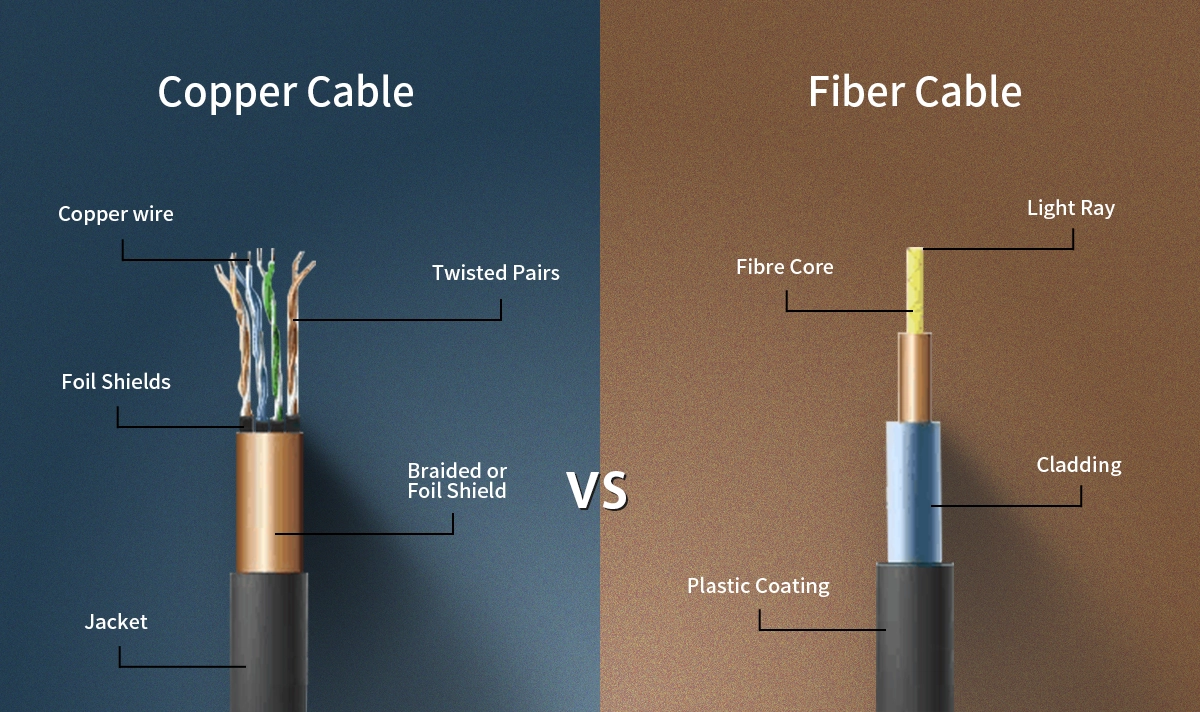
Fiber Optic Cable Structure
When you look inside a fiber optic cable, you find a core made from optically pure glass or plastic. This core is about as thin as a human hair. Around the core, there is a layer called cladding. The cladding keeps light signals inside the core by reflecting them back. You also see protective coatings, such as plastic or gel-filled sleeving, and sometimes even kevlar for extra strength. These layers protect the cable from damage and make it suitable for many environments. Fiber optic cables use light pulses, created by lasers or LEDs, to send data. The light travels through the core, bouncing off the cladding, and reaches its destination with very little loss.
Core: Glass or plastic fiber
Cladding: Reflects light back into the core
Protective layers: Plastic, gel, kevlar
Transmission: Light pulses
Copper Cable Structure
A copper cable uses thin strands of copper twisted together. These strands form the core, which carries electrical signals. The core is surrounded by insulation to prevent short circuits and protect the signal. Some copper cables have extra layers, like splines, for added strength. You often see copper cables in forms like twisted pair or coaxial, each designed for specific uses. Copper cables transmit data using electricity, which moves through the metal conductors.
Core: Twisted copper strands
Insulation: Protects and separates wires
Extra layers: For strength and durability
Transmission: Electrical signals
Physical Differences
You notice clear physical differences between fiber optic cables and copper cables. Fiber optic cables are much thinner and lighter than copper cables. They are also more flexible and take up less space, making them easier to install and manage. Fiber optic cables can handle higher pulling tension and resist damage better because of their strength members. Copper cables, on the other hand, are thicker and heavier due to the metal inside. They are less flexible and need more room during installation.
Đặc tính | Cáp sợi quang | Copper Cables |
|---|---|---|
Trọng lượng | Lighter | Heavier |
Kích thước | Thinner | Thicker |
Linh hoạt | Linh hoạt hơn | Less flexible |
Cài đặt | Easier, less space needed | Needs more space |
Tip: If you want a cable that is easy to install and manage, fiber optic cables offer clear advantages in size, weight, and flexibility.
Advantages & Disadvantages: A Deeper Dive
Fiber Optic Cable Advantages:
Blazing Speed & Bandwidth: Handles massive data loads for cloud computing, HD video streaming, and large-scale data centers. Essential for bộ thu phát quang tốc độ cao triển khai.
Long-Haul Champion: No signal degradation over kilometers, ideal for campuses, ISPs, and WANs.
EMI/RFI Immunity: Performs flawlessly in electrically noisy environments (factories, hospitals).
Bảo mật nâng cao: Non-conductive and emits no signals, making physical tapping detectable.
Lightweight & Space-Saving: Smaller diameter boosts conduit capacity.
Độ trễ: Lower latency crucial for real-time applications (gaming, finance).
Simplified Cable Management:
Supports emerging technologies without rewiring.
Fiber Optic Cable Disadvantages:
Higher Initial Cost: Cabling, fiber optic transceiver modules, and installation expertise cost more.
Fragility: Glass fibers require careful handling during installation.
Complex Installation: Requires precision splicing/termination and specialized tools.
No Native Power: Cannot deliver PoE; devices need separate power.
Copper Cable Advantages:
Chi phí thấp hơn: Significantly cheaper cables and connectors.
Simpler Installation: Familiar technology, easier termination, standard tools.
PoE Capability: Powers devices (phones, cameras, APs) over the data cable.
Device Compatibility: Ubiquitous support for end-user devices.
Physical Durability: Tolerates rougher handling during installation.
Copper Cable Disadvantages:
Distance Limitations: Signal degradation requires repeaters/boosters beyond ~100m.
EMI/RFI Vulnerability: Susceptible to interference from motors, power lines, etc.
Bandwidth Ceiling: Limited capacity struggles with future high-speed demands.
Security Risks: Potential for electromagnetic eavesdropping.
Heavier & Bulkier: Consumes more space in pathways.
Where Each Technology Excels: Matching Cable to Application
Fiber Optic Cable is Best For:
Long-distance backbone connections (buildings, campuses, cities).
High-bandwidth environments (data centers, server farms, cloud infrastructure).
Electrically noisy locations (industrial plants, hospitals).
Secure networks (government, finance).
Future-proofing critical infrastructure.
Undersea communications.
Copper Cable is Best For:
Short-distance horizontal cabling (desktop to switch, typically <100m).
Local Area Networks (LANs) with moderate bandwidth needs.
Deploying Power over Ethernet (PoE) devices.
Cost-sensitive projects where top speed/distance isn’t critical.
Legacy device connectivity.
Unlock Fiber’s Potential with LINK-PP Optical Transceivers

Fiber optic networks rely on high-quality optical transceivers to convert signals reliably. LINK-PP delivers industry-leading, tuân thủ tiêu chuẩn MSA transceivers known for performance and cost-effectiveness. Selecting the right LINK-PP transceiver module is vital – consider loại sợi quang (Đơn chế độ so với đa chế độ), 100G, bước sóng, and yếu tố hình dạng. Here are key LINK-PP transceiver modules:
SFP+: (10G) Essential for 10 Gigabit Ethernet. Models: LS-MM8510-S3C (MM), LS-SM3110-10C (SM).
SFP28: (25G) The backbone of modern data center access layers. Model: LS-MM8525-S1C.
QSFP28: (100G) Powers high-density data center cores/aggregation. Models: LQ-M85100-SR4C.
Investing in genuine LINK-PP fiber optic transceivers ensures compatibility, reliability, optimal network performance, and protects your warranty. Lựa chọn đúng LINK-PP transceiver model for your . Mô-đun cụ thể này được thiết kế dành cho các ứng dụng mật độ cao và mang lại hiệu suất xuất sắc trong các liên kết is crucial for achieving the maximum benefits of your fiber cabling.
Choosing the Right Cable: Key Considerations
Yêu cầu về băng thông: What speeds do you need now? What will you need in 3-5 years? (Think khả năng nâng cấp trong tương lai).
Khoảng cách: How far do you need to transmit data without amplification/repeaters?
Môi trường:
Is there significant EMI/RFI? Is security a top concern? Harsh conditions?Ngân sách: Consider total cost of ownership (TCO) – include cable, connectors, bộ thu phát quang (for fiber), switches, installation labor, and future upgrade costs, not just initial cable cost.
Ứng dụng: Is PoE needed? Is it for backbone, horizontal cabling, or device access?
The Hybrid Reality
Most modern networks aren’t exclusively fiber or copper; they leverage both strategically:
Đường cáp quang lõi: Handling high-speed, long-distance traffic between critical points (e.g., MDF to IDFs, data center cores).
Copper Edge: Delivering connectivity and power to end-user devices and access points.
Conclusion: It’s About Your Needs
There’s no absolute “winner” – the best choice depends on your specific application:
Choose Fiber Optic Cable when you need maximum bandwidth, long distances, immunity to interference, enhanced security, low latency, and long-term scalability. Partnering with a reliable supplier for bộ thu phát quang hiệu năng cao, như LINK-PP, is crucial for unlocking fiber’s full potential.
Choose Copper Cable for cost-effective device connectivity, shorter runs, PoE delivery, and leveraging existing infrastructure where performance suffices.
Ready to Optimize Your Network Infrastructure?
LINK-PP provides not only a wide array of high-quality, compatible optical transceiver modules (like the SFP-10G-LR, QSFP28-100G-SR4, and beyond) but also the expertise to help you design and implement the optimal hybrid cabling strategy. Don’t let your cabling become the bottleneck.
Xem Thêm
Tham gia và khám phá Ngay Hôm Nay Cộng đồng Sôi động của LINK-PP