















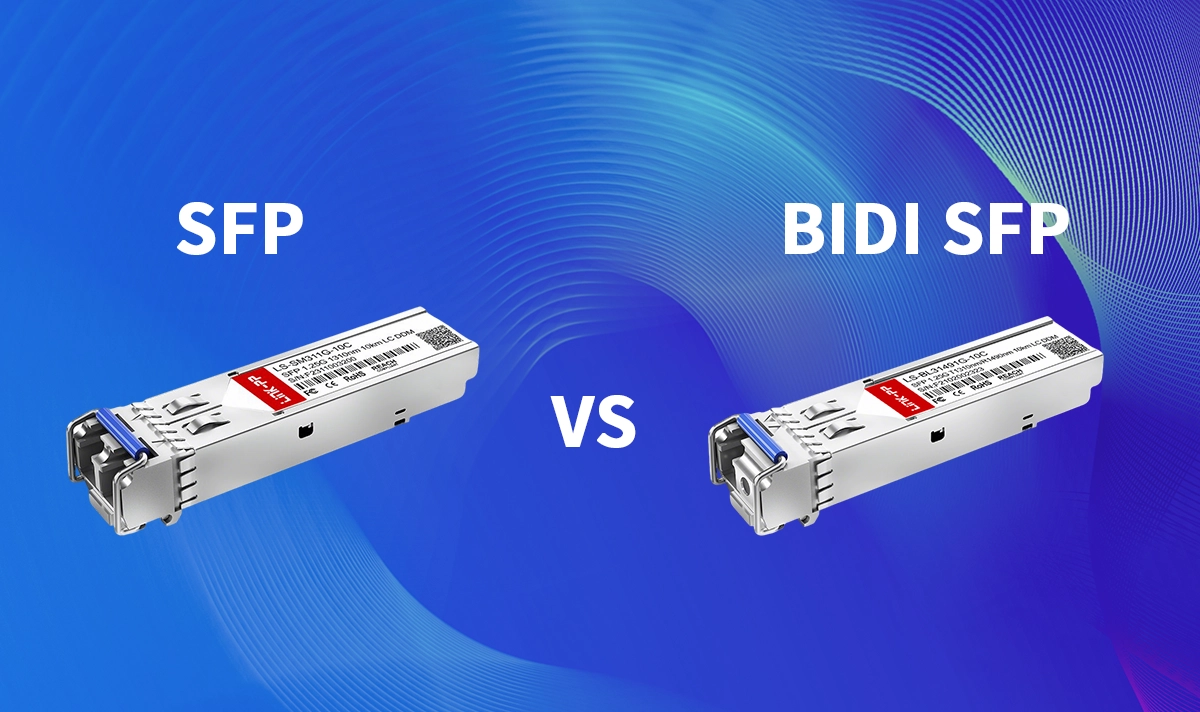
Tổng quan: Hiểu rõ sự khác biệt giữa SFP (Small Form-factor Pluggable) and BiDi SFP (Bidirectional SFP) transceivers is crucial for efficient and cost-effective network design. While both are compact fiber optic modules for switches and routers, BiDi SFPs uniquely enable bidirectional data transmission over a single fiber strand sử dụng Đa hợp phân chia theo bước sóng (WDM), contrasting with standard SFP modules requiring two fibers. This article delves into their core technologies, key differences, ideal applications, and how choosing the right module, such as those from LINK-PP, optimizes your fiber infrastructure.
Những điểm chính cần ghi nhớ
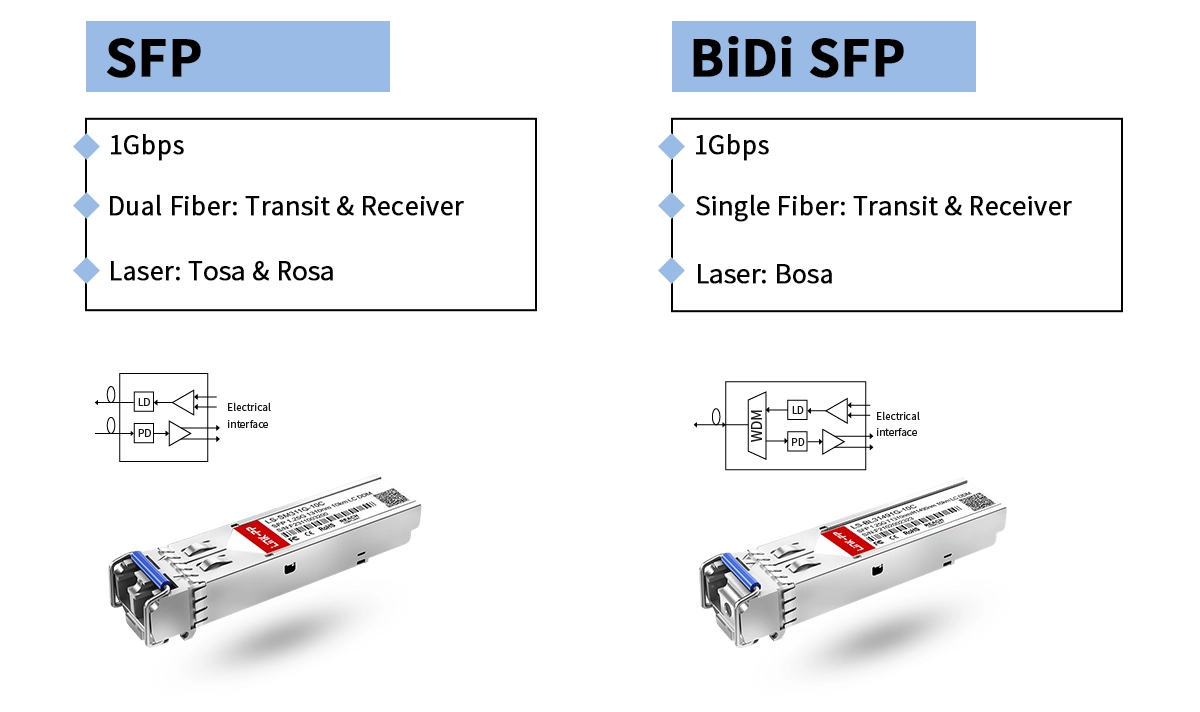
Các mô-đun SFP use two fibers. One fiber sends data. The other fiber receives data. BiDi SFP modules use only one fiber for both ways. They send signals at different wavelengths.
BiDi SFP modules help save fiber. They make the network less complex. They are good when fiber is hard to get or costs a lot. But you need matched pairs and devices that work with them.
SFP modules work with many devices and fiber types. This makes them a good choice for big or mixed networks.
Both types of modules have similar speeds and distances. Pick one based on your fiber, money, and what devices you have.
Check your network equipment and fiber type before you choose. This helps your network work well and makes upgrades easier.
1. Understanding the Basics: SFP Modules
Tiêu chuẩn Các mô-đun SFP are the workhorses of modern fiber optic networking. These các bộ thu phát có thể cắm nóng convert electrical signals from network devices into optical signals for transmission over fiber optic cables and vice versa. They plug into SFP ports on switches, routers, and media converters.
Key Function: Duplex communication over two fibers.
Transmission Principle: One fiber is dedicated solely to transmitting data (Tx), and the other fiber is dedicated solely to receiving data (Rx).
Common Applications: Short to long-range connections within data centers, enterprise networks, telecom backhaul, and FTTH (Fiber to the Home) deployments.
Bước sóng: Typically use matching wavelengths on each end (e.g., 850nm for multimode short-range, 1310nm or 1550nm for single-mode long-range).
Ưu điểm: Simplicity, widespread availability, compatibility, and well-understood technology. Ideal where fiber pairs are readily available.
2. The BiDi SFP Innovation: Single Fiber Solutions
Các module SFP BiDi (Bidirectional) solve a critical challenge: fiber scarcity. They achieve full-duplex communication using just một sợi quang đơn, từ đó nhân đôi khả năng của cơ sở hạ tầng cáp quang hiện có.
.
Công nghệ cốt lõi: Đa hợp phân chia theo bước sóng (WDM).
Transmission Principle:
Each BiDi SFP uses two different wavelengths.
On one end, the module transmits on wavelength λ1 (e.g., 1310nm) and receives on wavelength λ2 (e.g., 1550nm).
Ở phía opposite end of the same fiber link, a paired BiDi SFP transmits on λ2 (1550nm) and receives on λ1 (1310nm).
This allows simultaneous upstream and downstream data flow over the single fiber without interference.
Yêu cầu then chốt: SFP BiDi must be used in matched pairs with complementary wavelengths (e.g., one “TX1310/RX1550” module and one “TX1550/RX1310” module).
Primary Advantage: Halves the fiber count required per link, maximizing existing infrastructure and reducing costs for new deployments where fiber is expensive or limited.
3. Key Differences Between SFP and BiDi SFP
Understanding the technical and practical distinctions is vital for selection.
Đặc tính | Standard SFP Module | BiDi SFP Module |
|---|---|---|
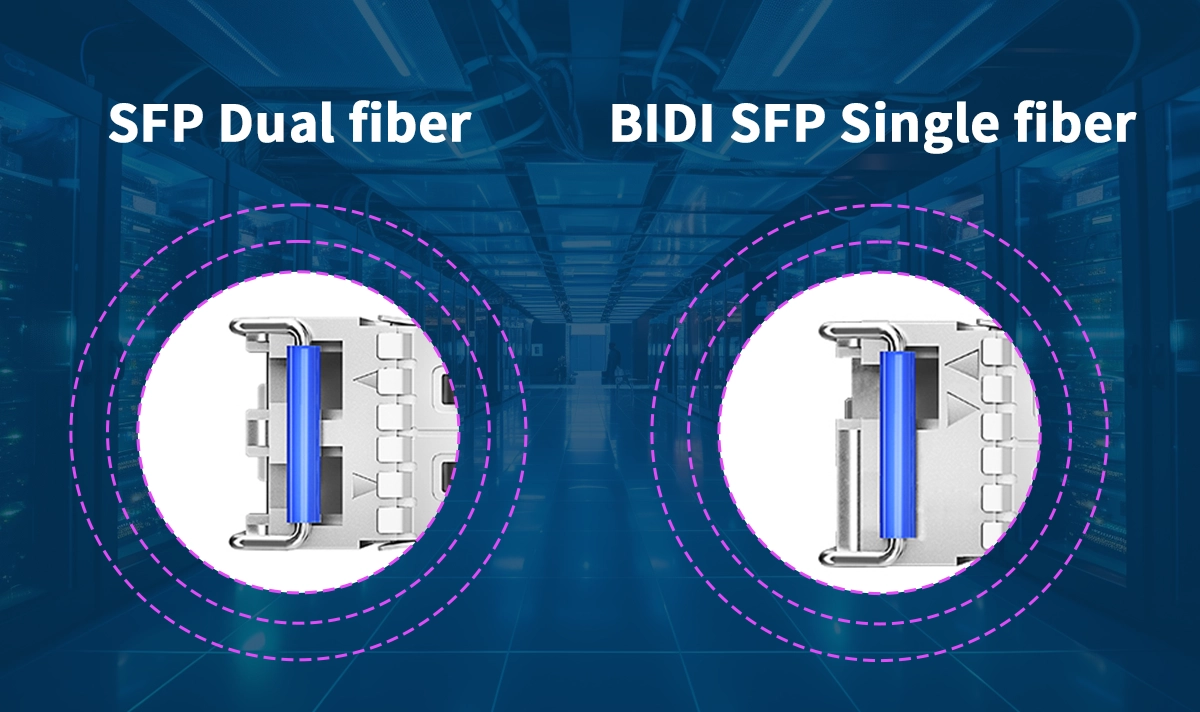
Số sợi | Yêu cầu 2 sợi (1 kênh phát, 1 kênh thu) | Yêu cầu 1 fiber strand |
Bước sóng | Same Tx/Rx wavelength on each end | Các loại Tx/Rx wavelengths; Requires matched pair (e.g., 1310nm/1490nm & 1490nm/1310nm) |
Nguyên lý | Duplex (Separate Tx/Rx fibers) | Bidirectional (WDM over single fiber) |
Cài đặt | Simpler; Modules identical at both ends | Quan trọng: Must install correctly paired modules (A-end & B-end) |
Chi phí (cáp quang) | Higher (Uses 2 fibers per link) | Lower (Uses 1 fiber per link); Saves significant fiber infrastructure costs |
Chi phí (module) | Generally lower per unit | Slightly higher per module (due to WDM filters) |
Trường hợp sử dụng chính | Where fiber pairs are abundant | Where fiber is limited or expensive (e.g., long-haul, leased lines, building risers) |
Các tiêu chuẩn phổ biến | 1000BASE-SX, 1000BASE-LX, 10GBASE-SR, 10GBASE-LR | 1000BASE-BX10, 1000BASE-BX20, 1000BASE-BX40, 10GBASE-BX10, 10GBASE-BX20, 10GBASE-BX40 |
4. When to Choose SFP vs. BiDi SFP: Application Scenarios
Selecting the right bộ thu phát quang sợi (fiber optic transceiver)
depends on your network’s specific constraints and goals.
Choose Standard SFP Modules When:
Bạn đã plenty of available fiber pairs trong cơ sở hạ tầng của bạn.
Simplicity and ease of deployment/management are top priorities (no need for wavelength matching).
You require compatibility with a vast array of existing equipment using standard interfaces.
Cost per module is the primary driver (though total fiber cost might be higher).
Common uses: Trung tâm dữ liệu server-to-switch links, intra-building backbone where fiber is abundant, enterprise network access layer.
Choose BiDi SFP Modules When:
Fiber resources are scarce or expensive to install (e.g., leased lines, long-distance links, congested conduits, building risers).
Bạn cần maximize capacity on existing single-fiber runs.
Khả năng nâng cấp trong tương lai for potential fiber exhaust is a concern.
Ứng Dụng: Fiber to the Home (FTTH) backhaul, Metro/Ethernet Access Networks, Cellular Backhaul, Enterprise WAN links between buildings, Upgrading legacy single-fiber links, Môi trường mật độ cao environments where fiber management is complex.
Optimizing Your Fiber Infrastructure? LINK-PP Offers the Solution Advantages of Using 1G BiDi SFPs: The Compelling Case
Whether you need standard duplex SFP của bên thứ ba or advanced
5. Selecting the Right Module: Compatibility and LINK-PP Solutions
Choosing compatible bộ quang SFP là điều bắt buộc để đảm bảo độ ổn định mạng.
Compatibility is Paramount: Always ensure modules are compatible with your specific switch, router, or media converter brand and model. While adhering to Hiệp định Nguồn Nhiều (MSAs) helps, vendor-specific coding can sometimes be a factor.
Wavelength Matching (BiDi Critical): For BiDi, precisely match the Tx/Rx wavelengths at both ends of the link (e.g., 1490nm/1310nm at one end, 1310nm/1490nm at the other). Mismatched pairs will not work.
Loại cáp quang: Both standard and BiDi SFPs are primarily designed for và sợi quang đơn mode (SMF). While some standard SFPs use multimode fiber (MMF), BiDi technology fundamentally relies on the characteristics of single fiber and WDM.
Yêu cầu khoảng cách: Check the module’s supported distance (e.g., 10km, 20km, 40km, 80km – denoted by standards like BX10, BX40) and ensure it meets your link length, factoring in attenuation and dispersion.
Tốc độ dữ liệu: Match the module’s speed (1G, 10G, 25G etc.) to your port and application requirements.
Vì sao nên chọn bộ thu phát quang LINK-PP?
Đảm bảo tương thích: Rigorously tested for seamless operation with major OEM equipment.
Phạm vi sản phẩm toàn diện: From standard SFP, SFP+ to advanced BiDi SFP, BiDi SFP+, CWDM, and DWDM solutions.
High Reliability & Performance: Built to MSA standards, ensuring low tỷ lệ lỗi bit (BER) and stable operation.
Hiệu quả chi phí: Significant savings vs. OEM modules without sacrificing quality or warranty.
Hỗ trợ chuyên gia: Technical assistance to help you select the perfect bộ thu phát quang, như LINK-PP LS-BL273310-40C for demanding 40km single-fiber links.
Maximize Your Network Efficiency with LINK-PP
Understanding the fundamental difference between SFP and BiDi SFP empowers you to make smarter, more economical decisions for your fiber optic infrastructure. While standard SFPs remain essential for duplex fiber pairs, BiDi SFPs are the indispensable solution for overcoming fiber scarcity, dramatically reducing costs, and maximizing the utilization of your existing single-mode fiber plant.
Các câu hỏi thường gặp (FAQ)
What is the main difference between SFP and BiDi SFP modules?
You use two fibers with SFP modules—one for sending and one for receiving. BiDi SFP modules let you use just one fiber for both directions. This saves fiber and makes your network simpler.
Can you mix SFP and BiDi SFP modules in the same network?
You can use both types in the same network, but not on the same link. Each link must use either two SFP modules or a matched pair of BiDi SFP modules. Mixing them on one link will not work.
Which module should you choose if fiber is limited?
You should pick BiDi SFP modules. They let you send and receive data on a single fiber. This helps you double your network capacity without adding more cables.
Are BiDi SFP modules compatible with all switches?
Not all switches support BiDi SFP modules. You need to check your switch’s specifications. Some switches require specific brands or models for BiDi SFP compatibility.
Do SFP and BiDi SFP modules support the same speeds and distances?
Both SFP and BiDi SFP modules support similar data rates and distances. You can find options for 1G, 10G, and even higher speeds in both types. Always check the specs for your needs.