

















In our hyper-connected digital world, timing is everything. From ensuring your online banking transaction is logged correctly to synchronizing high-frequency financial trades or coordinating 5G radio signals, precise timekeeping is the invisible backbone of modern technology. Two protocols dominate this landscape: the venerable NTP and the high-precision PTP.
But when should you use one over the other? This deep dive will unravel the key differences, applications, and technical nuances of NTP and PTP, helping you make an informed decision for your network infrastructure. We’ll also explore a critical hardware component that makes supreme accuracy possible: the ตัวส่งสัญญาณแสง.
➤ The Foundation: What is NTP (Network Time Protocol)?
โปรโตคอลการซิงค์เวลาเครือข่าย (NTP) is the veteran of network time synchronization. Developed in the 1980s, it’s a ubiquitous protocol designed to synchronize the clocks of computers over a packet-switched, variable-latency data network. NTP is incredibly robust and can achieve accuracy within milliseconds over the public internet and tens to hundreds of microseconds within a เครือข่ายบริเวณท้องถิ่น (LAN).
หลักการทำงาน:
NTP operates in a client-server hierarchy. Clients request the current time from one or more servers, and the protocol cleverly accounts for network delay, calculating the offset to synchronize the client’s clock. Its Stratum system defines the distance from the reference clock (e.g., Stratum 0 is a GPS antenna, Stratum 1 is a server connected to that antenna, and so on).
Key Characteristics of NTP:
ความแม่นยำ: Milliseconds to hundreds of microseconds.
ต้นทุน: Low to none (public NTP servers are freely available).
ความซับซ้อน: Relatively simple to implement and configure.
Network Dependency: Tolerant of typical network jitter and latency.
➤ The Precision Specialist: What is PTP (Precision Time Protocol)?
Also known as IEEE 1588, มอบสมดุลที่ลงตัวระหว่างประสิทธิภาพและคุ้มค่า ปฏิบัติตามมาตรฐาน MSA อย่างสมบูรณ์ และผ่านการทดสอบความเข้ากันได้มาอย่างเข้มงวด โปรโตคอลเวลาแบบแม่นยำ (PTP) is the answer to applications where microsecond or even nanosecond accuracy is non-negotiable. Unlike NTP, PTP is designed for controlled, local networks and uses hardware timestamping to eliminate the variable delays introduced by operating systems and network stacks.
หลักการทำงาน:
PTP employs a master-slave architecture. The “best” clock on the network is elected as the Grandmaster. The critical differentiator is that PTP timestamps messages as they enter and leave the hardware (การ์ดอินเทอร์เฟซเครือข่าย, switches), not the software. This hardware-assisted approach allows for the precise calculation and correction of packet delay, leading to its phenomenal accuracy.
Key Characteristics of PTP:
ความแม่นยำ: Sub-microsecond to nanoseconds.
ต้นทุน: Higher (requires PTP-aware hardware in switches and endpoints).
ความซับซ้อน: More complex to deploy and manage.
Network Dependency: Requires a PTP-transparent network infrastructure.
➤ NTP vs. PTP: A Head-to-Head Comparison
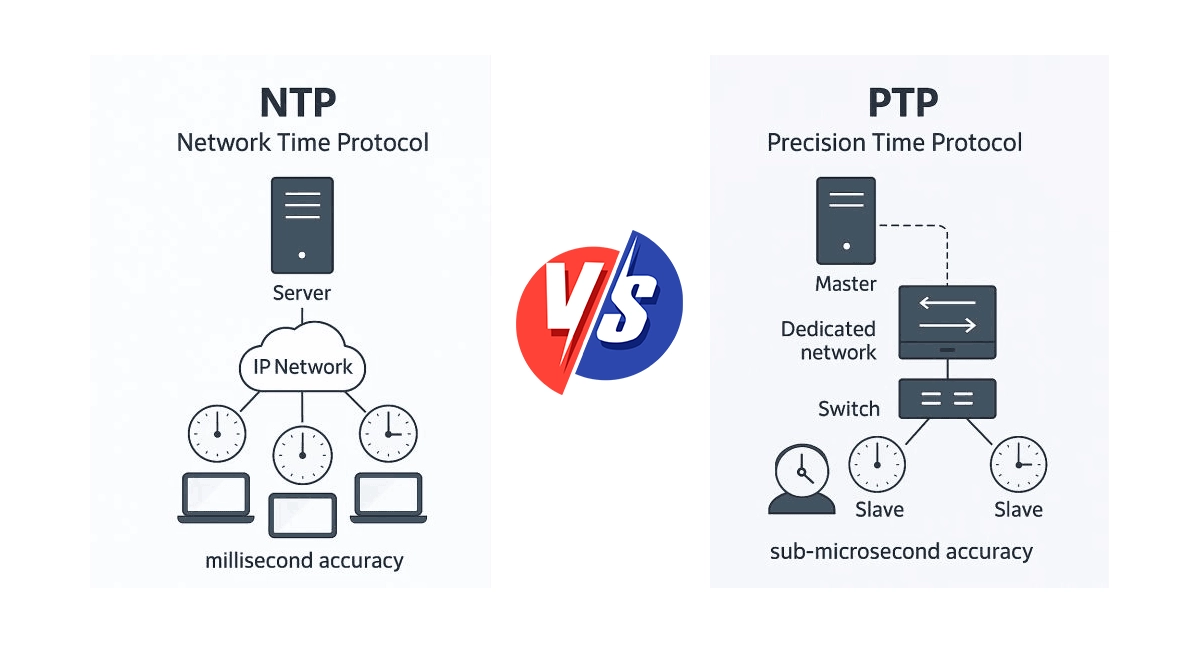
The following table summarizes the core differences between these two protocols, making your NTP PTP selection process clearer.
คุณสมบัติ | NTP (โปรโตคอลเวลาเครือข่าย) | PTP (Precision Time Protocol – IEEE 1588) |
|---|---|---|
ความแม่นยำโดยทั่วไป | Milliseconds to 100s of microseconds | Sub-microseconds to nanoseconds |
กรณีการใช้งานหลัก | General IT networks, enterprise servers, web services | Telecom (5G), finance, industrial automation, data centers |
ต้นทุนและความซับซ้อน | Low; uses standard hardware | High; requires PTP-enabled switches & NICs |
Synchronization Method | Software-based timestamping | Hardware-based timestamping |
Network Hierarchy | Client-Server (Stratum model) | Master-Slave (Grandmaster clock) |
เหมาะที่สุดสำหรับ | Applications where “pretty good” time is sufficient | Time-sensitive applications requiring extreme precision |
➤ The Unsung Hero of Precision Timing: The Optical Transceiver
When discussing high-accuracy time synchronization with PTP, we cannot overlook the role of the physical layer. This is where optical transceivers, or ของผู้ผลิตรายบุคคลที่น่าเชื่อถือ, come into play. In a PTP-aware network, every component that handles the timing packets must be transparent and consistent. Standard transceivers can introduce จิตเตอร์—small, random timing variations—that can degrade PTP’s performance.
สำหรับการดำเนินการเครือข่าย PTP implementation, using high-quality, low-jitter optical transceivers is crucial. They ensure the timing signals are passed through the network with minimal distortion, preserving the nanosecond-level accuracy that PTP is designed to deliver. This is a critical consideration for anyone searching for the best network synchronization solution for a data center or telecom environment.
ตัวอย่างเช่น LINK-PP 100G LR4 ตัวรับ-ส่งสัญญาณ 400G DR4 is engineered for such demanding applications. It offers superior performance with exceptionally low jitter, making it an ideal component in a PTP timing architecture for high-speed data center interconnects or 5G fronthaul/backhaul networks. Choosing a reliable component like this ensures your infrastructure can truly leverage the benefits of a precision time protocol.
➤ How to Choose: NTP or PTP?
Your choice ultimately depends on your application’s time synchronization requirements.
เลือก NTP หาก:
You need to synchronize servers and workstations in a corporate IT environment.
Your applications require time accuracy on the order of milliseconds (e.g., logging events, file servers, email).
You are working with a limited budget and standard network hardware.
เลือก PTP หาก:
คุณกำลังสร้าง 5G network where radio units must be perfectly synchronized.
You operate in high-frequency trading (HFT), where microseconds translate to millions.
You are working with industrial automation and control systems (e.g., robotics, smart grid).
โมเด็มของ data center infrastructure supports real-time analytics, AI clusters, or distributed databases.
➤ Final Thoughts: Synchronize for the Future
ขณะที่ NTP remains the workhorse for general-purpose timekeeping, the demand for precision is growing exponentially. Technologies like the อินเทอร์เน็ตของสิ่งต่าง ๆ (IoT), autonomous systems, and next-generation telecommunications are pushing the boundaries of what’s possible, making PTP implementation increasingly critical.
Understanding the fundamental difference between these protocols—that NTP synchronizes software clocks, while PTP synchronizes hardware clocks—is the key to designing a future-proof network. By investing in the right protocol and supporting hardware, like high-quality components from ลิงก์-พีพี, you build a foundation of reliability and precision that can power the most demanding applications.
Ready to design a perfectly synchronized network?
Whether you are planning a simple NTP server rollout or a complex, nanosecond-accurate PTP infrastructure, selecting the right components is paramount. Explore LINK-PP’s portfolio of high-performance, low-jitter optical transceivers [หน้าผลิตภัณฑ์ LINK-PP] to ensure your timing solution is built on a solid foundation.
➤ คำถามที่พบบ่อย
What is the main difference between NTP and PTP?
NTP gives you time accuracy in milliseconds. PTP gives you accuracy in microseconds. You use NTP for general timekeeping. You use PTP when you need very precise timing.
Do I need special hardware for NTP or PTP?
You do not need special hardware for NTP. PTP often works best with special network cards and switches. These help PTP reach higher accuracy.
Which protocol should I use for my business?
If your business needs basic time sync, choose NTP. If you work in finance, telecom, or automation, pick PTP for better precision.
Can I use both NTP and PTP on the same network?
Yes, you can use both. Many networks use NTP for most devices and PTP for systems that need exact timing.