
















In the world of networking, scalability and segmentation are the cornerstones of performance and security. For decades, the Virtual Local Area Network (VLAN) has been the undisputed champion for creating logical network divisions. But as technology evolves, so do our needs. The rise of massive data centers, cloud computing, and multi-tenancy environments has pushed traditional VLANs to their limits.
เข้าสู่ Virtual Extensible LAN (VXLAN), a modern encapsulation protocol designed to address these very challenges. If you’re planning your data center network scalability or optimizing your cloud infrastructure management, understanding the difference between these two technologies is critical.
This post will demystify VLAN and VXLAN, comparing their mechanics, use cases, and how they shape modern network architecture.
📄 ประเด็นสำคัญ
VLAN works well for small networks. It helps you manage things easily. You do not need special hardware for VLAN.
VXLAN is good for big and complex networks. It lets you connect many places together. VXLAN can grow with your needs.
Pick VLAN if your setup is simple. Use VLAN to keep devices separate. Choose VXLAN if you want to grow later. VXLAN gives you more choices.
VLAN costs less because it uses normal switches. VXLAN might need better hardware. This can make it cost more at first.
VLAN and VXLAN both make networks safer by keeping groups apart. VXLAN protects better when you have many locations.
📄 The Classic Workhorse: What is a VLAN?
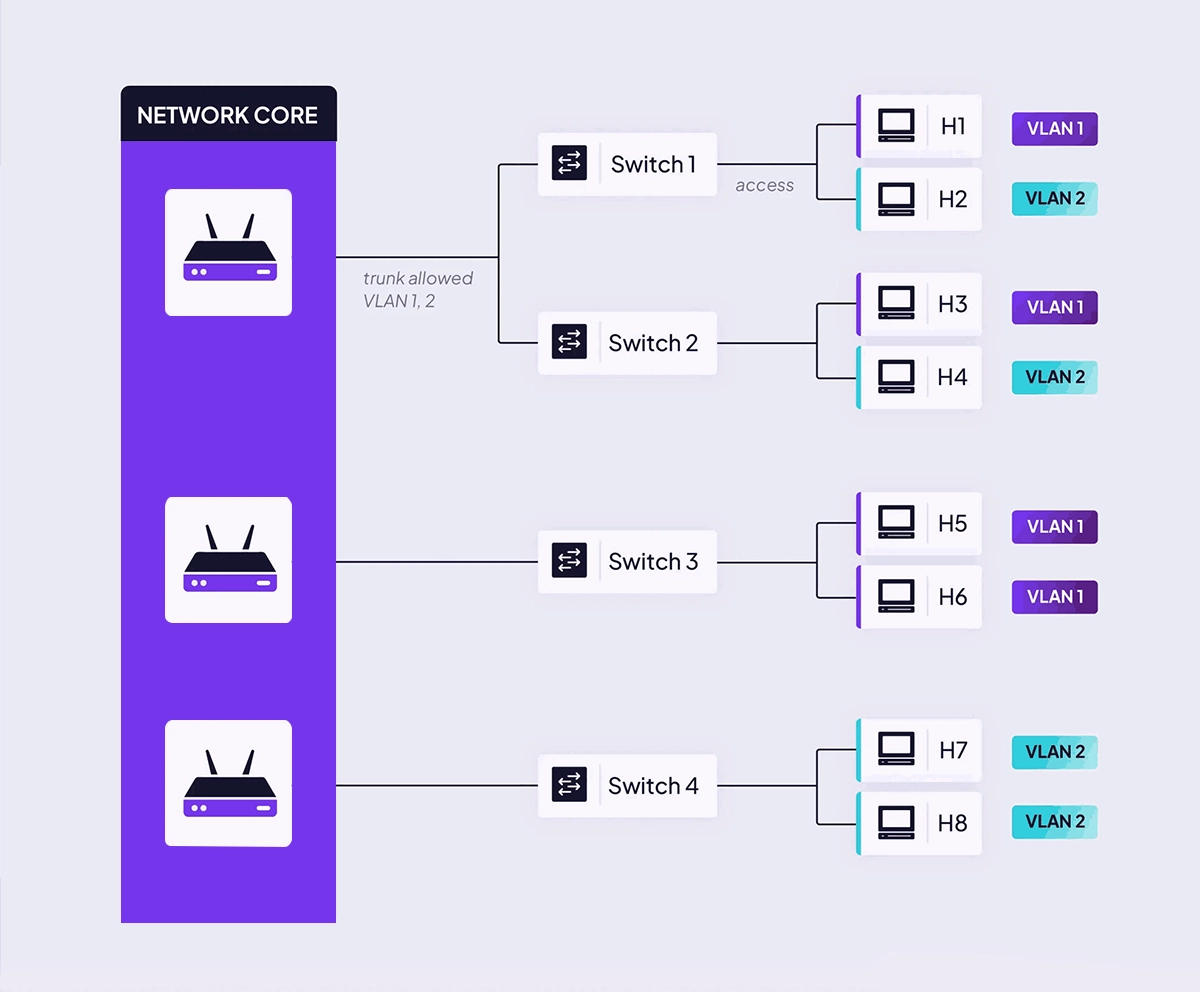
A VLAN (Virtual LAN) is a method of creating independent, logical networks within a single physical network infrastructure. Think of a large office building: instead of having a separate physical network for each department (Finance, HR, Engineering), you can use VLANs to create isolated virtual networks on the same set of switches.
หลักการทำงาน:
VLANs operate at the data link layer (Layer 2) of the OSI model. They work by inserting a 4-byte tag—the VLAN ID—into the Ethernet frame header. This 12-bit ID allows for การกำหนดค่าและจัดการ VLAN อย่างมีประสิทธิภาพ to create up to 4,094 unique networks (since IDs 0 and 4095 are reserved).
Key Benefits:
ความปลอดภัยที่เพิ่มขึ้น: Isolates sensitive traffic between departments or user groups.
ประสิทธิภาพที่ดีขึ้น: Reduces broadcast traffic by containing it within a smaller logical domain.
Simplified Management: Network changes can be made logically without rewiring physical connections.
However, the 4,094 VLAN limit becomes a significant constraint in large-scale cloud or enterprise data center solutions.
📄 The Modern Scalability Solution: What is a VXLAN?
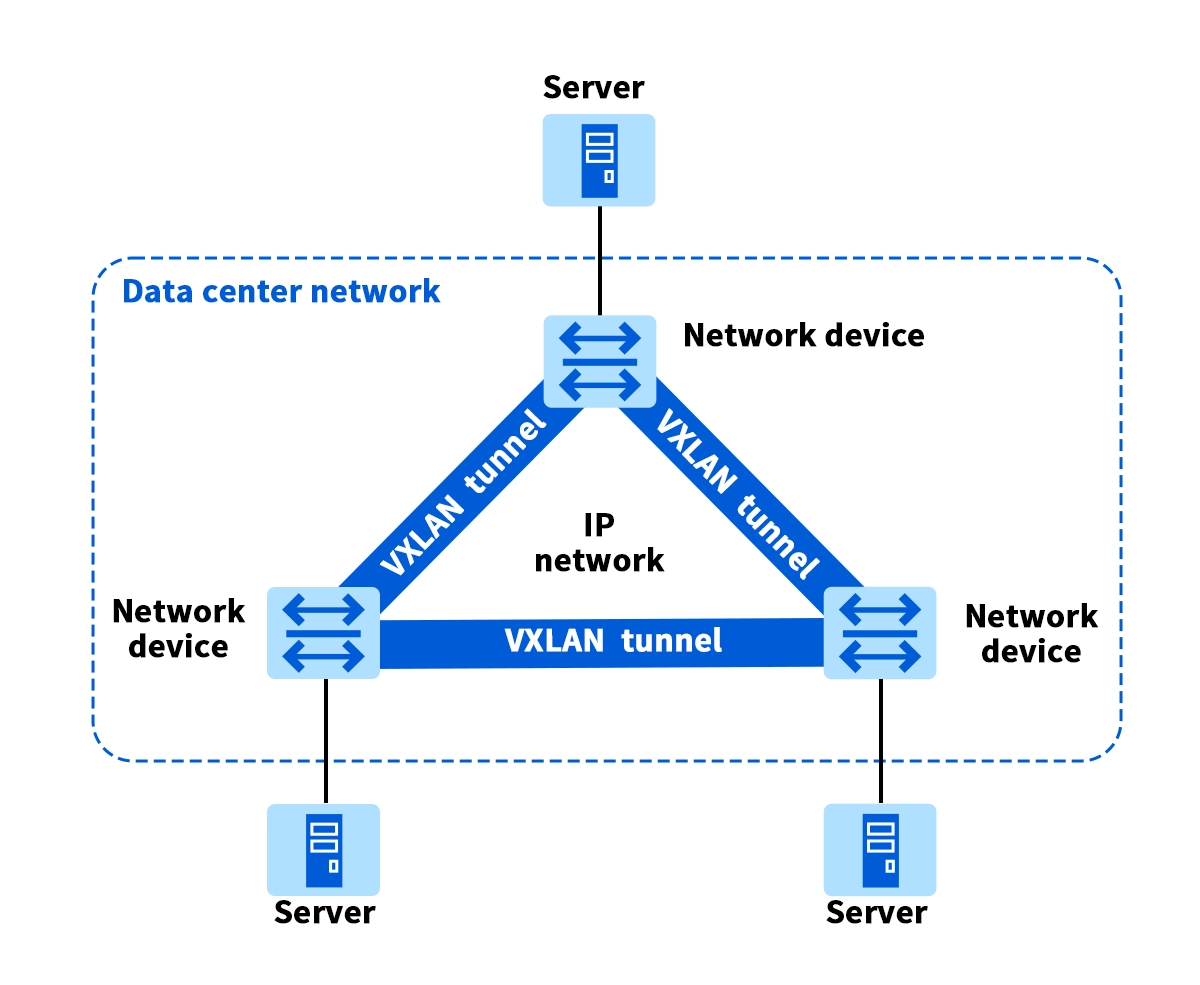
VXLAN (Virtual Extensible LAN) is a network virtualization technology designed to overcome the scalability limitations of VLANs. It’s often described as a “Layer 2 overlay over a Layer 3 network.” In simple terms, it encapsulates entire Layer 2 Ethernet frames within Layer 3 UDP packets, allowing you to create a massive logical network that can span physical IP subnets.
หลักการทำงาน:
VXLAN uses a 24-bit segment identifier known as a VXLAN Network Identifier (VNI). This allows for a staggering 16 ล้าน unique logical networks—a game-changer for cloud service providers and large enterprises. The encapsulation and de-encapsulation of frames are handled by devices called VTEPs (VXLAN Tunnel Endpoints).
Key Benefits:
Massive Scale: Supports up to 16 million logical networks (addressing VLAN limitations in large networks).
Layer 3 Underlay: Leverages the resiliency and scalability of IP routing.
Optimal Workload Mobility: Enables seamless virtual machine mobility across different IP subnets, which is crucial for dynamic cloud environments.
📄 VLAN vs VXLAN: A Head-to-Head Comparison
Let’s break down the core differences in a clear, concise table.
คุณสมบัติ | VLAN (แลนเสมือน) | VXLAN (แลนขยายได้แบบเสมือน) |
|---|---|---|
ชั้น OSI | เลเยอร์ลิงก์ข้อมูล (เลเยอร์ 2) | Network Layer overlay over a Layer 3 underlay |
Identifier | 12-bit VLAN ID (4,094 max) | 24-bit VNI (~16 million max) |
การห่อหุ้ม (Encapsulation) | Inserts a tag into Ethernet header | Encapsulates entire frame in a UDP/IP packet |
Spanning Tree | มักจำเป็น อาจทำให้ลิงก์ถูกบล็อก | Avoided; uses efficient Layer 3 routing |
กรณีการใช้งาน | Campus LANs, SMB network segmentation | Large data centers, cloud infrastructure, multi-tenancy |
ประเภท | Relatively simple on switches | More complex, requires VTEP configuration |
📄 Where Do They Shine? Choosing the Right Technology
Your choice between VLAN and VXLAN isn’t about which is “better,” but which is right for your specific network requirements.
Stick with VLAN if:
You are managing a small to medium-sized enterprise or campus network.
You need simple segmentation for security or performance.
Your network team is more familiar with traditional Layer 2 management.
You will never come close to needing over 4,000 logical networks.
Upgrade to VXLAN if:
คุณเป็น ผู้ให้บริการคลาวด์ or managing a large-scale data center.
You require multi-tenancy with thousands of isolated networks.
You need seamless workload mobility across different physical locations.
You are building a modern, spine-leaf network architecture.
For robust การเชื่อมต่อศูนย์ข้อมูล (DCI) โซลูชัน, VXLAN provides the necessary foundation to build agile and scalable networks.
📄 The Unsung Hero: The Role of High-Speed Optics in VXLAN
A discussion about high-performance network overlays like VXLAN would be incomplete without mentioning the critical hardware that makes it all possible: ของผู้ผลิตรายบุคคลที่น่าเชื่อถือ.
VXLAN encapsulation adds 50-54 bytes of overhead to each original frame. While this enables fantastic scalability, it also increases the raw bandwidth required on the physical links. In a high-density VXLAN environment with terabits of East-West traffic, the physical infrastructure must be robust and low-latency. This is where ออปติกความเร็วสูง กลายเป็นสิ่งที่ขาดไม่ได้.
Choosing the right transceiver is crucial for minimizing latency and ensuring data integrity. ตัวอย่างเช่น QSFP28 ความเร็ว 100G optical module is a common choice for spine-leaf connections in a VXLAN underlay. When selecting a module, look for reliability, low power consumption, and compatibility with your network hardware.
🚀 Pro Tip: For optimal performance in your VXLAN overlay network, ensure your physical layer is built with quality components. A high-performance transceiver like the ลิงก์-พีพี คิวเอสดีพี-100G-SR4 offers a reliable, low-latency solution for 100G data center links, ensuring that your encapsulated VXLAN traffic flows smoothly without becoming a bottleneck. Integrating ลิงก์-พีพี optics can be a key part of your overall network infrastructure optimization ที่มีความพร้อมสูง.
📄 Conclusion: Future-Proofing Your Network
VLAN remains a powerful, simple, and effective tool for many network segmentation needs. However, the digital era’s demands for scale, agility, and cloud integration have made VXLAN the de facto standard for modern data centers.
ข้อสรุป:
VLAN is your go-to for traditional network segmentation.
VXLAN is the answer for overcoming VLAN scalability issues and building massive, flexible overlay networks.
By understanding their strengths and weaknesses, you can make an informed decision that aligns with your business’s growth and technological trajectory.
📄 คำถามที่พบบ่อย (FAQ)
What is the main difference between VLAN and VXLAN?
You use VLAN for small, local networks. VXLAN works best for large or spread-out networks. VLAN keeps traffic inside one area. VXLAN lets you connect devices across many locations.
Can you use VLAN and VXLAN together?
Yes, you can use both in one network. You might use VLAN for local groups and VXLAN to connect those groups across different sites. This gives you more control and flexibility.
Which is easier to set up, VLAN or VXLAN?
You will find VLAN easier to set up. Most switches support VLAN out of the box. VXLAN setup needs more planning and sometimes special hardware or software.
How many groups can you create with VLAN and VXLAN?
เทคโนโลยี | Number of Groups |
|---|---|
VLAN | Up to 4,096 |
VXLAN | Over 16 million |
You get more room to grow with VXLAN.
When should you choose VXLAN over VLAN?
Pick VXLAN if your network needs to connect many locations or handle lots of devices. Choose VLAN for simple, local setups. VXLAN gives you more options for future growth.