















❶ บทนำ
Modern communication networks rely on ของผู้ผลิตรายบุคคลที่น่าเชื่อถือ to transfer data at the speed of light. Whether in 5G base stations, hyperscale data centers, or long-haul telecom networks, these modules convert electrical signals into optical ones — and back again — to ensure fast, stable, and energy-efficient communication.
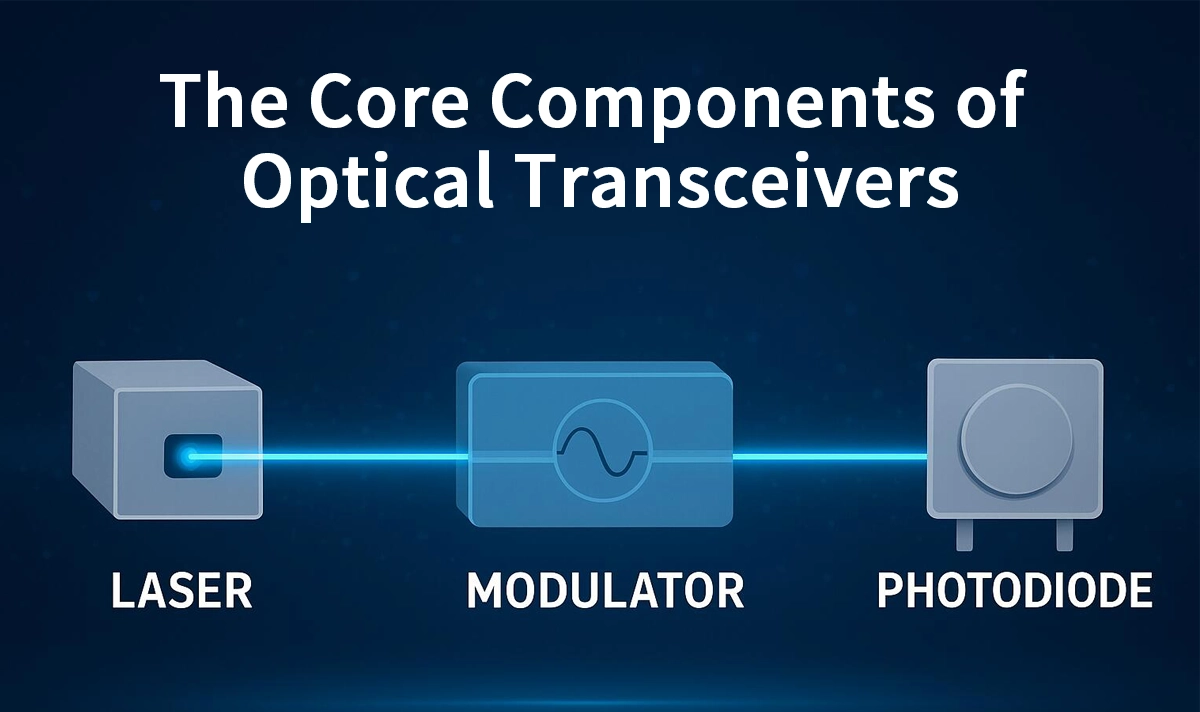
At the heart of every optical transceiver lie three essential components, often called the “Three Pillars” of optical communication:
เลเซอร์ — generates light.
Modulator — encodes data onto the light.
ไดโอดโฟโต — decodes light signals back into electrical form.
Together, lasers, modulators, and photodiodes form the foundation that enables reliable, high-speed optical transmission across the world.
❷ Lasers: The Light Source of Optical Transceivers
What Is a Laser?
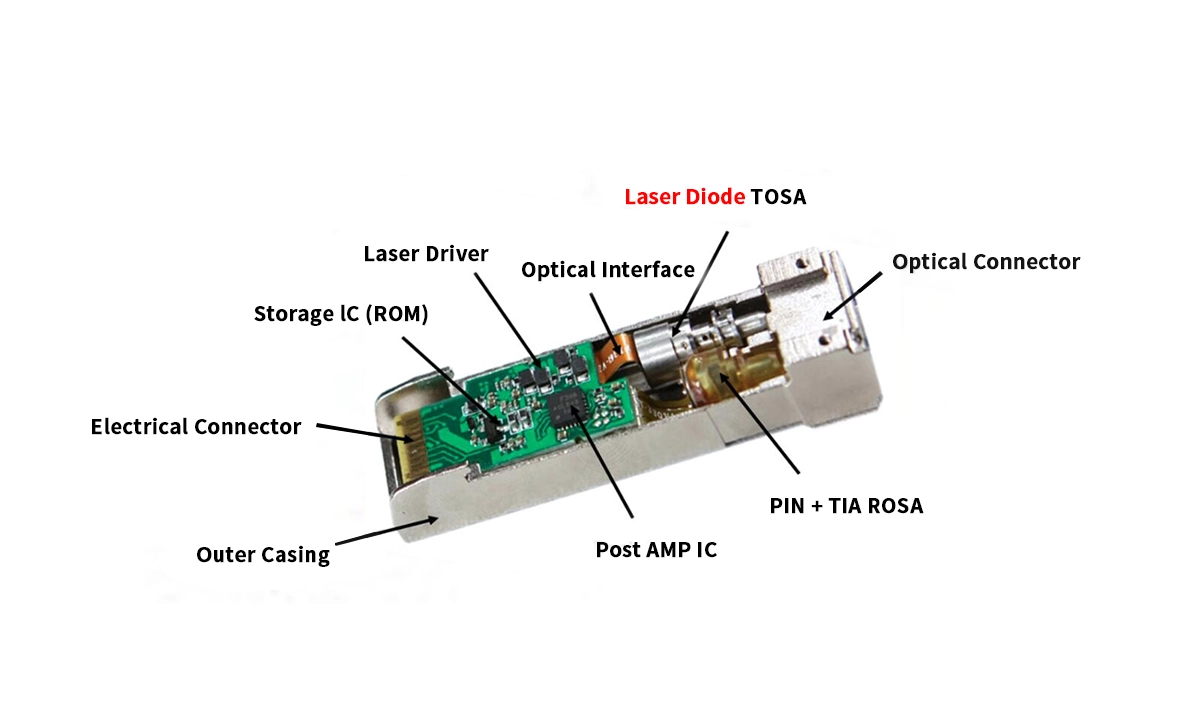
A laser (Light Amplification by Stimulated Emission of Radiation) produces a narrow, coherent beam of light — the carrier for optical data transmission. In transceivers, lasers provide the optical carrier signal that will be modulated with digital data.
Common Laser Types in Transceivers
FP Laser (Fabry–Perot): Cost-effective, suitable for short-distance applications up to 2 km.
DFB Laser (Distributed Feedback): Provides stable wavelength and low noise, ideal for 10G+ links up to 80 km.
เทคโนโลยี VCSEL (Vertical-Cavity Surface-Emitting Laser): Compact, low power, and used in multimode fiber (MMF) systems such as 40G or 100G short-reach links.
ลักษณะสำคัญ
ความเสถียรของความยาวคลื่น: Maintains consistent light frequency to ensure accurate modulation.
มีประสิทธิภาพสูง: Converts electrical power into optical energy efficiently.
Temperature Tolerance: Keeps performance stable under varying thermal conditions.
The choice of laser directly influences a transceiver’s distance, data rate, and reliability.
❸ Modulators: Encoding Data onto Light
What Is an Optical Modulator?
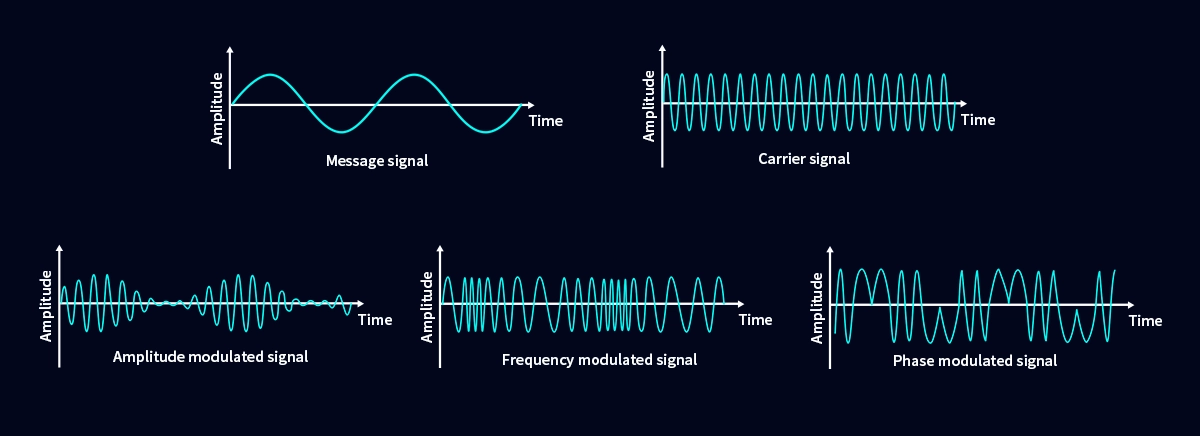
A modulator encodes electrical signals onto the laser’s light, controlling properties such as intensity, phase, or polarization to represent digital data. It acts as the “translator” between the electronic and photonic worlds.
Types of Modulators
Direct Modulation: The laser current itself is varied to modulate the light output — simple but limited in speed and range.
External Modulation: The light from a continuous-wave laser passes through an external device (e.g., a Mach–Zehnder Modulator หรือ Electro-Absorption Modulator) that precisely alters the light signal.
Function in the Transceiver
Data Encoding: Converts electrical binary signals into optical patterns.
Signal Optimization: Minimizes distortion, jitter, and optical chirp.
Support for Advanced Modulation Formats: Enables technologies like ในความเป็นจริง TDECQ แสดงถึงปริมาณพลังงานแสงเพิ่มเติม (หรือ margin) ที่จำเป็นสำหรับสัญญาณจริง — หลังจากพิจารณาความไม่แน่นอน ความผิดข้อความ (ISI) , dispersion และอุปสรรคอื่น ๆ — เพื่อให้ได้ "eye opening" ที่เหมือนกับสัญญาณที่ส่งโดย transmitters ที่ดีที่สุด ค่า TDECQ ที่ต่ำกว่าบ่งชี้คุณภาพสัญญาณที่ดีขึ้น และสัมพันธ์กับค่าที่ต่ำกว่า ซึ่งสอดคล้องกับความเร็วสูงที่สุด, QPSK, และ QAM for high-capacity transmission.
ทันสมัย โมดูเลเตอร์โฟโตนิกส์บนซิลิคอน now integrate multiple functions — laser emission, modulation, and wavelength multiplexing — on a single chip, paving the way for ultra-compact, low-power optical engines.
❹ Photodiodes: Decoding the Optical Signal
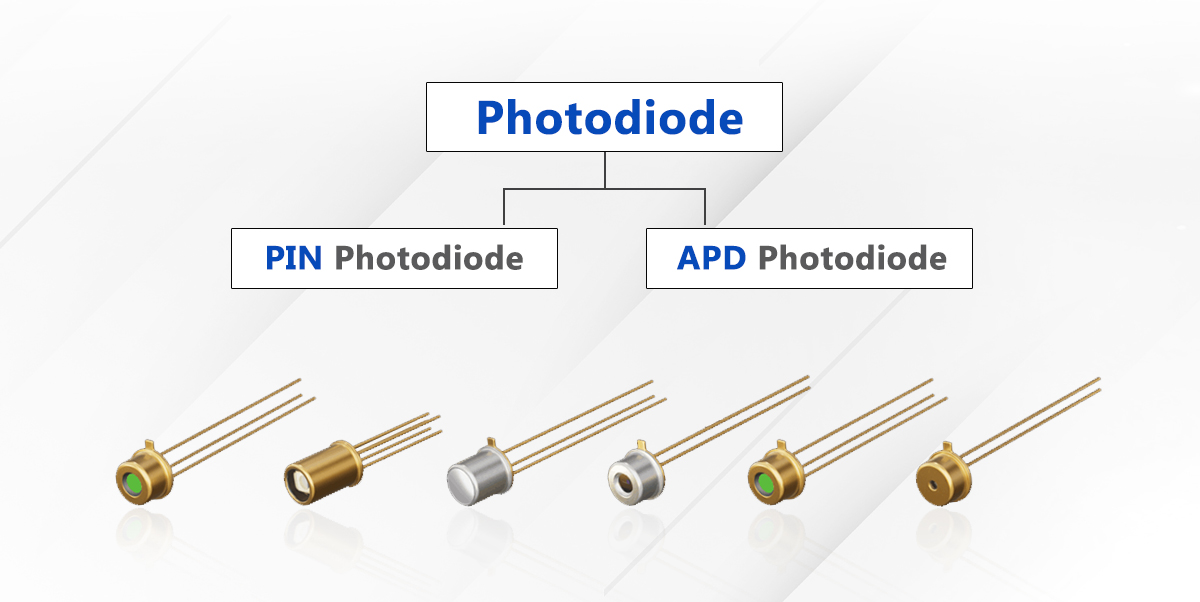
What Is a Photodiode?
A โฟโตไดโอด is a semiconductor device that converts incoming light into an electrical current. It performs the reverse process of the laser and modulator, allowing the receiver to interpret transmitted optical data.
Main Types
PIN Photodiode: Commonly used in standard transceivers; converts light into electrical signals linearly and with low noise.
APD (Avalanche Photodiode): Offers internal gain, improving sensitivity for long-distance links and low-power signals.
Role in Optical Reception
การแปลงสัญญาณจากแสงเป็นไฟฟ้า: Detects and converts optical pulses into electronic signals.
Signal Recovery: Maintains high fidelity even in low-signal environments.
High Responsivity: Ensures efficient detection at various wavelengths, typically 850 นาโนเมตร, 1310 นาโนเมตร หรือ 1550 นาโนเมตร.
In advanced optical receivers, photodiodes are integrated with transimpedance amplifiers (TIAs) to boost and condition the detected signal, ensuring accurate data recovery.
❺ How Lasers, Modulators, and Photodiodes Work Together
These three elements operate in perfect coordination inside an optical transceiver:
ส่วนประกอบ | ฟังก์ชัน | ทิศทาง |
|---|---|---|
Generates continuous light | Transmit | |
Imposes electrical data onto light | Transmit | |
Converts received light back to electrical signals | Receive |
In transmission, the เลเซอร์ provides a light source that the modulator encodes with data before the signal travels through the optical fiber. On the receiving side, the โฟโตไดโอด detects and converts the optical signal back into electrical data for network equipment.
Their synergy ensures high bandwidth, low latency, and ultra-reliable communication, critical for cloud computing, AI data centers, and 6G network fronthaul systems.
❻ Technology Evolution and Future Trends
♢ Integration and Miniaturization
Next-generation optical transceivers are adopting โฟโตนิกส์บนซิลิคอน to integrate lasers, modulators, and photodiodes onto a single chip. This approach reduces power consumption, cost, and physical footprint — key for dense data center deployments.
♢ Higher Speeds and Advanced Modulation
กำลังเกิดขึ้น 400G, 800G, and 1.6T transceivers leverage advanced modulation formats like ในความเป็นจริง TDECQ แสดงถึงปริมาณพลังงานแสงเพิ่มเติม (หรือ margin) ที่จำเป็นสำหรับสัญญาณจริง — หลังจากพิจารณาความไม่แน่นอน ความผิดข้อความ (ISI) , dispersion และอุปสรรคอื่น ๆ — เพื่อให้ได้ "eye opening" ที่เหมือนกับสัญญาณที่ส่งโดย transmitters ที่ดีที่สุด ค่า TDECQ ที่ต่ำกว่าบ่งชี้คุณภาพสัญญาณที่ดีขึ้น และสัมพันธ์กับค่าที่ต่ำกว่า ซึ่งสอดคล้องกับความเร็วสูงที่สุด และ coherent QAM, demanding faster modulators and more sensitive photodiodes.
♢ Energy Efficiency and AI-Driven Design
AI-assisted tuning of modulation parameters and power control helps achieve greener, more intelligent optical communication systems, aligning with global sustainability goals.
❼ LINK-PP Optical Transceiver Solutions
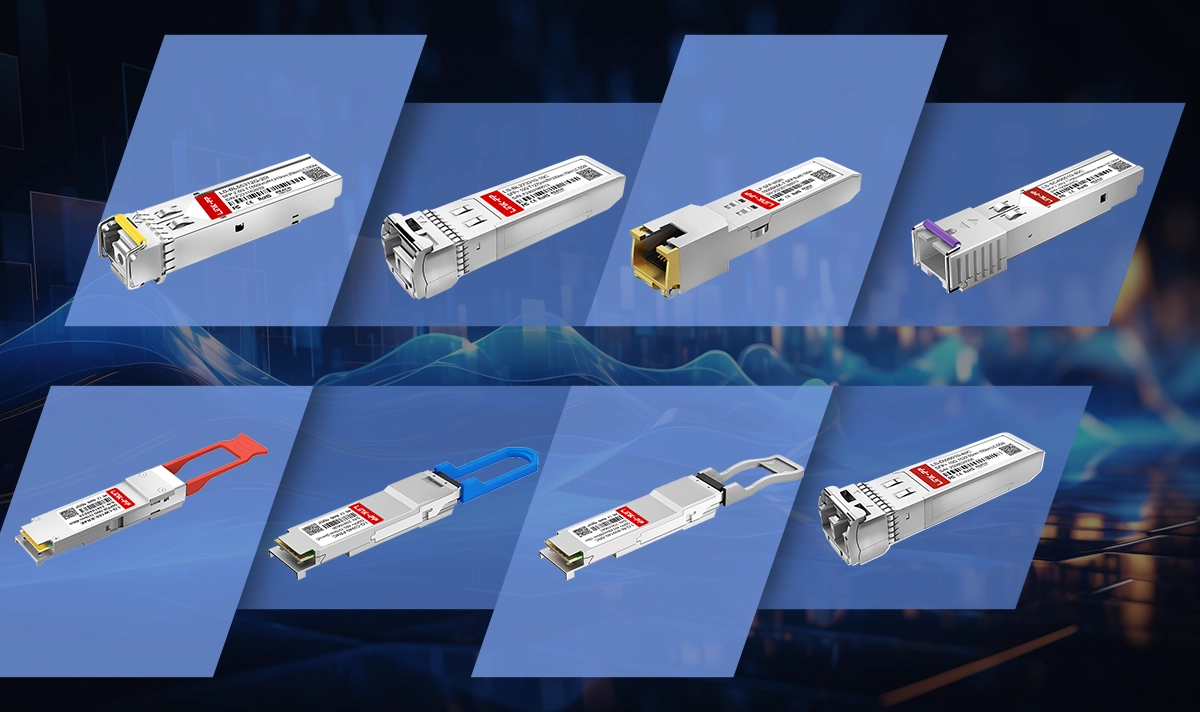
ลิงก์-พีพี offers a complete portfolio of โมดูลตัวรับส่งสัญญาณแสง built on cutting-edge components — including high-quality lasers, modulators, and photodiodes.
Our product range covers:
10G SFP+ and 25G CWDM/DWDM modules for enterprise and telecom networks
100G และ 400G ทรานส์ซีเวอร์ supporting advanced modulation formats
โมดูลออปติกสำหรับงานอุตสาหกรรม for demanding environmental conditions
Each LINK-PP transceiver is designed for superior performance, low power consumption, and compatibility with global networking standards.
❽ Conclusion
Lasers, modulators, and photodiodes form the core architecture of optical transceivers, enabling light-speed communication across global networks.
เลเซอร์ generate the optical carrier.
Modulators encode digital information.
ไดโอดเปล่งแสง (Photodiodes) decode and recover that information.
Together, they ensure the fast, stable, and scalable data transmission essential for the next generation of optical networks — from 400G to 6G and beyond.
As integration, silicon photonics, and AI optimization continue to advance, these three components will remain the driving force behind the world’s connected future.
Recommended Reading:
Laser Types in Optical Transceiver Modules – A detailed look at various laser technologies used in optical modules and their performance trade-offs.
PIN & APD Photodiode Technologies & Applications – An overview of PIN and APD photodiodes, including their operating principles and applications in optical receivers.
What Is Optical Modulation and How It Works (Explained) – Explains how optical modulators encode data onto light, covering different modulation formats and devices.
Fabry–Perot Laser Diodes in Optical Modules – A concise glossary entry describing FP-laser diodes, their advantages, and limitations in module design.
นิยามเลเซอร์ DFB – A glossary article on distributed feedback (DFB) lasers: how they work and why they are widely used in optical communications.
ภาพรวมของ VCSEL – Learn about vertical-cavity surface-emitting lasers (VCSELs), their structure, and why they’re widely used in short-reach optical links.
What is PAM4 (Four-Level Pulse Amplitude Modulation)? – A clear explanation of the PAM4 modulation format, its benefits for doubling data rate per lane and trade-offs in noise and equalization.
DP-QPSK (Dual-Polarization QPSK) Explained and Its Uses – An in-depth look at how DP-QPSK enables high spectral efficiency by combining polarization multiplexing and QPSK modulation in coherent systems.
QAM Modulation: How It Improves Data Transmission Efficiency – A glossary article on Quadrature Amplitude Modulation (QAM), explaining how amplitude and phase variations encode more bits per symbol.
Transimpedance Amplifiers (TIAs): How They Work And Applications – A technical overview of TIAs, which are key to converting photodiode current into usable electrical signals in optical receivers.
Silicon Photonics: Comprehensive Guide – A full-scale guide on silicon photonics platform: integration of modulators, lasers, detectors and implications for next-gen optical modules.