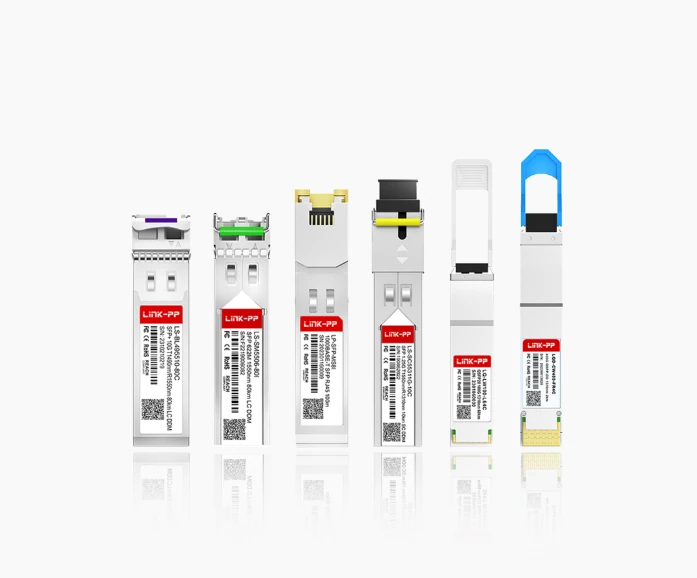
1G SFP Modules

100G Optical Transceivers

Topics
A fiber optic coupler splits or combines light signals in optical networks, improving data flow, reliability, and network flexibility for various applications.

Aging and burn-in tests ensure optical transceiver reliability by detecting early failures, improving performance, and extending module lifespan.
Pluggable optics offer flexible upgrades, while on-board optics provide higher speed and integration. Compare both for your data center needs.
Open optics and disaggregation in data center networks cut costs, boost flexibility, and improve performance while reducing vendor lock-in and energy use.
On-Board Optics boosts data speed, power efficiency, and channel density for data centers, supercomputers, and advanced network systems.
Spine-Leaf Architecture in optical networks enables scalable, non-blocking connectivity and high performance for modern data centers.
Pluggable optics enable flexible, cost-effective network upgrades and high-speed connections, with linear pluggable optics boosting AI and data center performance.
A wavelength converter in 2025 rapidly transforms light’s wavelength, enabling precise frequency, energy, and wavenumber calculations for devices.
Learn what MTTR (Mean Time to Repair) means, why it matters for system reliability, and how LINK‑PP’s hot-swappable SFP/SFP+ transceivers reduce repair time.
Green optical transceivers cut energy use and waste, helping your sustainable data center lower costs and reduce its environmental footprint.
Learn what an SFP link is, why it fails, and how to fix compatibility, cabling, and link-flap issues with practical checks and clear steps.
An SGMII SFP transceiver enables fast Ethernet connections over copper or fiber, supporting flexible speeds and device compatibility in modern networks.
Can you use a 1Gb SFP in a 10Gb port? Learn compatibility rules, limitations, configuration tips, and how to choose the right SFP module safely.
Are SFP modules hot-swappable? Learn how SFP hot swapping works, when it is safe, risks engineers discuss on forums, and best practices for switches and transceivers.
Learn how SFP small form-factor pluggable transceivers work, compare SFP vs SFP+/RJ45, choose UPC/APC connectors, and get spec-driven buying + troubleshooting tips.
AWS (Amazon Web Services) powers global cloud computing with scalable services and high-speed data center networks. Learn AWS basics, architecture, and how optical transceivers support AWS connectivity.
Compare 100G LR4, CWDM4, and PSM4 to find the best 100G transceiver for your network based on distance, cost, and cabling requirements.
VLAN vs SVI explained: VLAN segments networks at Layer 2, while SVI enables inter-VLAN routing at Layer 3 for communication between VLANs.
MUX and DEMUX streamline data transmission by combining and splitting signals, reducing cables, and enhancing network efficiency and reliability.
Compare Fiber Optic Splitter and coupler functions, signal loss, and best uses to choose the right device for efficient modern network distribution.
I/O modules connect control systems to sensors and devices, enabling accurate data exchange, real-time control, and reliable automation performance.
Dispersion-shifted fibers offer low dispersion and attenuation for high-speed, long-distance optical data transmission with improved signal quality.
Learn what Multipoint-to-Point (MP2P) architecture is, how it works, and how LINK-PP optical transceivers enhance data efficiency in modern fiber networks.
Learn how multipoint-to-multipoint (MP2MP) networks work, their advantages, and applications in optical communications. Discover LINK-PP optical modules supporting MP2MP systems.

Add Your Heading Text Here