Blog
Blog Type
Product
Topic
Blog Type
Product
Topic
Knowledge Center
Industry
Product
Product
Glossary
Category
40G QSFP+ Transceivers
100G Optical Transceivers
Topics
66
MUX and DEMUX streamline data transmission by combining and splitting signals, reducing cables, and enhancing network efficiency and reliability.
Compare Fiber Optic Splitter and coupler functions, signal loss, and best uses to choose the right device for efficient modern network distribution.
A cloud managed network lets you control devices remotely via a web dashboard, offering easy management, automatic updates, and strong security.
Open source gives control over software code, while open networking lets you mix hardware and software from multiple vendors for flexible networks.
Open networking enables flexible, vendor-neutral networks by separating hardware and software, offering more control, choice, and cost efficiency.
A fiber optic coupler splits or combines light signals in optical networks, improving data flow, reliability, and network flexibility for various applications.
Learn what IEEE 802.3bm is and how it defines the key PHY interfaces for 40G and 100G Ethernet. Explore SR4, LR4, CR4 technologies and why this standard powers modern data centers.
Aging and burn-in tests ensure optical transceiver reliability by detecting early failures, improving performance, and extending module lifespan.
Pluggable optics offer flexible upgrades, while on-board optics provide higher speed and integration. Compare both for your data center needs.
On-Board Optics boosts data speed, power efficiency, and channel density for data centers, supercomputers, and advanced network systems.
38
Understand QSFP data rate from 40G to 800G, including QSFP+, QSFP28, and QSFP-DD. Compare speeds, lane structure, and choose the right module.
Understand the key differences between XLPPI and XLAUI electrical interfaces, how they work in 40G/100G Ethernet systems, and which interface modern QSFP modules use.
Discover the advantages of XLPPI electrical interface in high-speed networking. Learn how it reduces latency, lowers power consumption, and future-proofs modern data transmission.
Compare 100G LR4, CWDM4, and PSM4 to find the best 100G transceiver for your network based on distance, cost, and cabling requirements.
VLAN vs SVI explained: VLAN segments networks at Layer 2, while SVI enables inter-VLAN routing at Layer 3 for communication between VLANs.
MUX and DEMUX streamline data transmission by combining and splitting signals, reducing cables, and enhancing network efficiency and reliability.
Compare Fiber Optic Splitter and coupler functions, signal loss, and best uses to choose the right device for efficient modern network distribution.
A cloud managed network lets you control devices remotely via a web dashboard, offering easy management, automatic updates, and strong security.
Open source gives control over software code, while open networking lets you mix hardware and software from multiple vendors for flexible networks.
Open networking enables flexible, vendor-neutral networks by separating hardware and software, offering more control, choice, and cost efficiency.
21
Packet loss disrupts your internet by causing lag, buffering, and dropped calls. Find out what causes packet loss and how to fix it for a stable connection.
An Optical Channel Monitor measures channel power, wavelength, and OSNR in fiber optic networks, ensuring reliable performance and fast problem detection.
Virtual Routing and Forwarding (VRF) enables multiple private routing tables on one device, improving network security, segmentation, and traffic management.

Photonic integrated circuits use light to transmit data, offering faster speeds, lower power use, and reliable connections for modern networks.

Uplink Failure Detection quickly identifies network link failures, enabling fast response to prevent downtime and maintain business continuity.
A VLAN segments a network at the data link layer, improving security, performance, and management by isolating devices within virtual groups.
Virtual Extensible LAN enables scalable, secure, and flexible network virtualization, supporting millions of segments for modern data center needs.
Mean Time Between Failure (MTBF) shows how long equipment runs before failing, helping you plan maintenance and boost reliability.
An IPv4 address uniquely identifies your device on a network, enabling internet access and secure data transfer between devices worldwide.
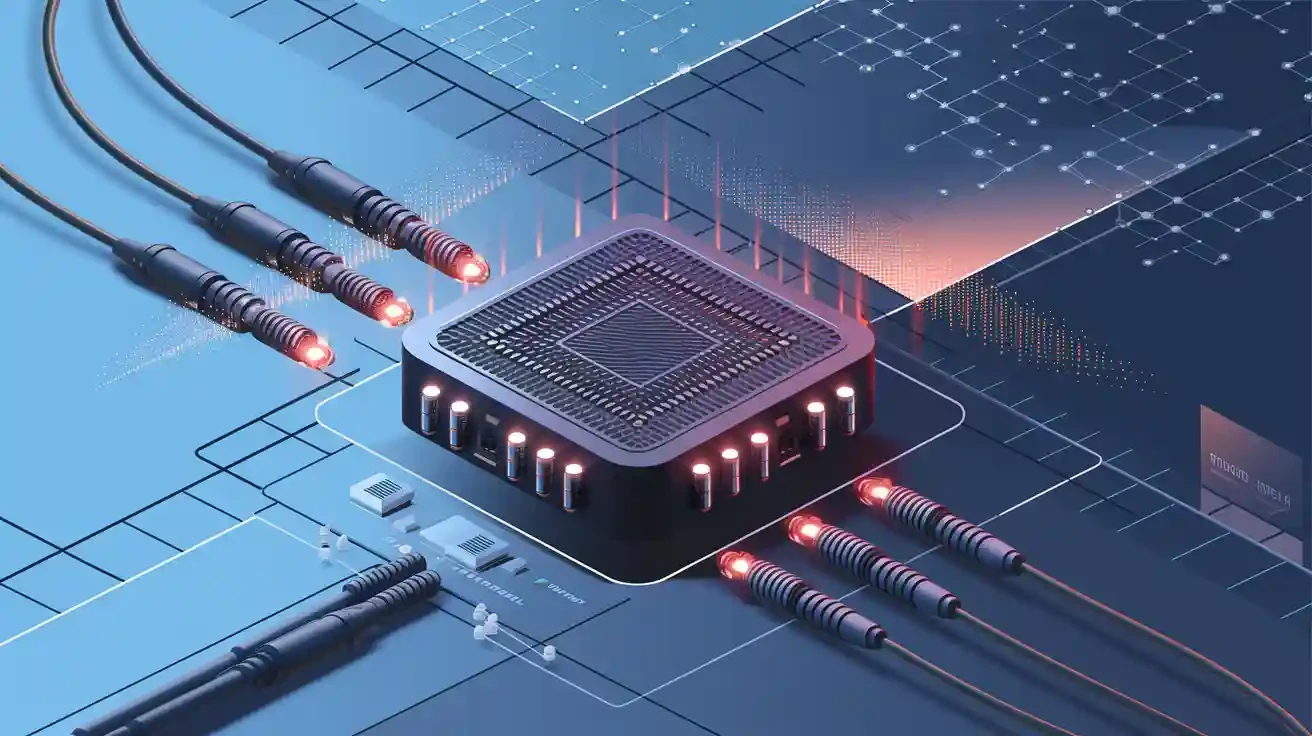
Receiver overload occurs when signals are too strong, causing distortion, shutdowns, or equipment damage. Learn causes, symptoms, and prevention tips.
0
Subscribe to LINK-PP
newsletter
Don’t miss anything. Get all the latest posts delivered straight to your inbox.
Video
00:41
Global Delivery Service | LINK-PP
https://resources.l-p.com/wp-content/uploads/2026/06/f3707104ff423f50cb51a7617d4e6a25.mp4
Jun 26, 2024
- 1.2k
- 888
×