












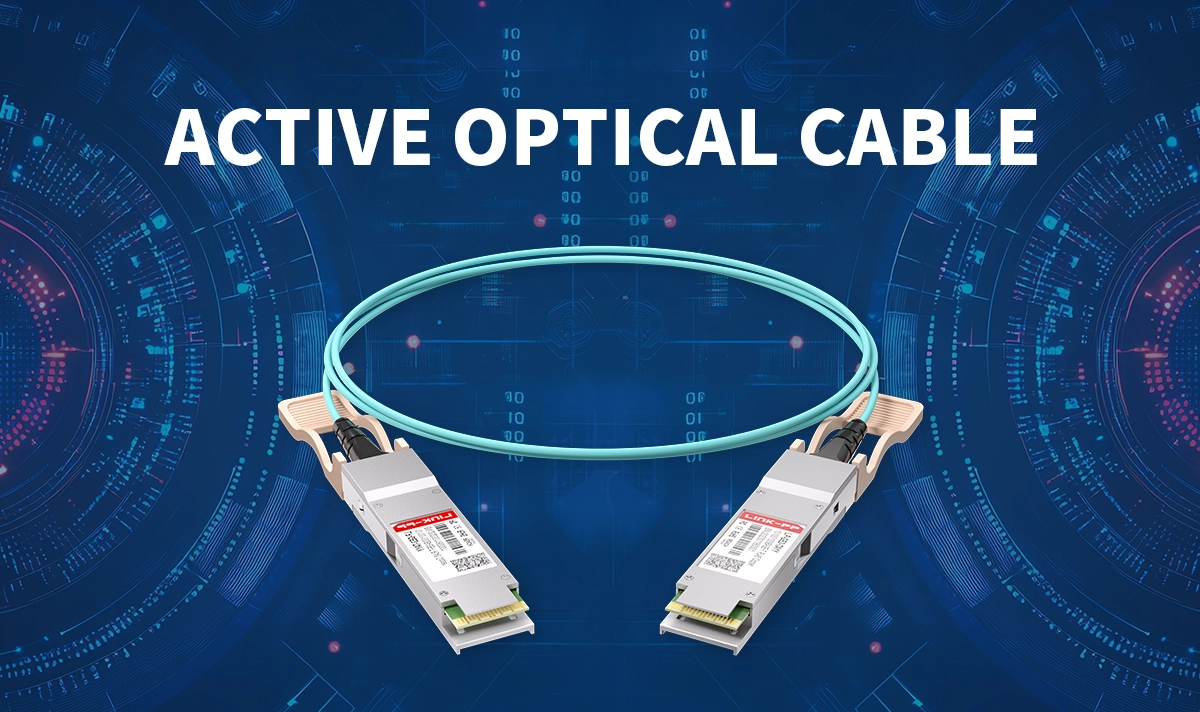
In the high-stakes world of data centers, cloud computing, and high-performance computing (HPC), densidade de largura de banda and eficiência energética are non-negotiable. Enter the Breakout Active Optical Cable (AOC)—a game-changer for modern infrastructure. If you’re exploring “what is breakout AOC cable,” you’re in the right place. We’ll demystify this critical tech, explore its benefits, and show how LINK-PP delivers industry-leading solutions.
➤ Breaking Down the Basics: What é a Breakout AOC Cable?
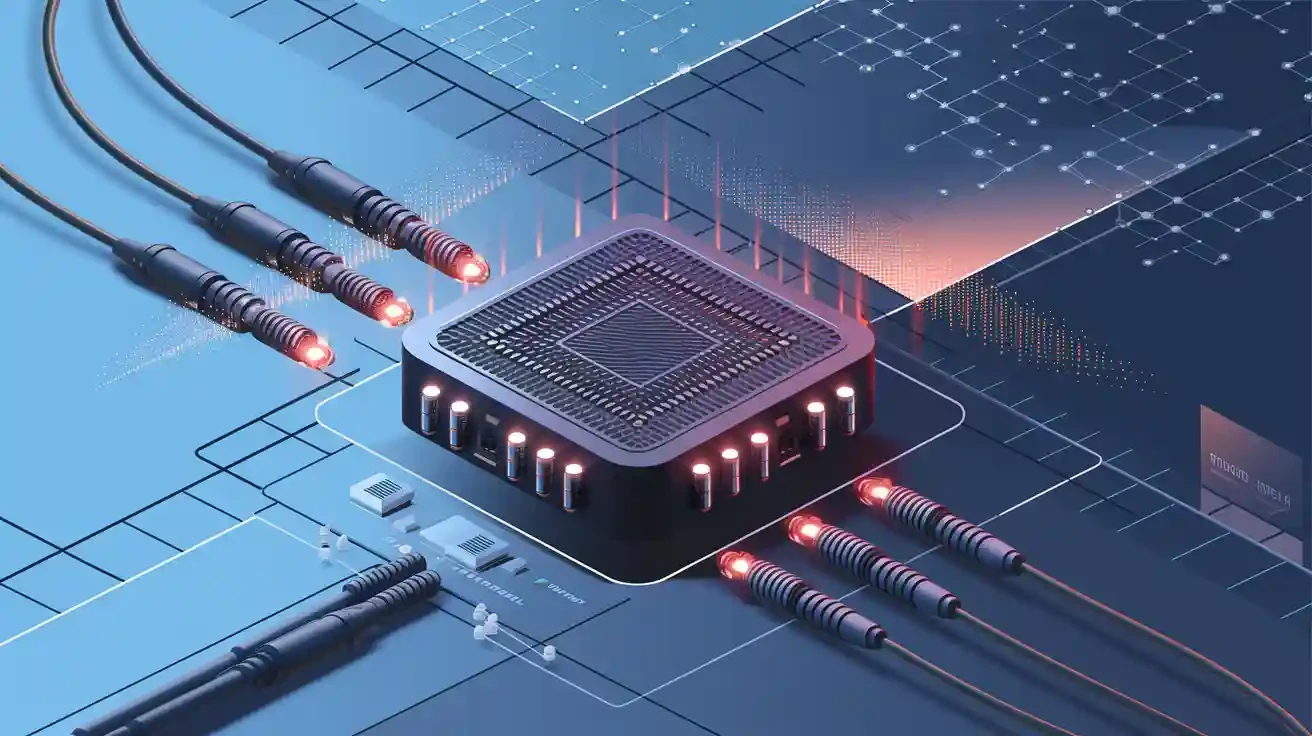
Em sua essência, um Breakout AOC Cable is a specialized type of Cabo Óptico Ativo. Unlike a standard AOC (which typically has one connector type on each end, like QSFP28 to QSFP28), a Breakout AOC has one higher-density connector on one end that “breaks out” into multiple lower-density connectors on the other end.
Cabo Óptico Ativo (AOC): Combines optical fiber with built-in transceivers on each end. It converts electrical signals to optical signals internally for transmission over the fiber, then back to electrical signals at the receiving end. This eliminates the need for separate, pluggable optical transceivers.
“Breakout” Functionality: This is the key differentiator. Instead of a single point-to-point link, one port (e.g., a 100G QSFP28 port) connects to multiple ports (e.g., four 25G SFP28 ports) simultaneously. Think of it as a multi-lane highway splitting into several smaller roads.
➤ How Does a Breakout AOC Cable Work? The Tech Inside
Electrical Input: The high-density connector (e.g., QSFP28) plugs into a switch or server port designed to support breakout mode.
Electrical-to-Optical Conversion: Built-in electronics within the QSFP28 connector housing convert the multiple electrical lanes into optical signals.
Transmissão Óptica: Multiple optical fibers (typically 4 fibers for a 4x breakout) carry the high-speed data signals.
Conversão óptica para elétrica: At the breakout end, smaller connectors (e.g., SFP28) house electronics that convert the optical signals back into electrical signals.
Electrical Output: The individual lower-density connectors (e.g., SFP28) plug into the target devices (servers, storage, lower-speed switches).
This integrated approach provides the speed and distance benefits of fiber optics without the complexity and cost of multiple discrete transceivers and fiber patch cords.
➤ Key Advantages: Why Choose a Breakout AOC Cable?
Simplified Cabling & Reduced Clutter: Drastically reduces the number of cables needed to connect high-density ports to multiple lower-speed devices. This improves airflow and simplifies management. Say goodbye to cable spaghetti nightmares!
Economia de Custos: Significantly lower cost per port compared to using multiple discrete transceivers and separate fiber patch cables. You pay for one integrated solution instead of many individual components.
High Bandwidth Density: Efficiently utilizes high-speed switch ports (like 100G, 400G) to connect to numerous lower-speed servers/storage devices (like 25G, 10G).
Latência Reduzida: Optimized internal design often results in lower latency compared to solutions using multiple discrete components.
Consumo de energia reduzido: Generally consumes less power than equivalent setups using separate pluggable sfp transceivers.
Confiabilidade: Factory-terminated and tested, reducing points of failure compared to field-terminated solutions. Less handling means lower risk of damage.
Hot-Pluggable: Like standard AOCs and transceivers, they support hot-swapping.
Guaranteed Interoperability: Designed to work seamlessly end-to-end, eliminating compatibility concerns between transceivers, cables, and ports.
➤ Common Breakout AOC Types & Applications
Breakout AOCs come in various configurations to match common high-density port speeds and breakout needs:
Common Breakout AOC Configurations | Aplicação típica |
|---|---|
QSFP28 (100G) to 4x SFP28 (25G) | Connecting 100G switches to 25G servers/storage. The workhorse of modern data centers. |
QSFP+ (40G) to 4x SFP+ (10G) | Migrating from 10G to 40G core, connecting legacy 10G devices to new 40G switches. |
QSFP56 (200G) to 2x QSFP28 (100G) | Breaking out 200G ports to two 100G links. |
QSFP-DD/OSFP (400G) to 4x QSFP28 (100G) | Connecting 400G spine switches to 100G leaf switches or devices. Future-proofing your core. |
QSFP-DD/OSFP (400G) to 8x SFP56 (50G) | High-density breakout for connecting to 50G servers. |
Where are Breakout AOCs Essential?
Data Center Top-of-Rack (ToR) / Leaf-Spine Architectures: Connecting high-speed spine/leaf switches down to individual servers with 25G/10G NICs. This is their primary battleground.
Computação de Alto Desempenho (HPC) Clusters: Interconnecting compute nodes and storage where high bandwidth and density are critical.
Infraestrutura em nuvem: Scaling out server farms efficiently.
Atualizações de rede: Phasing in higher-speed switches while still utilizing existing lower-speed equipment.
➤ LINK-PP Breakout AOC Cables: Performance You Can Trust
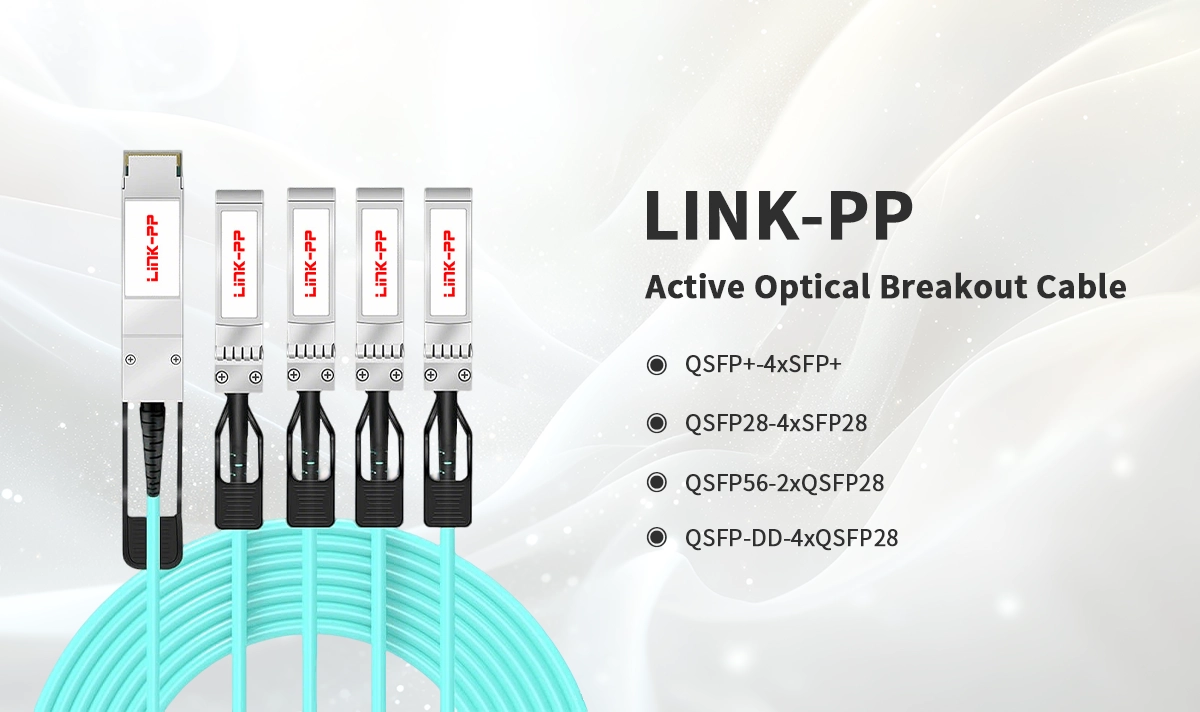
Ao selecionar breakout AOCs, quality and reliability are paramount. LINK-PP offers a range of high-performance, rigorously tested breakout active optical cables designed for demanding environments.
Key Features of LINK-PP Breakout AOCs:
Wide Range: Covering all major configurations (QSFP28-4xSFP28, QSFP+-4xSFP+, QSFP56-2xQSFP28, QSFP-DD-4xQSFP28, etc.).
Componentes premium: Utilizing high-quality fibers and reliable, low-power integrated optics.
Baixa latência: Optimized for performance-sensitive applications.
Low Bit Error Rate (BER): Ensuring data integrity (<10⁻¹²).
Excellent EMI Immunity: Crucial for stable operation in dense racks.
RoHS Compliant & Durable Design: Built to last with robust connectors and flexible, yet tough, cable jackets.
Comprehensive Compatibility: Tested for broad interoperability with major switch and server vendors.
Example LINK-PP Breakout AOC Model: LINK-PP LQ-AOC12200-5M
Recurso | Especificação | Benefício |
|---|---|---|
Fator de Forma | QSFP56 (1 end) to 2x QSFP28 (breakout end) | Connects 200G port to two 100G ports |
Taxa de Dados | Up to 2×100 Gbps (200 Gbps aggregate) | High-speed server/switch connectivity |
Tipo de cabo | Cabo Óptico Ativo (AOC) | Integrated optics, plug-and-play simplicity |
Distância Máxima | 5m, 10m, 15m, 20m, 30m, 50m, 100m options | Flexibilidade for various rack layouts |
Comprimento de onda | 850nm (Multimode) | Standard for short-reach data center links |
Conectores | QSFP28 (LC Duplex equivalent internally), 4x SFP28 (LC Duplex equivalent internally) | Secure, standard interfaces |
Consumo de Energia | < 1.5W per SFP28 end (Typical) | Lower power than discrete solutions |
Temperatura de Operação | 0 °C a 70 °C (32 °F a 158 °F) | Standard commercial range |
➤ Breakout AOC vs. DAC vs. Transceivers + Fiber: Quick Comparison
Recurso | Breakout AOC | Breakout DAC (Direct Attach Copper) | Discrete Transceivers + Fiber Patch Cables |
|---|---|---|---|
Tipo de cabo | Active Optical | Passive/Active Copper | Optical (Requires separate Transceivers) |
Distância Máxima | Longer (up to 100m+) | Shorter (Typically <= 7m) | Longest (km+) |
Weight / Flexibility | Light, Flexible | Stiffer, Heavier | Light, Flexible (but more components) |
Suscetibilidade à EMI | Imune | Suscetível | Imune (fiber part) |
Cost (Per Port) | Meio | Mais baixo | Mais alto |
Complexidade | Lowest (Integrated) | Baixa | Highest (Multiple components to manage/buy) |
Consumo de Energia | Baixo-Médio | Muito Baixo (Passivo) / Baixo (Ativo) | Média-Alta |
Melhor Para | Medium distances, density, cost balance | Very short runs within same rack | Long distances (>100m), specific transceiver needs |
➤ Conclusion: Streamlining High-Density Connectivity
Breakout AOC cables are a powerful tool in the modern network engineer’s arsenal. By combining the high bandwidth and reach of fiber optics with the simplicity and cost-effectiveness of integrated breakout connectivity, they solve a critical challenge in today’s data centers and HPC environments. They reduce cable clutter, lower costs per port, simplify deployment, and improve overall reliability.
Ready to untangle your high-density connectivity challenges and boost your data center efficiency?
Explore LINK-PP’s high-performance range of breakout AOC cables today! Find the perfect QSFP28 to 4x SFP28, QSFP+ to 4x SFP+, or 400G breakout solution for your specific needs.
➤ FAQ
What devices can you connect with a breakout AOC cable?
You can connect switches, servers, routers, and storage systems. Most devices with QSFP or SFP+ ports work with breakout AOC cables. Always check your device manual for supported cable types.
What makes breakout AOC cables different from regular fiber cables?
Breakout AOC cables have built-in electronics. You do not need extra transceivers. Regular fiber cables need separate transceivers at each end. AOC cables offer plug-and-play setup.
What is the maximum length for a breakout AOC cable?
Most breakout AOC cables reach up to 100 meters. You get reliable performance at this distance. Always check the cable specs before you buy.
What should you check before buying a breakout AOC cable?
Tip: Match the connector type to your device ports. Check speed and length needs. Review your network layout for best results.
What happens if you bend a breakout AOC cable too much?
You risk breaking the fiber inside. Always follow the minimum bend radius listed by the maker. Handle the cable gently to keep it working well.