















서론
As manufacturing and automation converge in the era of Industry 4.0, the underlying network infrastructure must evolve. Traditional segregation between 운영 기술(OT) 및 정보 기술(IT) is giving way to unified, high-performance connectivity. According to industry research, 광 통신 분야에서 기초적인 기술로 자리를 굳히고 있습니다. play a pivotal role in supporting the “smart factory” use-cases of Industry 4.0: high-bandwidth, low-latency, and highly reliable links.
In this blog, we explore the role of optical modules in Smart Industrial 4.0 networks, highlight key technical requirements, and show how three representative modules from LINK‑PP (1G, 10G & 25G) align with those requirements for industrial deployments.
1. Why Optical Modules Matter in Smart Industry 4.0 Networks
1.1 Convergence of OT and IT
In smart manufacturing environments, sensors, robots, PLC, edge-computing devices, and 데이터 센터 all need to communicate seamlessly. As noted by Corning:
“In nearly every situation … this means fibre-optic cabling.”
Fibre-based infrastructure provides the backbone for the converged OT/IT network, enabling higher throughput and longer reach compared to copper.
1.2 Characteristics Required
Industry 4.0 environments impose demanding requirements on network transport:
높은 대역폭: To carry video analytics, sensor streams, and digital twin traffic.
Low latency and deterministic performance: Real-time control, robotics, and edge applications cannot tolerate large jitter.
Robustness and environmental resilience: Factory floors bring vibration, EMI, and harsh temperatures.
확장성: As IIoT and 5G front-haul expand, networks must evolve beyond 1 G.
광 트랜스시버 모듈 (SFP/SFP+/SFP28) are therefore foundational components: they plug into switches, routers, or industrial gateways, converting electrical signals into optical and transporting data over fibre links. Without the right modules, the network cannot support the demands of a Smart Industry 4.0 system.
2. Key Technical Specifications & Considerations
When selecting optical modules for industrial Smart Industry 4.0 networks, several parameters must be reviewed:
인터페이스 유형 (LC, SC, RJ45 등)
Link distance and fibre type (single-mode vs multi-mode)
Wavelength and laser class
Form-factor (SFP, SFP+, SFP28) and host compatibility
Diagnostic/testing features (e.g., digital diagnostic monitoring – DDM)
Operating temperature range (industrial grade vs commercial)
Protocol compatibility (Ethernet, CPRI/eCPRI for mobile front-haul)
For example, one study highlights that optical transport for Industry 4.0 must support latency-critical applications and provide heterogeneous coverage (both indoor/outdoor). A guide from LINK-PP confirms that their 25G SFP28 module supports distances of up to 10 km over SMF, features an industrial temperature range, and includes built-in diagnostics.
3. Role of 1G, 10G, and 25G Modules in Smart Industry 4.0
3.1 1G Modules – Field and Access Layer
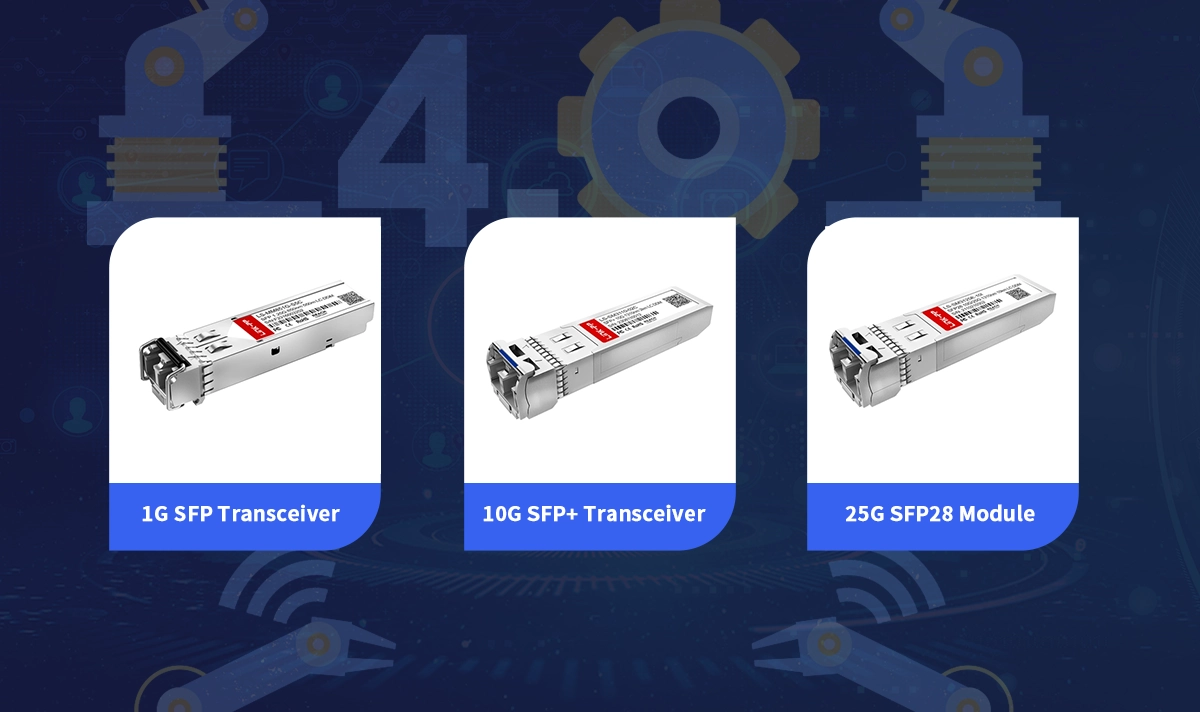
In many industrial sites, 1G links remain widely used for connectivity to sensors, I/O modules, and legacy devices. The module LS-MM851G-S5C from LINK-PP (a 1G SFP) provides cost-effective fibre connectivity, especially for multimode links up to ~550 m. Its role: providing fibre access to machine zones, enabling the OT network to merge into a higher-level backbone.
3.2 10G Modules – Aggregation and Control Layer
As data volumes increase (video, machine vision, edge computing), 10G links become essential. The module LS-SM3110-02C 는 10G SFP+ single-mode transceiver offering up to 2km reach (1310nm) and industrial-grade features.
In Smart Industry 4.0 networks, this module can serve the control layer (e.g., linking aggregation switches, edge servers), bridging machine zones to the data-centre/edge layer.
3.3 25G Modules – Future-Proof Backbone & Front-Haul
Looking forward, high-density and high-throughput applications (e.g., 5G eCPRI front-haul, real-time analytics, AI workloads) require 25 G or higher links. The module LS-SM3125-10I 는 25G SFP28 모듈 supporting up to ~25.78 Gb/s data rate, 10km SMF reach, industrial temperature range (-40 °C to +85 °C), and built-in diagnostics.
In a Smart Industry 4.0 deployment, this module enables the central backbone or 데이터센터 상호연결 and supports future migration to 5G-enabled or edge-augmented manufacturing.
4. Deployment Scenarios in Smart Factories
On-machine zone (device to switch): 1G SFP used between the robot controller and the aggregation switch.
Machine cluster to control room: A 10G link using SFP+ connects the cluster switch to the control network.
Control network to data centre/edge: 25G SFP28 serves as the backbone, supporting the aggregation of many 10G links, high throughput, and future-proof.
5G small cell front-haul: Modules like the 25G SFP28 can be used for eCPRI links between the factory private 5G network and central processing.
Harsh environment zones: Industrial-grade modules with -40 °C to +85 °C, rugged casing, and diagnostics ensure reliability.
5. Summary & Takeaways
광 트랜스시버 모듈 are a core enabler of bona fide Smart Industry 4.0 networks. From 1G SFPs in machine zones to 25G SFP28 modules in backbone links, selecting the right rate, fibre type, reach, and industrial-grade reliability is essential. LINK-PP’s portfolio (LS-MM851G-S5C, LS-SM3110-02C, LS-SM3125-10I) covers key tiers of the network architecture, delivering scalability today and readiness for tomorrow’s high-speed connected factory.
For manufacturers and network architects building Smart Industry 4.0 infrastructure, aligning your module selection with the bandwidth, latency, environmental, and future-growth requirements will ensure your network is not just “connected” but truly intelligent.