














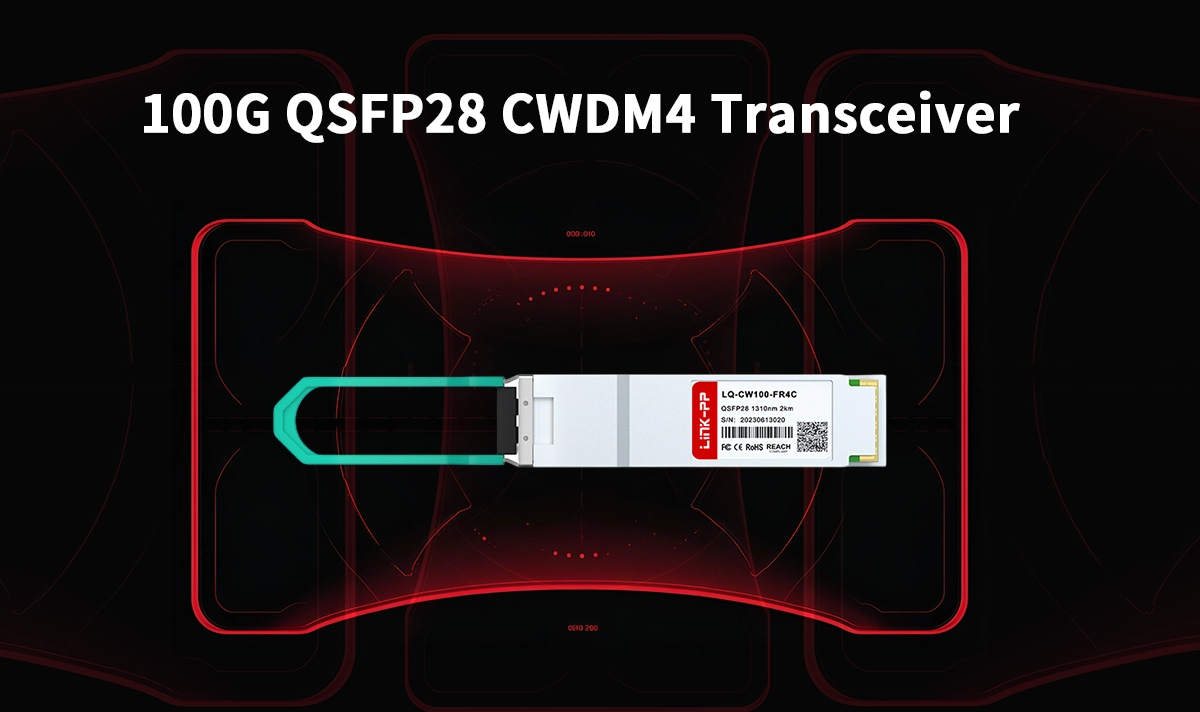
100G CWDM4 optical transceivers are the industry-standard solution for cost-effective, high-performance 100 Gigabit Ethernet connections over distances up to 2 kilometers. Utilizing Coarse Wavelength Division Multiplexing (CWDM)
technology over duplex シングルモードファイバ (SMF), they offer significant advantages in data center interconnects (DCI), enterprise networking, and service provider networks. This guide dives deep into how they work, their key benefits, and why choosing a reliable brand like LINK-PP matters for your optical infrastructure.
The relentless demand for bandwidth in modern data centers and networks necessitates robust, scalable, and cost-efficient connectivity solutions. Enter the 100G CWDM4 (100G QSFP28 CWDM4) optical transceiver module – a cornerstone technology for 100Gbps links spanning up to 2km. Let’s explore why it’s become such a popular choice.
✅ Understanding 100G CWDM4 Technology
Unlike parallel optics solutions requiring multiple fibers (like SR4), CWDM4 leverages 波長分割多重化 (波長分割多重化). It combines four distinct 25Gbps optical lanes onto just two strands of single-mode fiber (one for transmit, one for receive). This is achieved using four CWDM wavelengths within the O-band:
Lane 1: 1271nm
Lane 2: 1291nm
Lane 3: 1311nm
Lane 4: 1331nm
A マルチプレクサ(Mux)に接続されます。 combines these signals at the transmitter end, and a デマルチプレクサ(Demux) separates them at the receiver end. This efficient use of fiber infrastructure drastically reduces cabling complexity and cost compared to multi-fiber solutions, especially in dense environments.
✅ Key Applications of 100G CWDM4 Modules
データセンター相互接続(DCI): Connecting servers, top-of-rack (ToR) switches, and aggregation switches within and between data center buildings or campuses (within the 2km range).
Enterprise Backbone Networks: High-speed links between core switches and routers in large enterprise networks.
通信事業者およびサービスプロバイダーネットワーク: Providing 100G client interfaces for metro access and edge applications.
Network Function Virtualization (NFV) & Storage Area Networks (SAN): Supporting high-bandwidth virtualized services and storage connectivity.
✅ Major Advantages of Choosing 100G CWDM4 Transceiver
Cost Efficiency (Capex & Opex): Reduces fiber strand count by 75% compared to SR4 (8 fibers vs 2 fibers), lowering cable costs, patch panel ports, and management overhead. Lower power consumption than some alternatives also reduces OpEx.
ファイバー管理の簡素化: Duplex LC connectors are smaller, easier to manage, and require less space than MPO connectors used in parallel optics. This is crucial in high-density environments.
Standardized Interoperability: デュプレックス(2芯)単一モードファイバー上でのデータセンター間接続(DCI)です。 MSA (マルチソース・アグリーメント:MSA) ensures modules from different vendors (like LINK-PP, Finisar, Intel, etc.) interoperate seamlessly when connected to compliant Mux/Demux units.
Proven Reliability & Performance: A mature technology offering stable, high-performance 100G connectivity up to 2km with low ビットエラーレート (ビットエラー率:BER).
拡張性: Facilitates easier network upgrades and expansions due to simplified fiber infrastructure.
✅ CWDM4 vs. PSM4: Choosing the Right 2km 100G Solution
どちらも、 CWDM4 and PSM4 target the 2km 100G duplex SMF market. Here’s a quick comparison:
機能 | 100G CWDM4 (QSFP28) | 100G PSM4 (QSFP28) |
|---|---|---|
技術 | CWDM (4 wavelengths) | Parallel Single Mode (4 identical λ ~1310nm) |
光ファイバータイプ | SMF (2 fibers) | SMF (4 fibers) (Requires MPO-12 connector) |
波長 | 1271, 1291, 1311, 1331nm | 4x ~1310 nm |
主なメリット | Minimal Fiber Count (2) | Simpler Optics (No WDM Mux/Demux needed at ends) |
主な欠点 | Requires WDM Mux/Demux in path | Higher Fiber Count (4) |
最も適した用途 | Maximizing fiber efficiency, DCI, new builds | Short SMF runs where fiber is abundant, direct point-to-point links without external Mux/Demux |
Generally, CWDM4 is preferred for its superior fiber savings, while PSM4 might be chosen for very simple, direct links where avoiding external Mux/Demux units is a priority (though needing 4 fibers).
✅ Why Quality & Compatibility Matter: The LINK-PP Advantage
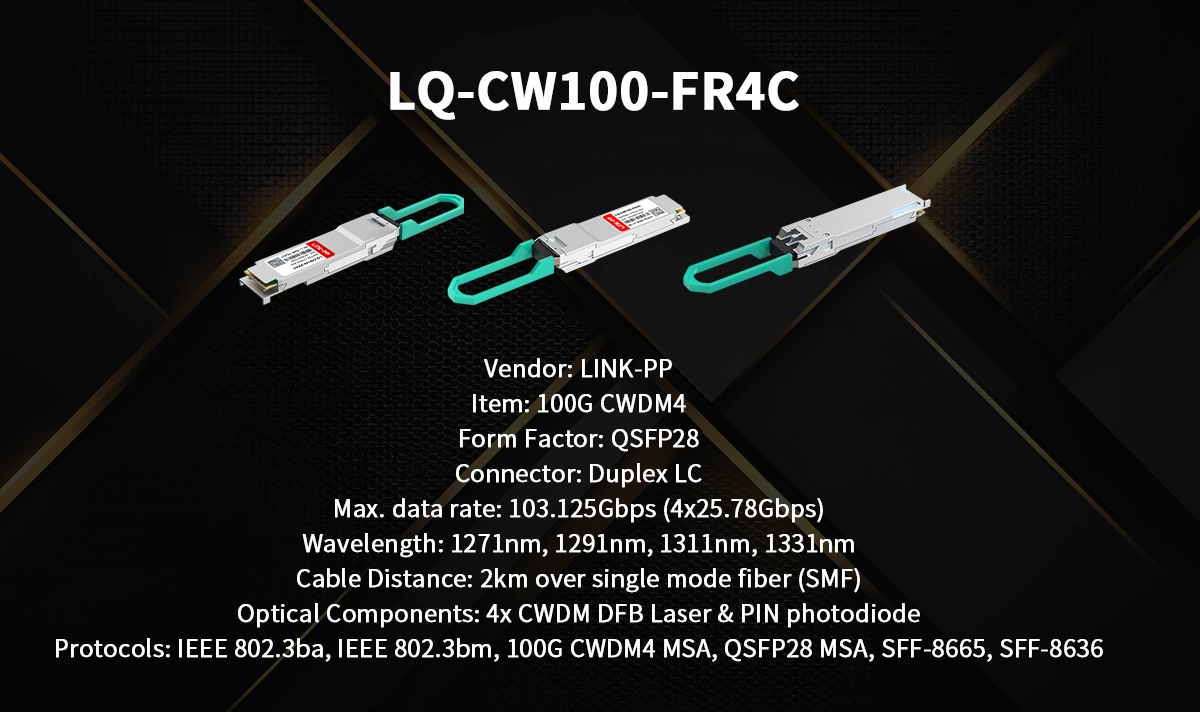
Not all transceivers are created equal. Using high-quality, MSA準拠の modules is essential for network stability, performance, and longevity. LINK-PP manufactures rigorously tested 100G QSFP28 CWDM4 modules 以下を保証します:
完全なMSA準拠: Guaranteed interoperability with major switch/router brands (Cisco, Juniper, Arista, Mellanox/NVIDIA, etc.).
Exceptional Performance: Low power consumption (< 3.5W typical), excellent sensitivity, and compliance with IEEE 802.3bm standards for reliable 100GBASE-LR4 performance over 2km SMF.
厳格な品質管理: Each module undergoes extensive testing for optical power, receiver sensitivity, and BER.
コスト削減: LINK-PP offers high-reliability optics at competitive prices, providing an excellent alternative to often overpriced OEM modules without sacrificing quality.
包括的なサポート: Backed by technical expertise and reliable warranties.
💡 プロのヒント: Ensure compatibility by checking your switch/router’s supported transceiver list (often called an MSA or Optics Compatibility Matrix). LINK-PP provides compatibility information for its modules, like the popular LINK-PP LQ-CW100-FR4C
モデルの物理層(レイヤー1)に位置します。.
Ready to Simplify Your 100G 2km Links?
この 100G CWDM4 optical transceiver remains a dominant and highly effective solution for 100 Gigabit Ethernet connectivity within data centers and up to 2km. Its combination of performance, fiber efficiency, cost savings, and standardization makes it an incredibly compelling choice.
Optimize your network infrastructure today! Explore LINK-PP’s range of high-quality, compatible 100G CWDM4 transceivers, including the reliable LQ-CW100-FR4C model.
✅ Frequently Asked Questions (FAQs)
Q: What is the maximum distance for 100G CWDM4?
A: The standard specifies operation up to 2 kilometers over G.652.D single-mode fiber.Q: Do I need special filters or Mux/Demux for CWDM4?
A: はい。. CWDM4 transceivers require passive CWDM Mux and Demux units installed in the fiber path between the two endpoints to combine and separate the wavelengths. These are separate passive components.Q: Can CWDM4 modules work with BiDi technology?
A: No. Standard CWDM4 uses two fibers (Tx and Rx). 100G BiDi solutions (like QSFP28 BiDi) exist but use different wavelengths on a お客様の fiber pair for potentially longer reaches (e.g., 10km, 20km, 40km).Q: Is CWDM4 hot-pluggable?
A: Yes, like most QSFP28 modules, CWDM4 transceivers are designed for hot-pluggability, allowing installation and removal without powering down the host equipment.Q: Why choose LINK-PP CWDM4 modules?
A: LINK-PP LINK-PP は、 MSA-compliant, high-performance, reliable 100G CWDM4 optics backed by quality assurance and significant cost savings compared to OEM options, making them an intelligent choice for scaling your optical network.
また参照
100G QSFP28光トランシーバーを探索:SR4、LR4、CWDM4、PSM4など
PSM4 vs. CWDM4: What is the differences?