















1. Introduzione
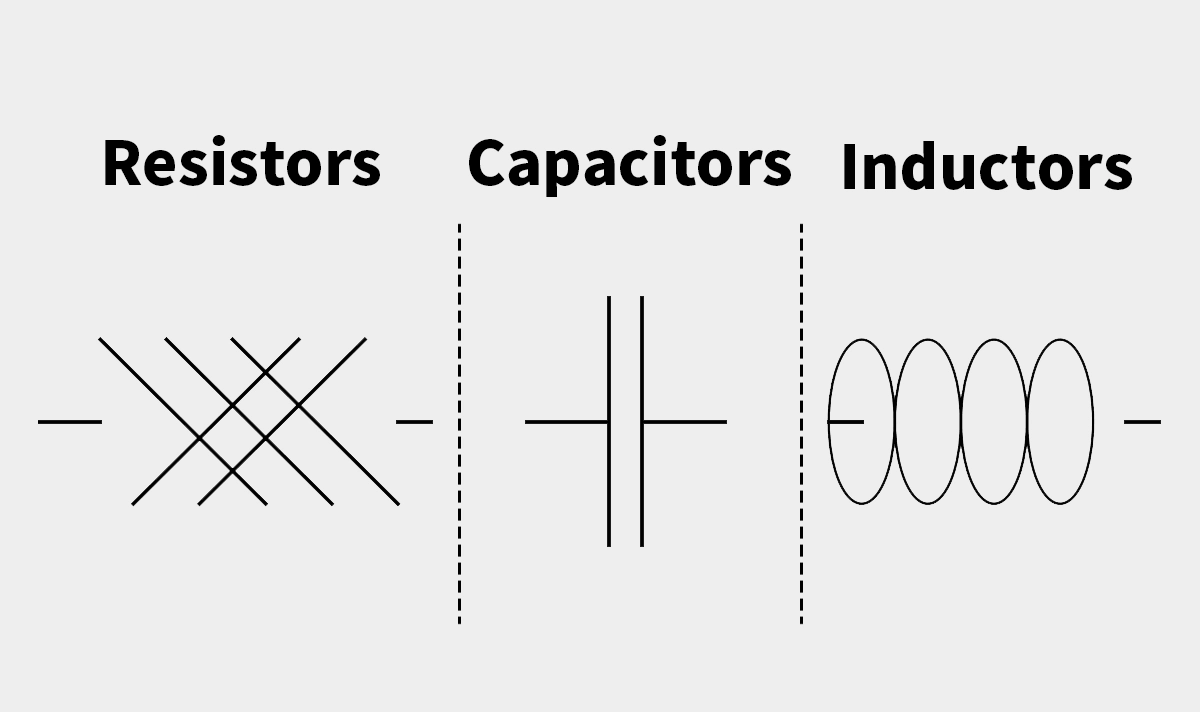
In electronic circuit design, three passive components form the foundation of nearly every system: resistors, condensatori, and inductors. While they appear simple, their unique characteristics determine how current and voltage behave in both analog and digital applications. Understanding their roles is essential for engineers, PCB designers, and system architects.
2. What Is a Resistor?
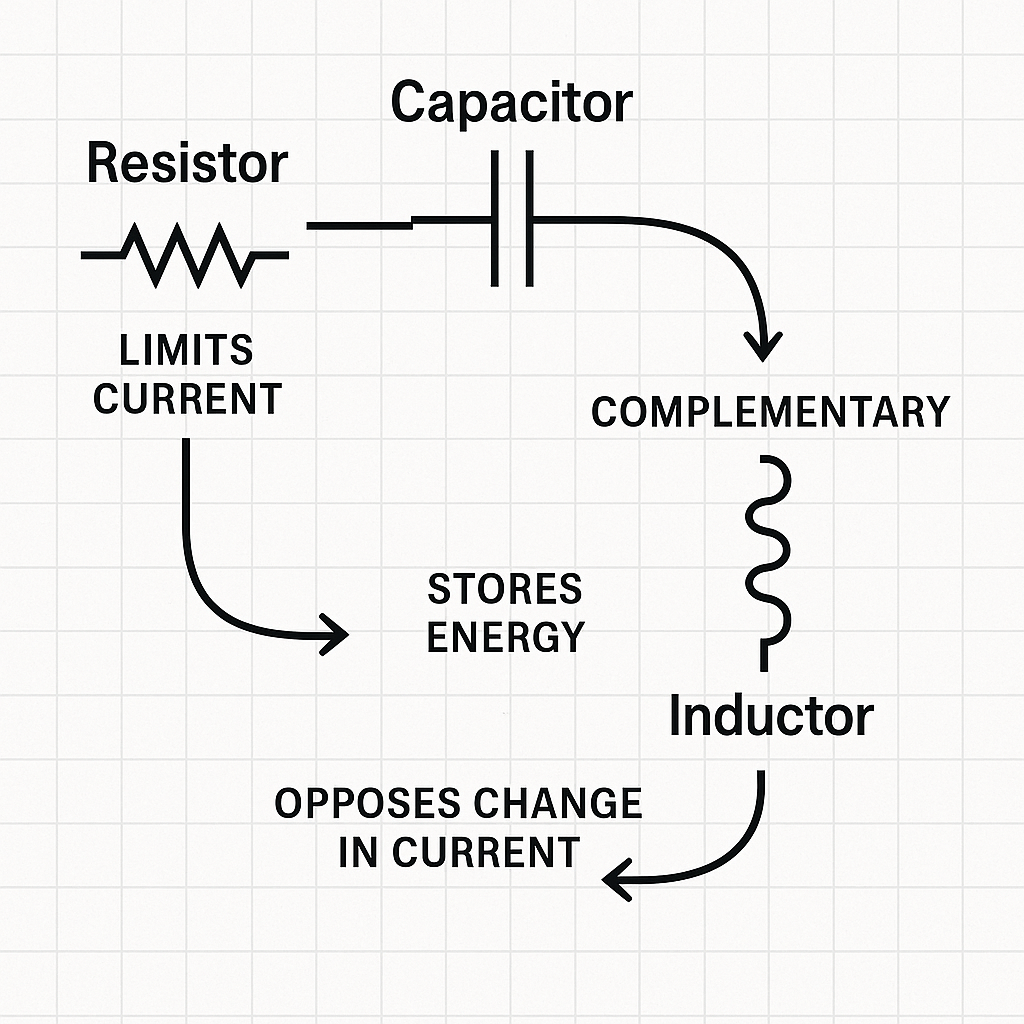
A resistore is the most common passive component. Its primary function is to limit current and control voltage levels by converting electrical energy into heat.
Key Parameter: Resistance (Ω, ohms)
Equation:

Applicazioni:
Voltage dividers
Current limiting for LEDs
Pull-up or pull-down logic stabilization
Resistors are frequency-independent components, meaning they behave the same in both DC and AC circuits.
3. What Is a Capacitor?
A condensatore stores energy in the form of an electric field. It resists changes in voltage, making it useful for filtering, smoothing, and coupling applications.
Key Parameter: Capacitance (F, farads)
Equation:

Behavior in AC Circuits: Blocks low-frequency (DC), allows high-frequency to pass
Applicazioni:
Power supply filtering
Signal coupling/decoupling
Timing circuits (RC networks)
Condensatori are frequency-dependent, meaning their impedance decreases as frequency increases.
4. What Is an Inductor?
An induttore stores energy in a magnetic field. It resists changes in current, making it complementary to capacitors.
Key Parameter: Inductance (H, henries)
Equation: V=LdIdtV = L frac{dI}{dt}V=LdtdI

Behavior in AC Circuits: Blocks high-frequency signals, allows low-frequency signals to pass
Applicazioni:
Power supply energy storage (DC-DC converters)
RF filters
Transformers and magnetic coupling
Inductors are frequency-dependent, with impedance increasing as frequency rises.
5. The Relationship Between R, C, and L
Resistors dissipate energy.
Condensatori store energy in an electric field.
Inductors store energy in a magnetic field.
When combined, they form RLC circuits that are fundamental in filters, oscillators, and signal processing. For example:
An RC circuit creates a low-pass or high-pass filter.
An LC circuit creates resonance for oscillators and tuning.
An RLC circuit balances damping and resonance in communication systems.
6. Practical Applications
Elettronica di potenza: Capacitors smooth voltage ripple, inductors store switching energy, and resistors handle load balancing.
Elaborazione del segnale: RC and LC filters remove unwanted frequencies.
Telecomunicazioni:
Inductors and capacitors define bandwidth in transceivers.
Conclusione
Resistors, capacitors, and inductors may be passive components, but they are the backbone of modern electronics. Mastering their properties allows engineers to design circuits that manage power, filter signals, and enable communication systems.
LINK-PP provides advanced magnetic components that integrate resistive, capacitive, and inductive effects to ensure signal integrity and reliability.