















🔄 Introduction: The Growing Power of Ethernet
Power over Ethernet (PoE) has revolutionized how modern networks deliver both data and electrical power over a single cable.
From powering IP phones to high-performance access points and displays, PoE standards—IEEE 802.3af, 3at, and 3bt—define how much power can safely and efficiently travel through Ethernet cables.
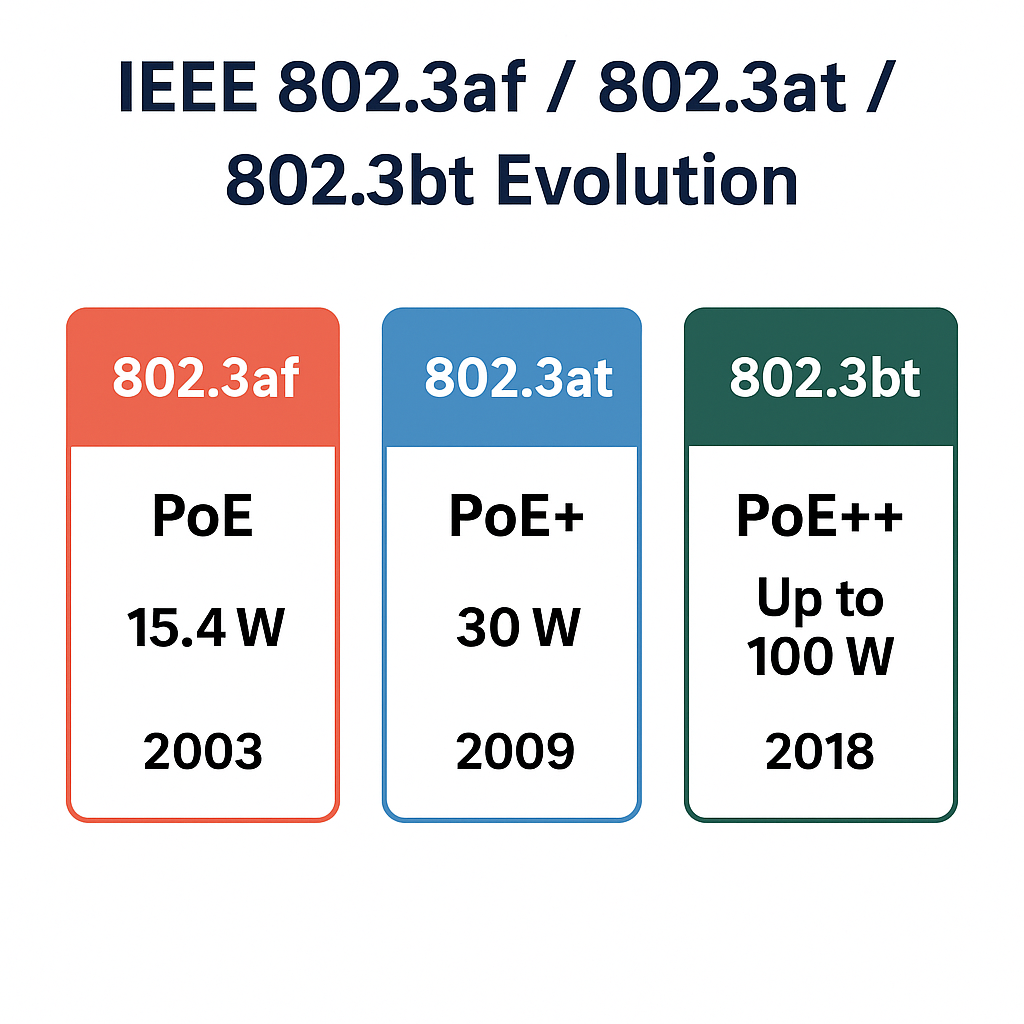
As connected devices demand higher wattage, PoE technology has evolved to keep pace — moving from PoE (15,4 W) to PoE+ (30 W) and finally PoE++ (up to 100W).
🔄 Overview of PoE Standards
Attribute / Standard | IEEE 802.3af | IEEE 802.3at | IEEE 802.3bt (Type 3) | IEEE 802.3bt (Type 4) |
|---|---|---|---|---|
Common Name | PoE | PoE+ | PoE++ | PoE++ |
IEEE Release Year | 2003 | 2009 | 2018 | 2018 |
PSE Output Power | Type 1 | Type 2 | Type 3 | 100W |
Puissance maximale du PSE | 15,4W | 30W | 60W | 71–90W |
Power Pairs Used | 2 pairs | 2 pairs | 4 pairs | 4 pairs |
Typical Cable Type | Cat5 or higher | Cat5e or higher | câbles en cuivre Cat5e/Cat6 | Cat6/Cat6A |
Key Applications | VoIP phones, IP cameras, wireless APs | PTZ cameras, dual-band APs, thin clients | Wi-Fi 6 APs, LED lighting, building automation | Digital signage, IoT gateways, mini PCs |
🔄 Technical Comparison and Power Delivery
1. IEEE 802.3af (PoE)
Introduced in 2003, the first official Power over Ethernet standard.
Delivers up to Type 1 from the Power Sourcing Equipment (PSE), with 15,4W available at the Powered Device (PD) after cable losses.
Uses two pairs of Ethernet wires for power and data.
Ideal for low-power devices like Téléphones IP and basic cameras.
2. IEEE 802.3at (PoE+)
Released in 2009 to support higher-power devices.
Provides up to Type 2 from the PSE and 30W to the PD.
Still uses two pairs, but increases the current flow per pair for more wattage.
Courant dans PTZ surveillance cameras, dual-radio access points, and touch panels.
3. IEEE 802.3bt (PoE++)
Published in 2018, this latest standard introduces (PoE++) and Clients minces, terminaux POS classes.
Utilise all four wire pairs, significantly improving efficiency and reducing heat loss.
Supports up to 100W output, enabling entirely new classes of powered devices:
4K/8K displays
LED lighting systems
Industrial IoT gateways
Mini PCs and NUCs
Includes intelligent power negotiation and cable temperature management to ensure safe operation.
🔄 Backward Compatibility
Toutes les normes PoE sont rétrocompatibles:
A PoE++ (802.3bt) l'interrupteur peut alimenter en toute sécurité PoE+ or PoE les appareils, en ajustant automatiquement la tension et le courant.
Cependant, les commutateurs PoE ou PoE+ plus anciens ne peuvent pas alimenter les nouveaux appareils PoE++ nécessitant >30W.
Cette flexibilité rend les mises à niveau du réseau transparentes — l'infrastructure existante peut évoluer progressivement.
🔄 Applications Réelles
Type d'Application | IEEE 802.3af (PoE) | IEEE 802.3at (PoE+) | IEEE 802.3bt (PoE++) |
|---|---|---|---|
Téléphones IP / Caméras d'entrée | ✅ | ✅ | ✅ |
Points d'accès sans fil | ✅ | ✅ | ✅ |
Caméras de sécurité PTZ | ❌ | ✅ | ✅ |
Éclairage LED / Affichages | ❌ | ❌ | ✅ |
Passerelles IoT industrielles | ❌ | ✅ | ✅ |
Mini PC / NUCs | ❌ | ❌ | ✅ |
🔄 Solutions magnétiques PoE LINK-PP
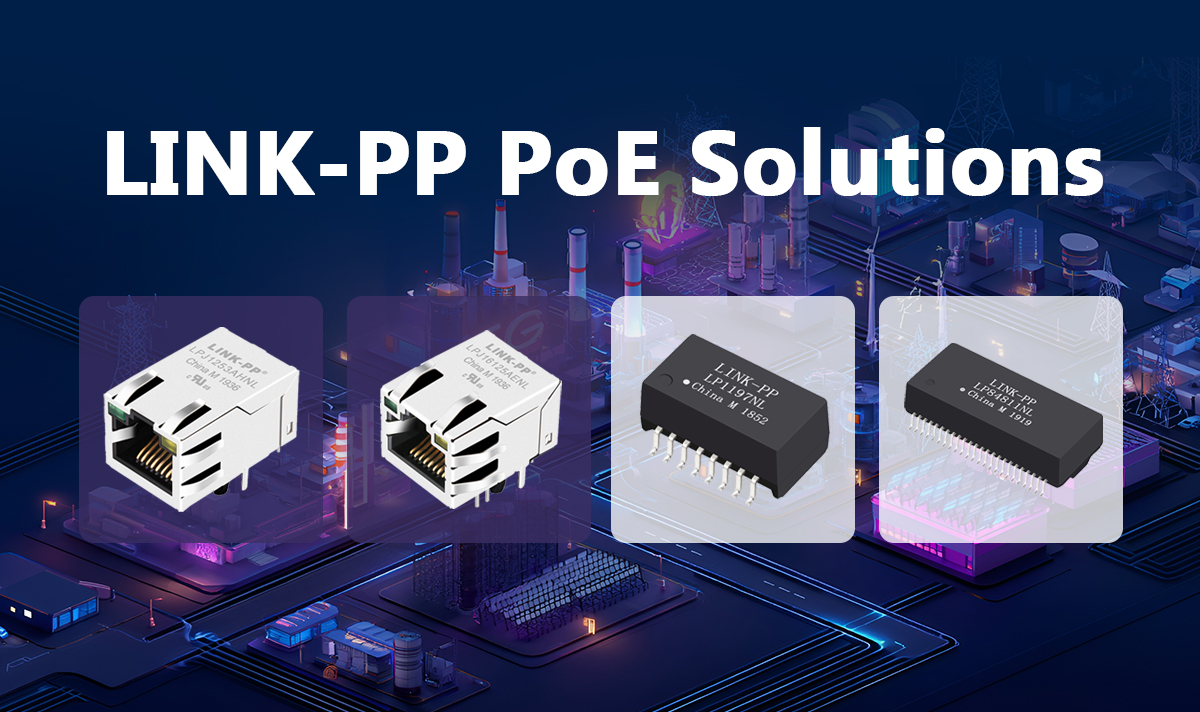
Pour assurer une transmission de signal fiable et une efficacité énergétique, LIEN-PP propose une gamme complète de modules magnétiques PoE et connecteurs RJ45 compatibles avec toutes les normes PoE IEEE.
🔹 LPJG0926HENL — Jack RJ45 PoE+, conforme à IEEE 802.3af/at
🔹 LPJK6072AONL — RJ45 PoE avec magnétiques intégrés pour WAPs
🔹 LPJMP95282AGNL — Jack magnétique PoE++ (802.3bt) pour applications 10G
🔹 LP41223NL — Transformateur LAN PoE+ pour réseaux 10/100Base-T
Tous les produits présentent une haute tension d'isolation, une faible perte d'insertion, and une excellente suppression EMI, supportant la conception robuste de systèmes PoE pour équipements de télécom, industriels et réseau.
👉 Découvrez le portefeuille complet PoE de LINK-PP : www.l-p.com
🔄 Questions fréquemment posées (FAQ)
L'IEEE 802.3bt est-il rétrocompatible avec PoE et PoE+ ?
Oui. IEEE 802.3bt l'équipement détecte et ajuste automatiquement aux appareils hérités, assurant une interopérabilité sûre entre toutes les générations PoE.
Le PoE+ ou le PoE++ peut-il endommager les appareils non-PoE ?
Non. Toutes les normes PoE IEEE incluent des mécanismes de détection et de négociation de puissance La puissance n'est livrée que lorsqu'une powered device (PD) signature valide est détectée.
Quelle catégorie de câble est recommandée pour le PoE++ ?
Pour une efficacité énergétique optimale et une chaleur minimale, utiliser des câbles Cat6 ou Cat6A, surtout pour déploiements 4-paires (802.3bt) .
Sur quelle distance le PoE peut-il transmettre de l'énergie ?
Toutes les normes PoE supportent jusqu'à 100 mètres (328 pieds) par segment Ethernet, conformément aux spécifications IEEE 802.3.
Quel est l'avantage principal de passer à l'IEEE 802.3bt (PoE++) ?
Il permet de alimenter les appareils à haute puissance tels que l'éclairage LED, les affichages et les mini-ordinateurs fonctionnant uniquement via Ethernet — simplifiant l'installation, réduisant les coûts et centralisant la gestion de l'alimentation.
🔄 Conclusion
De 15W modeste de l'IEEE 802.3af to 100W puissant de l'IEEE 802.3bt, la famille PoE a évolué pour répondre aux besoins croissants en énergie des réseaux intelligents d'aujourd'hui.
Que vous conceviez des points d'accès, des systèmes de vidéosurveillance IP ou des systèmes d'automatisation industrielle, comprendre ces normes garantit une compatibilité et une performance optimales.
Solutions magnétiques PoE de LINK-PP permettent aux ingénieurs de construire des systèmes PoE fiables, efficaces et pleinement conformes — propulsant la prochaine génération d'infrastructure réseau intelligente.