














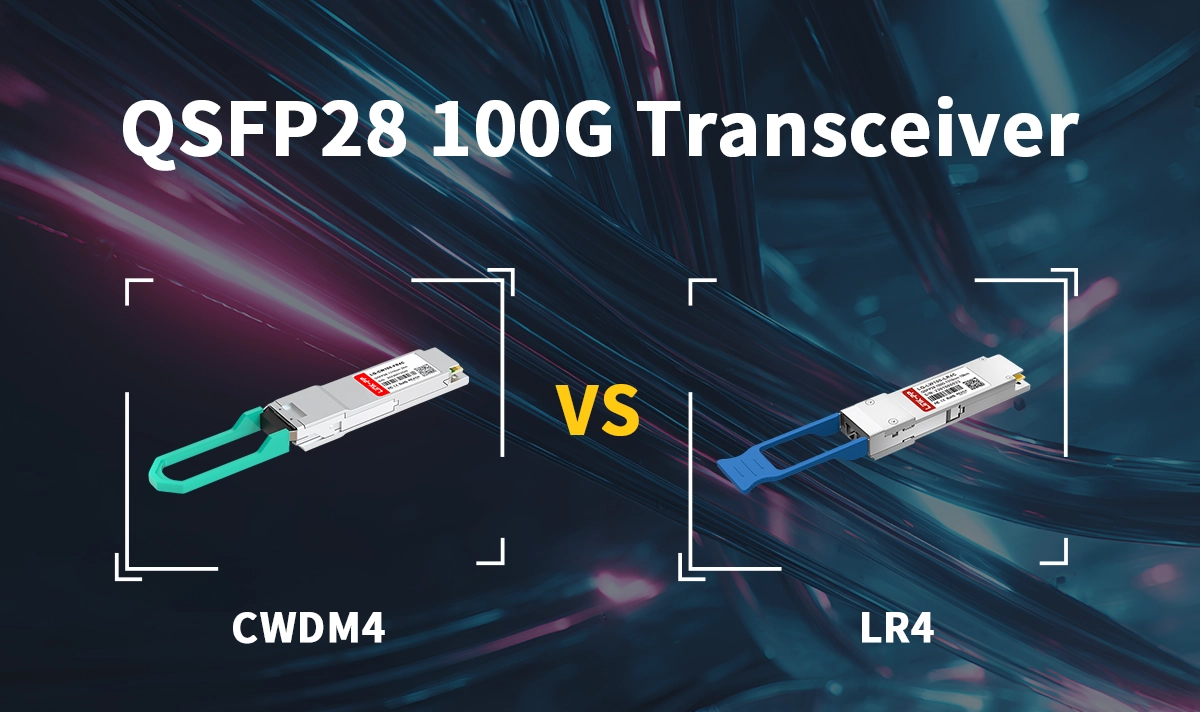
How to choose between QSFP28 100G CWDM4 and LR4 modules for your data center? These two dominant transceiver optique 100G standards look similar but have critical differences impacting cost, reach, and infrastructure. This guide cuts through the complexity, empowering you to make the parfait, choix économique for your high-speed links.
➤ Points clés à retenir
Choisir 100G CWDM4 modules for short or medium distances jusqu’à 2km. These modules help you save money and use less power. They still give good performance.
Utilisez 100G LR4 modules for long distances jusqu’à 10 km
. These modules give strong and reliable signals. You need to spend more for them.Check if your network equipment works with the modules before you buy. Make sure the modules fit your switches and routers.
Think about how far your network needs to go and your budget. Pick the module that matches your needs now and in the future.
Know that CWDM4 uses direct modulation lasers and needs error correction. LR4 uses external modulation lasers for longer reach and may not always need error correction.
➤ Compréhension des technologies fondamentales
Both QSFP28 CWDM4 and QSFP28 LR4 are hot-pluggable, 100GBase transceivers using four 25Gbps lanes. Their core divergence lies in ER4 =
and budget de liaison:
QSFP28 100G CWDM4 Transceiver (100GBase-CWDM4):
Longueurs d’onde : Uses four wavelengths within the Multiplexage par répartition en longueurs d’onde grossière (CWDM) grid: approximately 1271nm, 1291nm, 1311nm, and 1331nm.
Portée : Optimisé pour up to 2 km over standard . Que vous soyez connectés aux bâtiments campus, établissement de liens métro ou mise en œuvre de DCI, comprendre les capacités et les meilleures pratiques de déploiement est clé pour le succès. (SMF).
Avantage principal : Rentabilité. Leverages wider channel spacing, allowing simpler (cheaper) lasers and optics. Crucial for centre de données à forte densité
deployments where consommation d'énergie
and optic module price sont primordiales.Fiber Usage: Uses dual single-mode fiber (SMF) strands (one for Tx, one for Rx) – a pair of fibers.
QSFP28 100G LR4 Transceiver (100GBase-LR4):
Longueurs d’onde : Uses four tightly packed wavelengths around the 1310nm window (1295.56nm, 1300.05nm, 1304.58nm, 1309.14nm) based on LAN-WDM technologie.
Portée : Designed for longer distances, supporting jusqu’à 10 km over standard monomode (SMF).
Key Advantage: Reach. Essential for connecting et les réseaux de campus, les réseaux métro Ethernet, or linking disaggregated data center buildings.
Fiber Usage: Also uses dual single-mode fiber (SMF) strands (one for Tx, one for Rx).
➤ Head-to-Head Comparison: CWDM4 vs LR4
Here’s a clear breakdown of the critical differences:
Fonctionnalité | QSFP28 100G CWDM4 | transceiver QSFP28 100G LR4 |
|---|---|---|
Norme | 100GBase-CWDM4 (IEEE) / MSA | 100GBase-LR4 (IEEE 802.3bm Clause 88) |
Wavelength Grid | CWDM (~1271, 1291, 1311, 1331 nm) | LAN-WDM (~1295, 1300, 1304, 1309 nm) |
Portée maximale | 2 km | 10 km |
Type de fibre | Fibre monomode (SMF) | Fibre monomode (SMF) |
Teneur en fibres | 2 Fibres (1 Tx pair, 1 Rx pair) ✅ | 2 Fibres (1 Tx pair, 1 Rx pair) |
Coût typique | Lower (Simpler lasers & optics) 💰 | Plus élevé (Tighter tolerances & reach) |
Consommation d’énergie | Généralement Lower (< 3.5W) 🔋 | Généralement Légèrement plus élevé (≤ 3.5W) |
Cas d’utilisation principal | Short-Reach Data Center Interconnects (DCI), Top-of-Rack (ToR) to Leaf | Longer-Reach DCI, Metro, Campus Links, Leaf to Spine/Core |
Conformité aux MSA | CWDM4 MSA | IEEE 802.3bm |
Interopérabilité | Not directly interoperable with LR4 ❌ | Not directly interoperable with CWDM4 ❌ |
Levier principal | Cost Optimization, Power Efficiency | Reach Requirement |
➤ Why the Reach Difference Matters (And When Cost Wins)
The 2km reach of CWDM4 transceiver is often perfect within modern les centres de données hyperscale. If your links connect racks within a row or adjacent rows in the same hall, CWDM4 delivers significant savings des milliards de fois par seconde. Ce motif d’impulsions lumineuses parcourt la fibre à grande vitesse, sur des milliers de kilomètres, puis est décodé à nouveau en données à l’autre extrémité. optic module cost without sacrificing performance. This makes it the go-to choice for high-volume data center deployments prioritizing coût total de possession (TCO). Le module
LQ-CW100-FR4C is a market leader here, offering reliability at an optimal price point.
The 10km reach of LR4 module is indispensable when connecting across buildings, to a central office, or within a les mises à niveau de réseaux métropolitains. While the optic module price is higher due to more precise laser requirements, it eliminates the need for potentially expensive reach extenders or additional network hops for these longer distances. For robust, future-proofed long distance fiber optic transmission, Le module
LQ-LW100-LR4C provides the necessary performance.
✅ Key Takeaways & Which One to Choose
Need ≤ 2km within a data center? Choose CWDM4. It’s the économique, power-efficient workhorse for hyperscalables
, webscale networking, and enterprise data center spine-leaf architectures. Maximize your budget without compromise.Need up to 10km (campus, metro, inter-building)? Choose LR4. Its longer reach is non-negotiable for these scenarios, justifying the higher optic module price. Indispensable pour telecom applications and extended data center interconnects.
Interopérabilité : CWDM4 and LR4 modules are NOT plug-and-play compatible. Ensure both ends of a link use the même technology (CWDM4-CWDM4 or LR4-LR4).
Infrastructure en fibre optique : Both require standard single-mode fiber patch cables. The choice doesn’t impact your underlying fiber plant type, only the reach it enables.
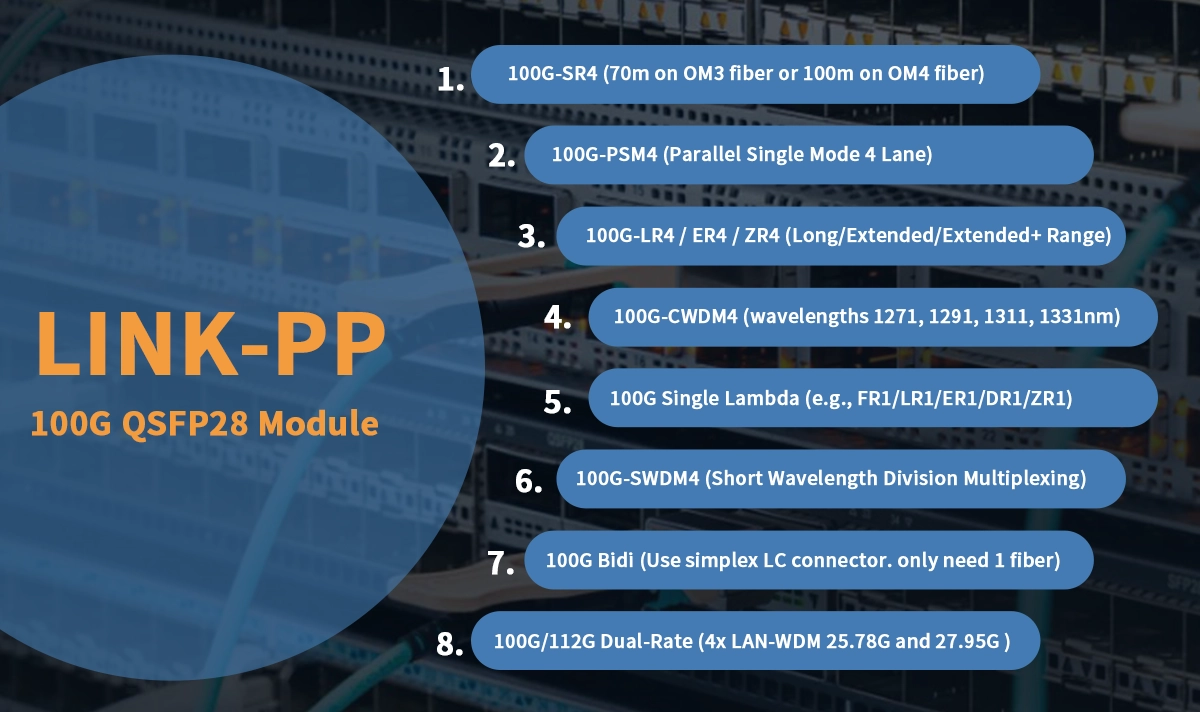
➤ LINK-PP: Your Partner for High-Performance 100G Optics
Whether you need the cost-optimized efficiency de CWDM4 for massive data center scaling or the portée étendue de LR4 for metro connectivity, LIEN-PP delivers reliable, high-quality QSFP28 solutions. Our 100G CWDM4 and 100G LR4 modules are rigorously tested for seamless 100g qsfp28 integration and performance.
Ready to Optimize Your 100G Network? ✉️
Consult with LINK-PP experts today! We’ll help you select the perfect 100g transceiver – whether it’s CWDM4, LR4, or other cutting-edge les modules – ensuring maximum performance, reliability, and value for your specific . La performance des liens physiques interne et entre les centres de données est primordiale, souvent déterminée par . Get a quote or request samples now ➞
➤ FAQ
What is the main difference between 100G CWDM4 and 100G LR4?
You will find that CWDM4 works best for short to medium distances, up to 2km. LR4 supports longer distances, up to 10km. LR4 uses stronger lasers and costs more.
Do I need special equipment for CWDM4 or LR4 modules?
Most modern switches and routers support CWDM4. LR4 sometimes needs special gear for long distances. Always check your device’s compatibility before you buy.
Why does CWDM4 require FEC?
CWDM4 needs Correction d’erreurs directe (CED) to fix errors during data transmission. FEC helps keep your data safe and reliable, especially over longer links.
Can I use CWDM4 and LR4 modules together in one network?
You can use both types in the same network if your equipment supports them. Make sure each link uses the right module for its distance and requirements.