















Dans la technologie « Power over Ethernet » (PoE), équipement source d’alimentation (PSE) joue un rôle central en acheminant à la fois des données et de l'énergie électrique via un seul câble Ethernet.
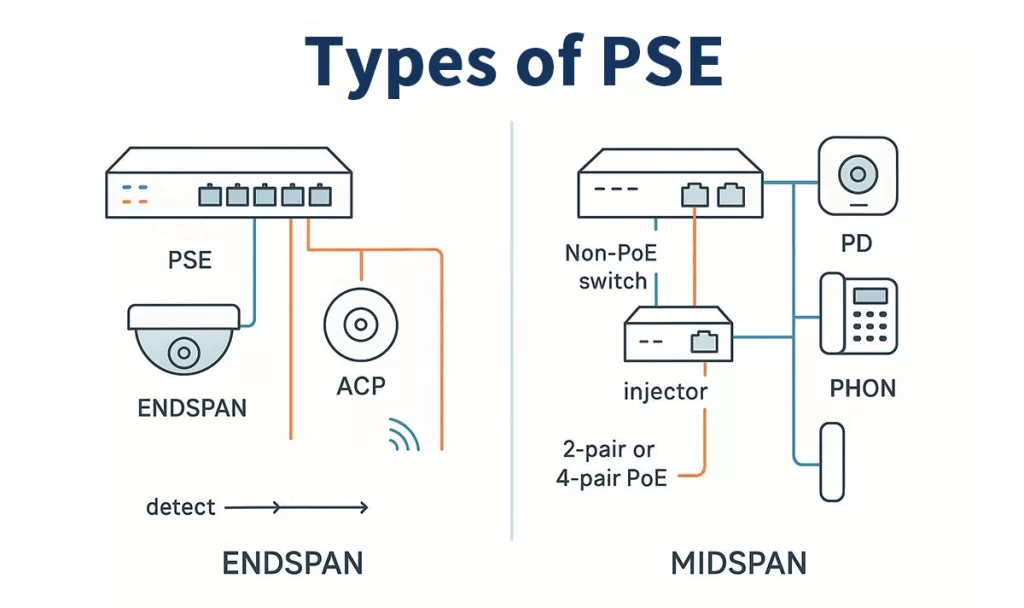
Selon le point d'injection de l'énergie dans le réseau, les dispositifs PSE se répartissent en deux catégories : PSE Endspan and PSE Midspan.
Il est essentiel de bien comprendre leurs différences lors de la conception ou du déploiement de réseaux PoE performants.
1. Qu'est-ce que l'Endspan PSE ?
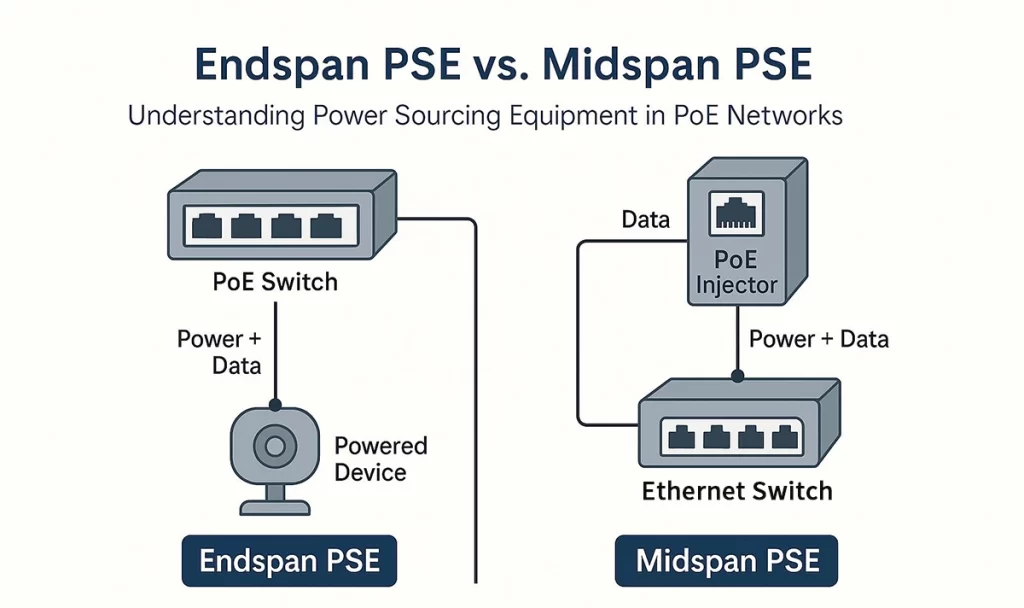
PSE Endspan, souvent appelé « Commutateur PoE, intègre l'alimentation par câble directement dans le commutateur réseau lui-même.
Chaque port Ethernet du commutateur est capable de transmettre à la fois des données et une alimentation en courant continu vers Appareils alimentés (PD) telles que les caméras IP, points d'accès sans fil (WAPs), ainsi que les téléphones VoIP.
Caractéristiques principales
Intégré au matériel du commutateur
Transmet à la fois les données et l'alimentation via le même port RJ45
Aucun injecteur PoE supplémentaire n'est nécessaire
Ci-dessous IEEE 802.3af / 3at / 3bt normes
Simplifie le câblage et réduit les points de défaillance
Avantages
Configuration simplifiée : un seul appareil suffit
Réduction des pertes de puissance grâce à l'intégration directe
Une gestion centralisée plus simple de l'alimentation du réseau
Exemple :
Un commutateur PoE+ de niveau entreprise capable d'alimenter simultanément 24 caméras IP est un exemple typique de PSE Endspan appareil.
2. Qu'est-ce que le PSE « midspan » ?
A PSE Midspan—communément appelé « » Injecteur PoE— est un périphérique externe placé entre un commutateur non PoE et le PD.
Il alimente le câble Ethernet en courant électrique sans altérer le signal de données.
Caractéristiques principales
Fonctionne avec des commutateurs traditionnels ou non PoE
Injecte une alimentation en courant continu dans les câbles Ethernet à mi-parcours
Généralement disponibles sous forme d'injecteurs à un ou plusieurs orifices
Conforme à Normes PoE de l'IEEE pour des raisons de sécurité et de compatibilité
Avantages
Permet la prise en charge du PoE sur l'infrastructure réseau existante
Solution économique pour la mise à niveau de ports spécifiques ou de petits systèmes
Déploiement flexible : pas besoin de remplacer les commutateurs existants
Exemple :
Un injecteur PoE à un seul port alimentant un point d'accès sans fil extérieur à partir d'un commutateur Ethernet standard est un PSE Midspan configuration.
3. Comparaison technique : Endspan vs Midspan
Fonctionnalité | Endspan PSE (commutateur PoE) | PSE Midspan (injecteur PoE) |
|---|---|---|
Emplacement | Intégré au commutateur | Entre le commutateur et le PD |
Fonction | Fournit des données et de l'énergie | Ajoute uniquement de la puissance |
Installation | Un appareil | Nécessite du matériel supplémentaire |
Cas d’utilisation | Nouvelle infrastructure PoE | Modernisation des réseaux existants |
Efficacité | Plus élevé | Légèrement inférieur (conversion supplémentaire) |
Appareils typiques | Commutateurs PoE | Injecteurs PoE, concentrateurs |
Conformité aux normes IEEE | 802.3af / 802.3at / 802.3bt | 802.3af / 802.3at / 802.3bt |
Ces deux types de PSE jouent un rôle essentiel.
PSE Endspan est idéal pour les réseaux PoE centralisés à grande échelle, tandis que PSE Midspan offre une grande souplesse et une compatibilité avec les mises à niveau dans des environnements mixtes.
4. Alimentation électrique et dispositifs de sécurité
Quel que soit leur type, les dispositifs PSE « Endspan » et « Midspan » suivent tous deux le même processus de négociation d'alimentation PoE défini par les normes IEEE :
Détection : Vérifiez si un appareil connecté prend en charge la technologie PoE.
Classification : Déterminez le niveau de puissance requis pour le PD (classe 0 à 8).
Application de puissance : Alimentez en courant continu en utilisant le mode A (paires de données) ou le mode B (paires de réserve).
Surveillance : Assurer la stabilité de la tension et du courant pendant le fonctionnement.
Arrêt : Couper automatiquement l'alimentation en cas de défauts ou de coupures.
Cela garantit que Les appareils non PoE ne sont jamais endommagés, et tous les PD bénéficient d'une alimentation stable et conforme.
5. Applications pratiques
PSE endspan :
Centres de données et réseaux d'entreprise
Systèmes de vidéosurveillance
Automatisation des bâtiments intelligents
PSE midspan :
Mise à niveau des commutateurs existants pour prendre en charge les périphériques PoE
Installations à distance ou temporaires
Industriel IoT situations où les sources d'alimentation sont limitées
6. Solutions LINK-PP pour les équipements PSE
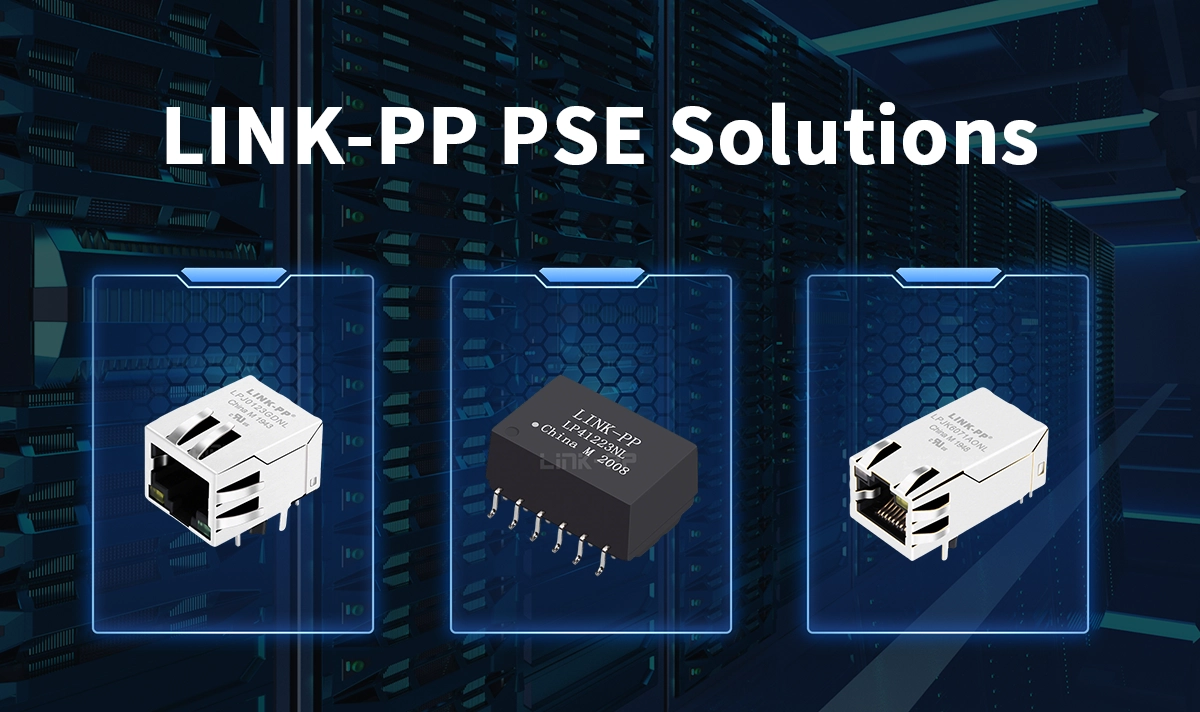
LINK-PP propose une gamme complète de Connecteurs RJ45 magnétiques compatibles PoE and Transformateurs Ethernet conçu pour les déploiements PSE de type « Endspan » et « Midspan ».
Par exemple :
LPJ0123GDNL — Un modèle compact Connecteur RJ45 PoE+ prenant en charge IEEE 802.3at (PoE+), idéal pour les commutateurs PoE (PSE Endspan).
LP41223NL — A Transformateur LAN 10/100Base-T PoE+ qui garantit une isolation élevée et une alimentation électrique efficace des injecteurs (Midspan PSE).
LPJK6071AONL — A Module magnétique Gigabit pour les applications 1000Base-T prenant en charge la norme PoE++, adaptées aux conceptions PSE de niveau industriel.
Ces composants sont conçus pour signal, stabilité thermique, and fiabilité à long terme, garantissant ainsi des performances optimales tant pour les commutateurs PoE que pour les injecteurs.
7. Choisir le bon type de PSE
Au moment de choisir entre Endspan and Midspan PSE, réfléchis à ceci :
Échelle du réseau : Pour les installations de grande envergure ou les nouvelles installations, optez pour Endspan.
Intégration des systèmes existants : Pour les commutateurs non PoE existants, la solution Midspan est économique.
Alimentation électrique : Les appareils à forte puissance (par exemple, 802.3bt Type 4) peuvent nécessiter des modules PSE avancés.
Conditions environnementales : Choisissez des connecteurs PoE et des transformateurs adaptés aux plages de température industrielles pour les environnements difficiles.
Conclusion
Both PSE Endspan and PSE Midspan sont des éléments essentiels d'une infrastructure PoE moderne.
Alors qu'Endspan intègre l'alimentation électrique et la transmission de données dans un seul appareil, Midspan offre la flexibilité nécessaire pour moderniser les réseaux non PoE sans avoir à remplacer l'ensemble du matériel.
Pour les équipementiers et les ingénieurs réseau, il est essentiel de choisir des composants fiables et certifiés PoE. Découvrez la gamme de produits LINK-PP Connecteurs RJ45 PoE and Transformateurs LAN pour développer des solutions PSE efficaces et hautement performantes chez l-p.com.