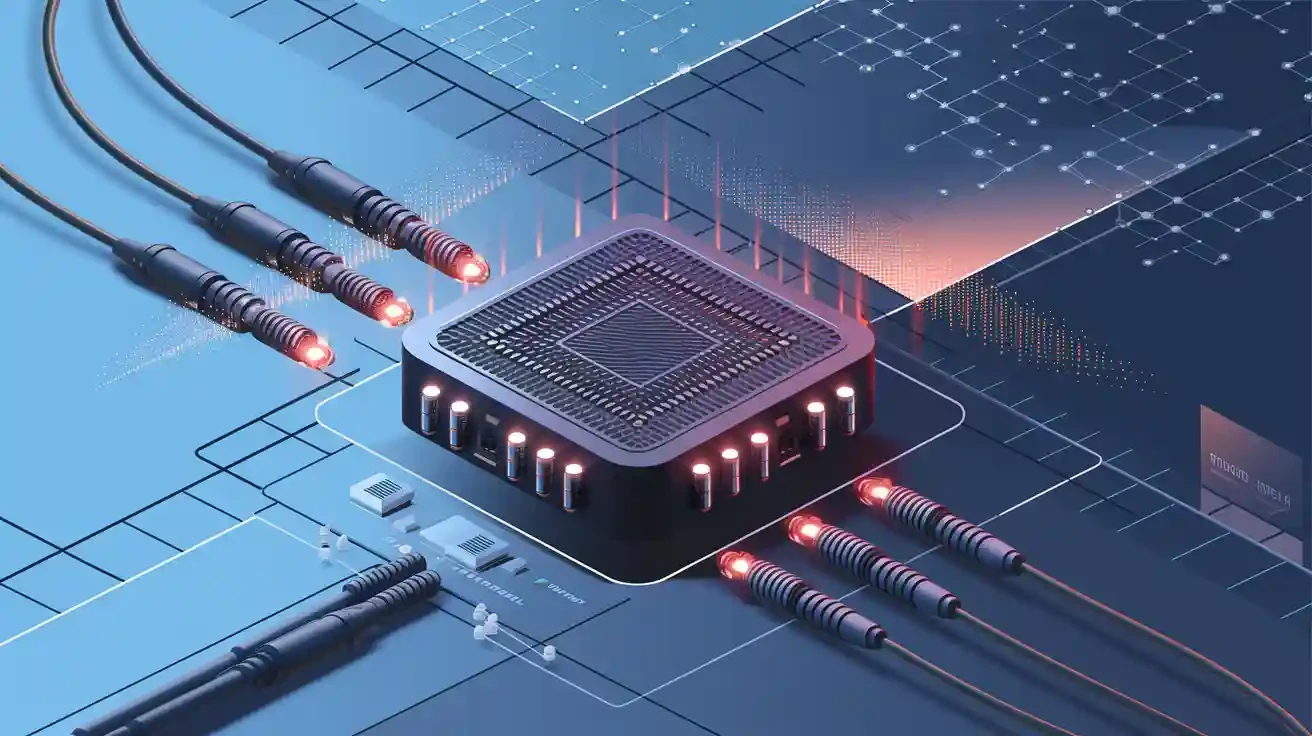

















An Connecteur LC duplex SFP est une interface à fibre optique utilisée dans de nombreux modules SFP (Small Form-Factor Pluggable) émetteurs-récepteurs optiques pour permettre une communication optique en duplex intégral. Le connecteur intègre deux interfaces LC (Lucent Connector) dans un seul boîtier compact, permettant à une fibre de transmettre des signaux optiques (TX) et à l’autre de les recevoir (RX). Cette conception à double fibre prend en charge la transmission bidirectionnelle simultanée de données, qui constitue le mode de fonctionnement standard de la plupart des liaisons optiques Ethernet et de télécommunications.
Les connecteurs LC duplex sont largement utilisés dans SFP, SFP+, and SFP28 des modules optiques car ils offrent plusieurs avantages importants : une taille compacte adaptée aux configurations de ports à haute densité, un alignement précis de la fibre grâce à une ferrule en céramique de 1,25 mm, et une compatibilité avec les systèmes à fibre monomode (SMF) et multimode (MMF). Alors que les réseaux modernes continuent d’augmenter la densité des ports dans les centres de données et les équipements de commutation, le format LC est devenu l’interface optique dominante pour de nombreux types d’émetteurs-récepteurs, notamment les modules optiques Ethernet 1G, 10G et 25G.
Il est important pour les ingénieurs réseau, les intégrateurs de systèmes et les concepteurs d'infrastructures de comprendre le fonctionnement des connecteurs LC duplex SFP. Une polarité correcte de la fibre, une manipulation adéquate des connecteurs et une bonne compréhension des chemins de signal TX/RX contribuent toutes à maintenir la stabilité des liaisons optiques. Une maîtrise solide de ces principes fondamentaux permet de garantir un déploiement fiable des émetteurs-récepteurs optiques dans des environnements tels que les centres de données, les réseaux de transport de télécommunications et les infrastructures dorsales d'entreprise.
En lisant cet article, vous apprendrez :
• Quelle Connecteur LC duplex SFP ce qu'est et comment il est structuré
• Comment fonctionnent les connecteurs LC duplex à l'intérieur des émetteurs-récepteurs optiques
• Les principales différences entre connecteurs de fibre optique simplex et duplex
• Pourquoi la plupart des modules optiques SFP utilisent Interfaces LC duplex
• Scénarios de déploiement courants dans centres de données, réseaux de télécommunications et infrastructures d'entreprise
▶️ What Does Duplex LC Mean in Fiber Optics
Dans les réseaux à fibre optique, le terme « Duplex LC » désigne une configuration de connecteur qui associe le format du connecteur LC à une architecture de communication à double fibre. Il s'agit de l'une des interfaces les plus couramment utilisées pour les émetteurs-récepteurs optiques, car elle permet une transmission de données en full-duplex fiable, indispensable pour la plupart des liaisons Ethernet et de télécommunications.
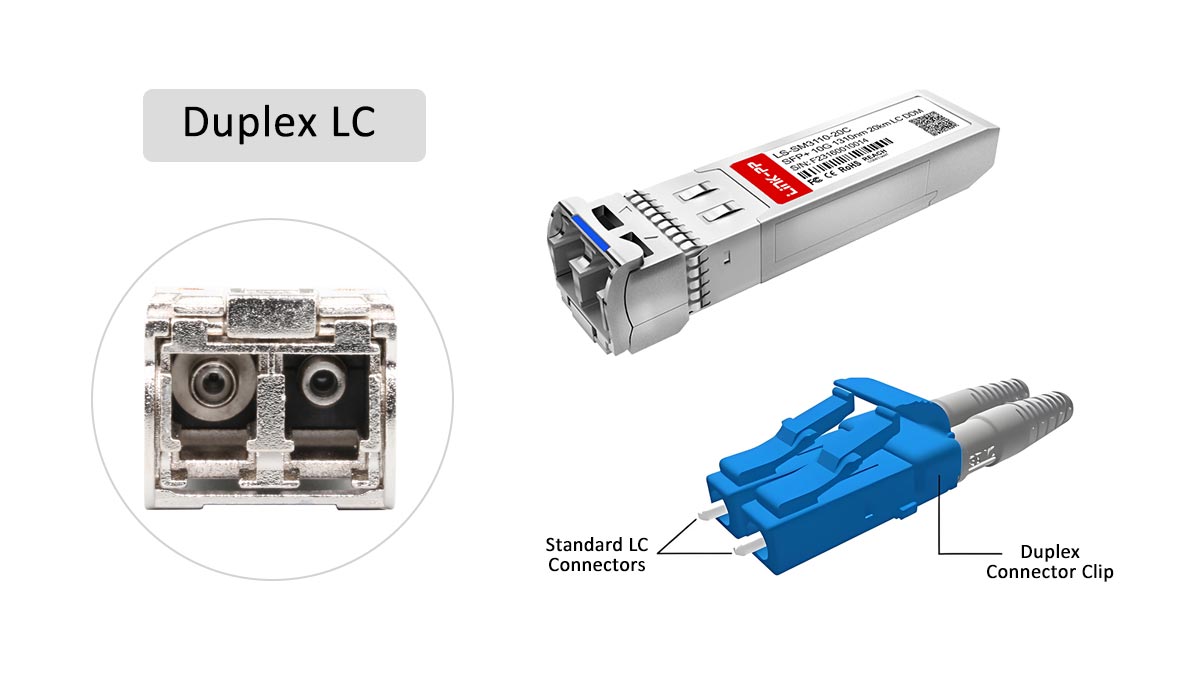
Pour comprendre la signification de LC duplex, il est utile d'examiner séparément les deux composantes de ce terme : LC and duplex.
LC : Connecteur Lucent
LC signifie Connecteur Lucent, un connecteur à fibre optique de petite taille initialement mis au point par Lucent Technologies et désormais normalisé dans de nombreux systèmes de réseaux optiques.
Le connecteur LC se caractérise par :
A Embout en céramique de 1,25 mm, qui aligne avec précision le cœur de la fibre
A encombrement réduit, soit environ la moitié de la taille des anciens connecteurs SC
A mécanisme de verrouillage à double action pour une insertion sûre et un retrait facile
Haute fiabilité dans environnements réseau à haute densité
Grâce à sa taille compacte, le connecteur LC permet aux fabricants d'équipements d'intégrer davantage de ports optiques sur les commutateurs, les routeurs et les serveurs. Cet avantage en termes de densité est l'une des principales raisons pour lesquelles les connecteurs LC sont largement utilisés dans les modules optiques SFP, SFP+ et SFP28.
Duplex : deux fibres fonctionnant en paire
En fibre optique, duplex désigne une configuration dans laquelle deux fibres optiques distinctes sont utilisées conjointement pour permettre une communication bidirectionnelle.
Dans une liaison à fibre optique duplex :
Une fibre transporte le émettre (TX) signal
L'autre fibre transporte le réception (RX) signal
Cette configuration permet une communication bidirectionnelle simultanée, communément appelée transmission en duplex intégral. Le fonctionnement en duplex intégral est essentiel pour les réseaux Ethernet, car les périphériques doivent pouvoir envoyer et recevoir des données simultanément sans provoquer de collisions.
Deux connecteurs LC reliés entre eux
A connecteur LC duplex Il se compose de deux connecteurs LC reliés entre eux par un clip duplex, formant ainsi une seule interface appariée. Chaque connecteur termine une fibre optique au sein d'un câble de raccordement duplex.
Dans les connexions classiques de modules SFP :
The Le port TX d'un appareil se connecte au port RX de l'appareil opposé
The Le port RX se connecte au port TX situé en face
Cette interconnexion garantit que les signaux optiques émis par un appareil sont correctement reçus par l'autre.
Grâce à cette architecture simple, normalisée et extrêmement fiable, les connecteurs LC duplex sont devenus l'interface optique par défaut pour la plupart des réseaux Ethernet 1G, 10G et 25G. Émetteurs-récepteurs SFP utilisées dans les réseaux à fibre optique modernes.
▶️ Structure of a Duplex LC Connector
Un connecteur LC duplex est constitué de la combinaison de deux connecteurs LC simplex en une seule interface appariée à l'aide d'un clip double face. Cette conception permet à deux fibres optiques de fonctionner conjointement — l'une pour la transmission des données et l'autre pour la réception — tout en conservant l'encombrement réduit requis par les équipements réseau à haute densité tels que les commutateurs, les routeurs et les émetteurs-récepteurs optiques.
Le format de connecteur LC est largement utilisé dans les modules SFP, SFP+ et autres modules à format compact des modules optiques, où un alignement précis des fibres et une connexion mécanique fiable sont essentiels pour garantir une transmission stable du signal optique.
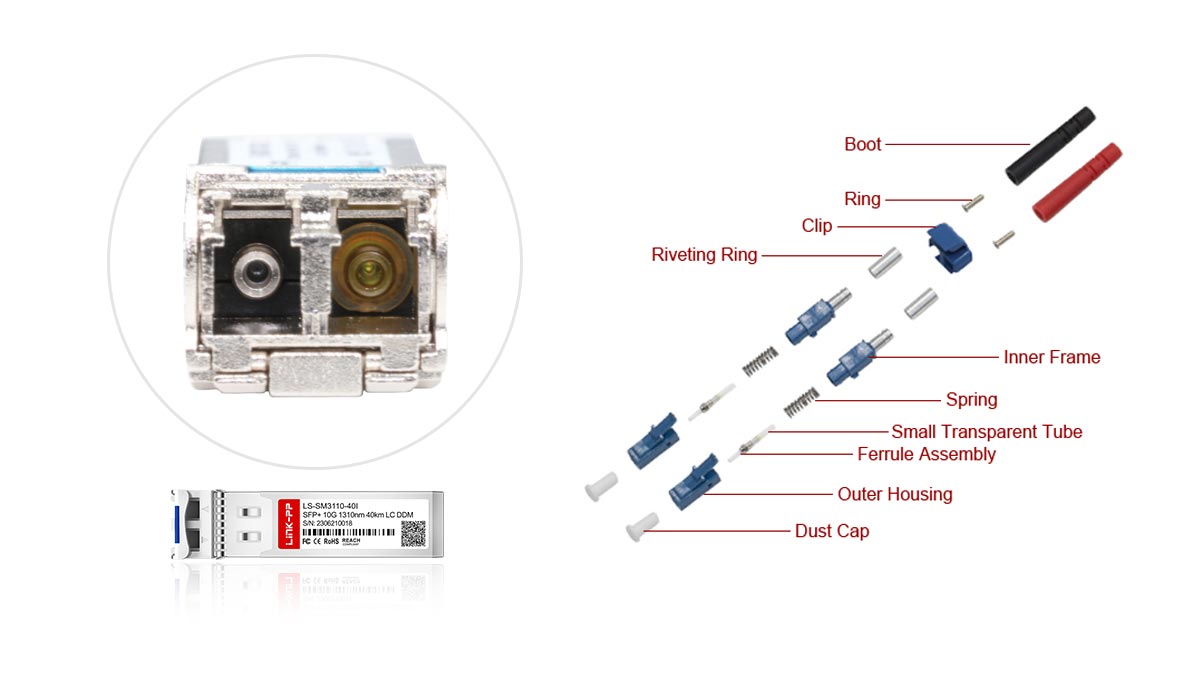
Composants clés d'un connecteur LC duplex
Un ensemble de connecteur LC duplex type comprend plusieurs éléments mécaniques et optiques importants :
• Embouts en céramique de 1,25 mm
Chaque connecteur LC contient un élément de précision Embout en céramique de 1,25 mm qui maintient et aligne la fibre optique. La ferrule garantit un positionnement précis du cœur de la fibre, permettant ainsi à la lumière de circuler efficacement entre deux connecteurs accouplés avec une perte d'insertion minimale.
• Manchon d'alignement de fibres
À l'intérieur du connecteur de l'adaptateur ou de l'émetteur-récepteur, un douille d'alignement permet d'aligner avec précision les deux embouts. Ce composant contribue à maintenir une faible perte optique et un couplage de signal constant entre les fibres connectées.
• Boîtier en plastique avec mécanisme de verrouillage
Le corps du connecteur est généralement fabriqué en plastique résistant et comprend un mécanisme de verrouillage à double action. Ce loquet maintient fermement le connecteur dans le port tout en permettant une insertion et un retrait rapides lors de l'installation ou de la maintenance.
• Clip double face
A clip double face Il maintient deux connecteurs LC côte à côte, formant ainsi une paire duplex. Ce clip assure un espacement et une orientation corrects entre les fibres d'émission et de réception, garantissant ainsi une polarité constante lorsqu'il est utilisé avec des câbles de raccordement à fibre optique duplex.
Pourquoi cette structure est-elle importante ?
La conception mécanique compacte du connecteur LC duplex offre plusieurs avantages pour les réseaux optiques :
Haute densité de ports dans les commutateurs et les équipements de centres de données
Alignement fiable de la fibre optique pour garantir des performances optiques stables
Installation et démontage faciles grâce au mécanisme de verrouillage
Compatibilité normalisée avec la plupart des émetteurs-récepteurs optiques de type SFP
En raison de ces caractéristiques structurelles, les connecteurs LC duplex sont devenus l'une des interfaces fibre optique les plus largement déployées dans les réseaux Ethernet et de télécommunications modernes.
▶️ How Duplex LC Connectors Work in Optical Transceivers
Dans le domaine des réseaux optiques, Les connecteurs LC duplex permettent une communication en duplex intégral entre les appareils en offrant des voies optiques distinctes pour la transmission et la réception des données.. La plupart SFP 1 G, SFP+ 10 G, and SFP28 25 G Les modules sont équipés d'une interface LC duplex afin de prendre en charge cette architecture de communication à deux fibres.
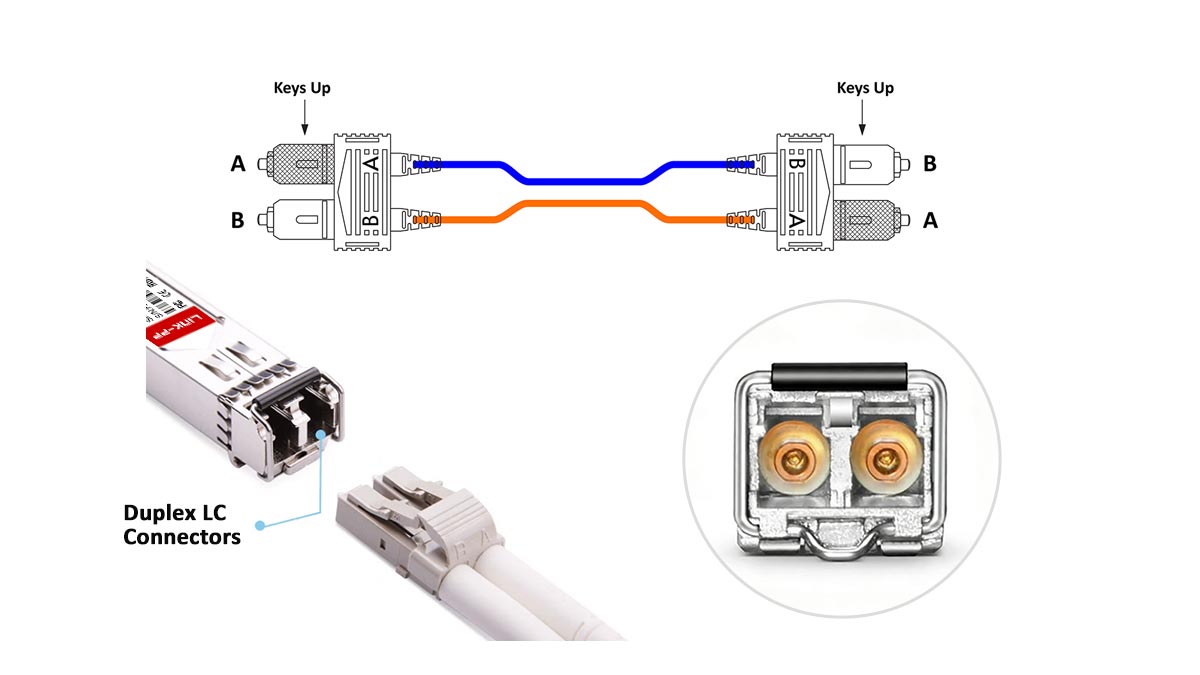
À l'intérieur d'un émetteur-récepteur optique, le connecteur LC duplex relie le module à un câble de raccordement à fibre optique duplex, qui contient deux fibres optiques. Chaque fibre remplit une fonction spécifique :
TX Fiber → Transmet le signal optique de l'émetteur-récepteur vers l'appareil distant
Fibre RX → Reçoit le signal optique provenant de l'appareil distant
Cette séparation des canaux d'émission et de réception permet aux deux appareils d'envoyer et de recevoir des données simultanément, ce qui rend possible une véritable communication Ethernet en duplex intégral.
Chemin du signal entre deux dispositifs optiques
Lorsque deux appareils — tels que commutateurs or routeurs—sont reliés à l'aide d'une fibre optique LC duplex, les chemins optiques doivent être correctement croisés pour établir la communication. Le port d'émission d'un appareil doit être connecté au port de réception de l'autre.
Le parcours du signal suit le schéma suivant :
Appareil A (TX)  →  Appareil B (RX)
Appareil B (TX)  →  Appareil A (RX)
Cette connexion croisée garantit que les signaux optiques générés par un émetteur-récepteur sont transmis au récepteur de l'émetteur-récepteur opposé. Dans la plupart des installations, les câbles de raccordement en fibre optique duplex sont fabriqués avec la polarité appropriée, de sorte que cette connexion s'établisse automatiquement lorsque les deux connecteurs sont branchés.
Transmission optique à l'intérieur de l'émetteur-récepteur
Au sein du SFP ou module SFP+ En soi, le processus de conversion du signal optique s'effectue dans deux sens :
Électrique vers optique (voie d'émission)
Les données du réseau entrent dans l'émetteur-récepteur sous forme de signal électrique. A diode laser (tel qu'un VCSEL pour l'optique multimode ou un laser DFB pour l'optique monomode) convertit le signal électrique en lumière modulée, qui est ensuite injectée dans la fibre d'émission via la ferrule LC.
Conversion optique-électrique (voie de réception)
La lumière provenant de l'appareil distant traverse le Fibre RX dans l'émetteur-récepteur, où un photodiode détecte le signal optique et le reconvertit en signal électrique destiné au périphérique réseau.
Pourquoi le connecteur LC duplex est-il idéal pour les émetteurs-récepteurs SFP ?
L'interface LC duplex est largement utilisée dans les émetteurs-récepteurs optiques car elle offre :
Taille compacte du connecteur, permettant ainsi une forte densité de ports sur les commutateurs et les routeurs
Alignement fiable de la fibre optique, garantissant un couplage optique stable
Compatibilité normalisée avec des câbles de raccordement Ethernet à fibre optique
Prise en charge des modules optiques monomodes et multimodes
C'est pour ces raisons que les connecteurs LC duplex sont devenus l'interface standard pour la plupart des émetteurs-récepteurs optiques SFP 1G, 10G et 25G utilisés dans les réseaux à fibre optique modernes.
▶️ Duplex LC vs. Simplex Fiber Connectors
En matière de connectivité par fibre optique, Les connecteurs LC peuvent être configurés en mode duplex ou simplex., en fonction du nombre de fibres utilisées pour la transmission du signal. Il est important de bien comprendre la différence entre ces deux configurations lors du choix des émetteurs-récepteurs optiques et des câbles de raccordement en fibre optique pour le déploiement d'un réseau.
A connecteur LC duplex utilise deux fibres pour prendre en charge des voies distinctes d'émission et de réception, ce qui correspond à l'architecture standard de la plupart des liaisons optiques Ethernet. En revanche, un connecteur LC simplex utilise une seule fibre optique et s'appuie sur la technologie de multiplexage en longueur d'onde pour assurer la communication bidirectionnelle.
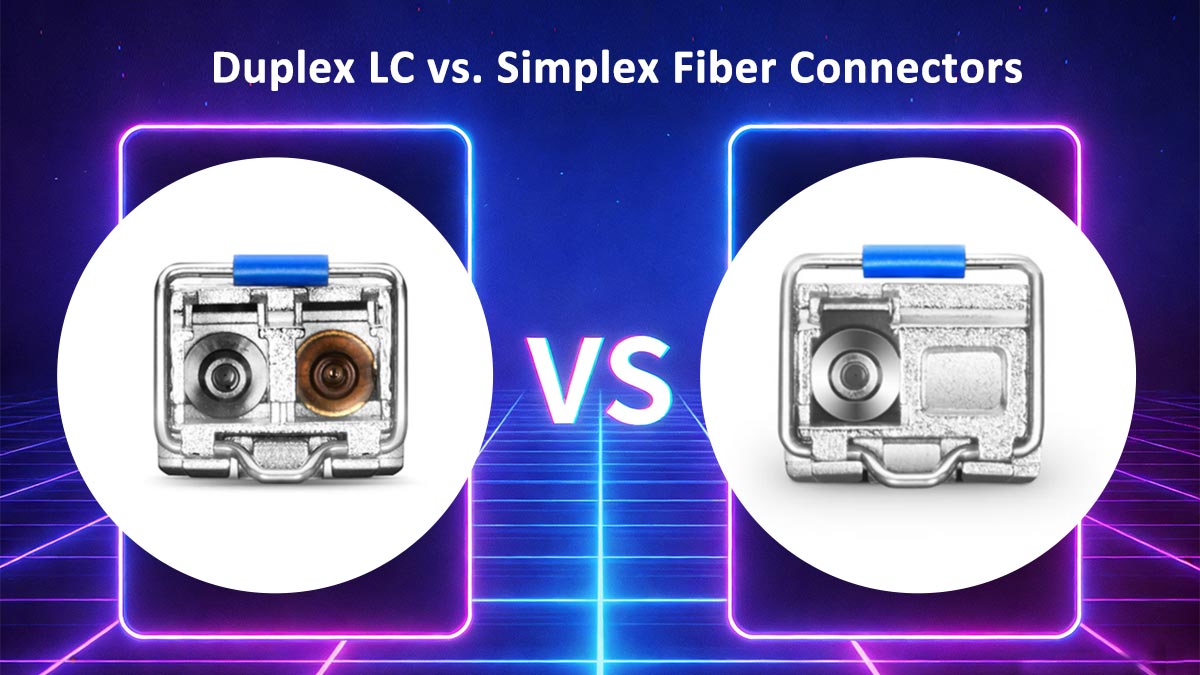
Principales différences entre le LC Duplex et le LC Simplex
Fonctionnalité | LC duplex | Simplex LC |
|---|---|---|
Teneur en fibres | 2 fibres | 1 fibre |
Canaux d'émission / de réception | Fibres distinctes pour l'émission et la réception | Fibre partagée utilisant différentes longueurs d'onde |
Modules types | SFP / SFP+ / SFP28 standard | BiDi Modules SFP (bidirectionnels) |
Applications courantes | Réseaux Ethernet et centres de données | WDM ou dans des environnements où la fibre optique est limitée |
En quoi la communication duplex diffère-t-elle de la communication simplex ?
In a configuration LC duplex, on utilise deux fibres optiques :
Une fibre transporte le émettre (TX) signal
L'autre fibre transporte le réception (RX) signal
Cette conception offre une voie de communication en duplex intégral simple et extrêmement fiable, ce qui explique son utilisation généralisée dans les normes Ethernet telles que 1000BASE-SX, 10GBASE-SR, and 10GBASE-LR.
A configuration LC simplex, en revanche, n'utilise qu'une seule fibre. Pour permettre une communication bidirectionnelle sur cette fibre unique, Émetteurs-récepteurs optiques BiDi émettre et recevoir des signaux à différentes longueurs d'onde. Par exemple, un côté peut émettre à 1 310 nm et recevoir à 1 550 nm, tandis que le côté opposé utilise les longueurs d'onde inverses.
Quand utiliser chaque type de connecteur ?
Les connecteurs LC duplex sont généralement utilisés dans des environnements où la disponibilité de la fibre optique ne constitue pas une contrainte et où une compatibilité maximale avec les modules optiques Ethernet standard est requise. Cela inclut notamment :
Interconnexions de centre de données
Réseaux dorsaux d’entreprise
Liaisons fibre optique de commutateur à commutateur
Les connecteurs Simplex LC sont plus couramment utilisés lorsque les ressources en fibre optique sont limitées, par exemple dans les réseaux d'accès longue distance ou dans les infrastructures de fibre optique existantes où l'installation de fibres supplémentaires s'avère difficile ou coûteuse.
Pour la plupart des équipements de réseau optique modernes, notamment les modules SFP et Émetteurs-récepteurs SFP+ Utilisé dans les réseaux Ethernet, le connecteur LC duplex reste l'interface la plus courante et la plus normalisée.
▶️ LC vs. SC vs. MPO Connectors
Les réseaux à fibre optique utilisent plusieurs types de connecteurs, chacun étant conçu pour répondre à des exigences de performance, des densités de ports et des architectures de transmission différentes. Parmi ceux-ci, Connecteurs LC, SC et MPO (ou MTP) sont les plus couramment rencontrées dans les équipements réseau modernes et les infrastructures à fibre optique.
Comprendre les différences entre ces types de connecteurs aide les ingénieurs réseau à choisir l'interface la mieux adaptée à des applications spécifiques telles que les émetteurs-récepteurs SFP, le câblage haute densité des centres de données ou les systèmes de télécommunications existants.
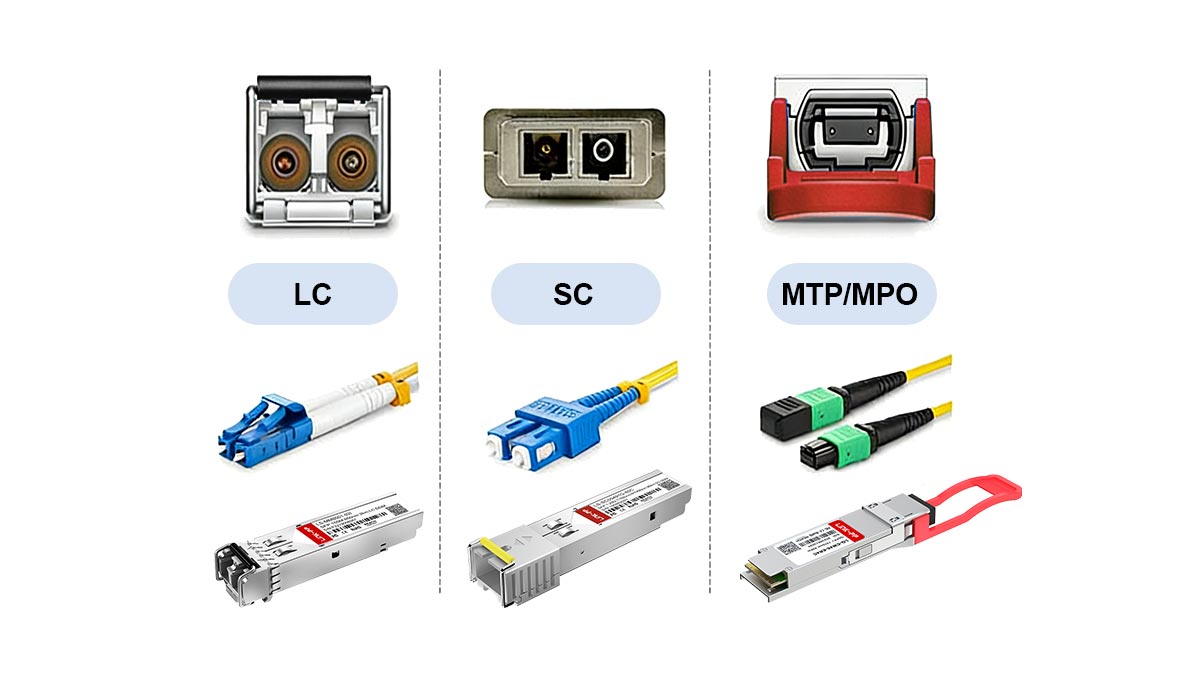
Comparaison des principaux types de connecteurs pour fibres optiques
Connecteur | Teneur en fibres | Utilisation typique |
|---|---|---|
LC | 2 (duplex) | Émetteurs-récepteurs optiques SFP / SFP+ / SFP28 |
SC | 1 ou 2 | Systèmes de télécommunications traditionnels et réseaux fibre optique d'entreprise |
MPO / MTP | 8 / 12 / 24 (ou plus) | Optiques parallèles à haut débit, telles que les 40G et 100G |
Connecteurs LC
The Connecteur LC est un connecteur de petite taille qui utilise un embout de 1,25 mm et un mécanisme de verrouillage à double action. Grâce à sa taille compacte, les équipements réseau peuvent prendre en charge une forte densité de ports optiques, ce qui est essentiel pour les commutateurs et routeurs modernes.
En raison de ces avantages, les connecteurs LC sont largement utilisés avec les modules optiques SFP, notamment :
SFP 1G (1000BASE-SX / LX)
10G SFP+ (10GBASE-SR / LR / ER)
Émetteurs-récepteurs SFP28 25G
La plupart de ces modules utilisent des interfaces LC duplex pour prendre en charge des fibres distinctes pour l'émission et la réception.
Connecteurs SC
The Connecteur SC (Connecteur d'abonné ou connecteur carré) est une interface fibre optique plus ancienne, mais toujours largement utilisée. Elle utilise un embout de 2,5 mm, ce qui le rend plus grand que les connecteurs LC.
Les connecteurs SC sont couramment utilisés dans :
Équipements de télécommunications obsolètes
Réseau optique passif infrastructure (PON)
Anciennes installations de fibre optique d'entreprise
Bien que les connecteurs SC offrent des performances fiables, leur taille plus importante les rend moins adaptés aux ports de commutateurs à haute densité, ce qui a contribué à la généralisation des connecteurs LC dans les équipements modernes.
Connecteurs MPO / MTP
MPO (Multi-Fiber Push-On) Les connecteurs sont conçus pour transmission par fibres parallèles, où plusieurs fibres sont regroupées dans un seul connecteur. Les connecteurs MPO prennent généralement en charge 8, 12, 24 fibres ou plus au sein d'une même interface.
Ces connecteurs sont couramment utilisés dans les environnements de centres de données à haut débit qui nécessitent une transmission optique parallèle, notamment :
Ethernet 40G (40GBASE-SR4)
Ethernet 100G (100GBASE-SR4 / SR10)
Câblage de liaison à haute densité en fibre optique
Le MTP est une variante haute performance du MPO qui améliore l'alignement mécanique et les performances optiques.
Pourquoi les connecteurs LC sont-ils les plus couramment utilisés pour les émetteurs-récepteurs SFP ?
Parmi ces types de connecteurs, les connecteurs LC offrent un équilibre optimal entre taille, performances et compatibilité. Leur conception compacte permet aux fabricants d'équipements d'optimiser la densité des ports tout en garantissant un alignement optique fiable et une faible perte d'insertion.
C'est pourquoi les connecteurs LC duplex sont désormais l'interface standard pour la plupart des émetteurs-récepteurs optiques SFP et SFP+ utilisés dans les réseaux Ethernet modernes.
▶️ Fiber Types Used with SFP Duplex LC Connectors
Les connecteurs LC duplex sont compatibles avec les deux multimode (MMF) and monomode (SMF) systèmes. Le choix du type de fibre dépend principalement de la distance de transmission requise, de l'architecture du réseau et de la norme de transcepteur optique utilisée.
Dans les réseaux optiques Ethernet, de nombreux Émetteurs-récepteurs SFP, SFP+ et SFP28 Utilisez des interfaces LC duplex, que le module soit conçu pour une fibre multimode ou monomode. Le format du connecteur reste le même, tandis que les composants optiques et les longueurs d'onde à l'intérieur de l'émetteur-récepteur déterminent le type de fibre pris en charge et la distance de transmission.
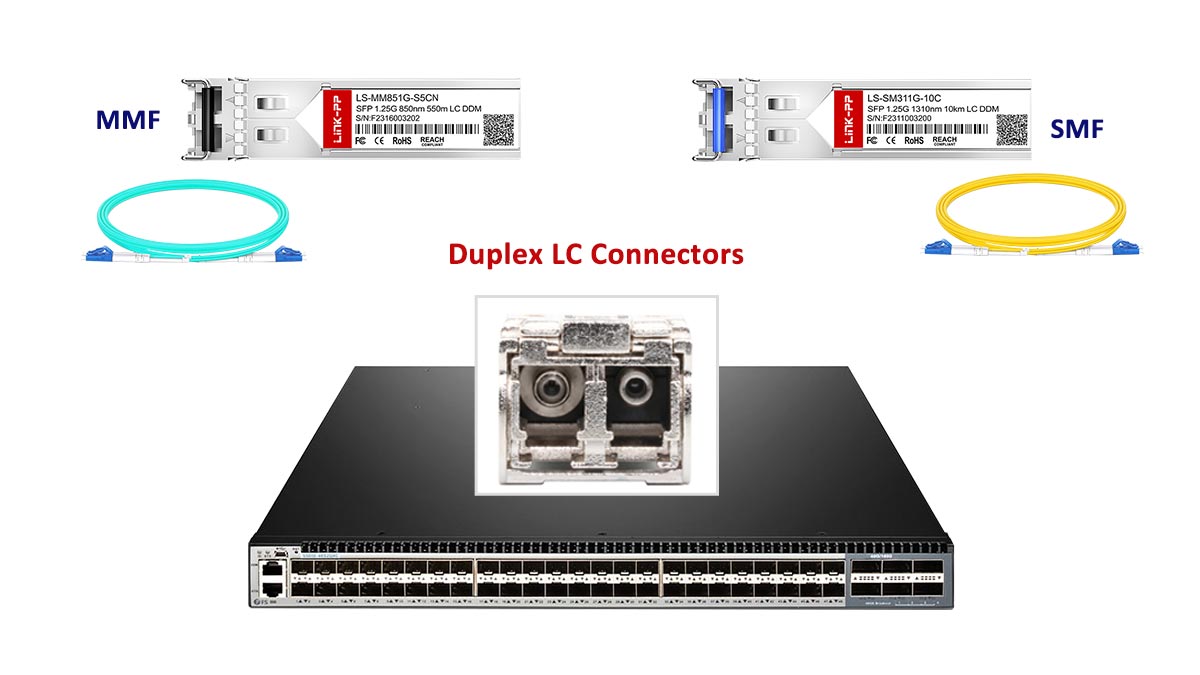
Fibre multimode (MMF)
Fibre multimode est généralement utilisé pour les communications sur des distances courtes à moyennes au sein de bâtiments, de campus et de centres de données. Il présente un diamètre de cœur plus important (généralement 50 µm ou 62,5 µm), ce qui permet plusieurs chemins de propagation de la lumière, ce qui le rend adapté aux connexions à large bande passante sur des distances relativement courtes.
Émetteurs-récepteurs optiques multimodes fonctionnent généralement à une longueur d'onde de 850 nm et utilisent souvent Les lasers (Laser à cavité verticale émettant par la surface) technologie.
Modules optiques Ethernet courants qui utilisent connecteurs LC duplex avec fibre multimode Connexions à faible distance, efficaces et à faible coût
Norme optique | Distance maximale typique | Type de fibre |
|---|---|---|
1000BASE-SX | Jusqu'à 550 m (OM2) | Fibre multimode |
10GBASE-SR | Jusqu'à 300 m (OM3) / 400 m (OM4) | Fibre multimode |
Jusqu'à 70 m (OM3) / 100 m (OM4) | Fibre multimode |
En raison de son rapport coût-efficacité et de ses performances en termes de bande passante sur de courtes distances, la fibre multimode est largement utilisée dans les liaisons entre commutateurs des centres de données et pour la connectivité des serveurs.
Fibre monomode (SMF)
Fibre monomode est conçu pour la transmission optique sur de longues distances. Son diamètre de cœur est nettement plus petit, généralement de l'ordre de 9 µm, ce qui permet à la lumière de se propager selon un seul chemin optique. Cela réduit la dispersion modale et permet une communication fiable sur des distances nettement plus longues.
Émetteurs-récepteurs monomodes fonctionnent généralement à longueurs d'onde de 1 310 nm ou 1 550 nm et utilisent couramment Lasers DFB (à rétroaction distribuée) pour une transmission stable sur de longues distances.
Parmi les modules optiques Ethernet courants qui utilisent des connecteurs LC duplex avec une fibre monomode, on peut citer :
Norme optique | Distance maximale typique | Type de fibre |
|---|---|---|
Jusqu’à 10 km | Fibre monomode | |
10GBASE-LR | Jusqu’à 10 km | Fibre monomode |
Jusqu’à 40 km | Fibre monomode |
La fibre monomode est couramment utilisée dans les réseaux de télécommunications, les réseaux métropolitains et les liaisons interurbaines des réseaux dorsaux d'entreprise, où une portée étendue et une transmission stable du signal sont requises.
Pourquoi le connecteur LC duplex fonctionne avec les deux types de fibre optique
Le connecteur LC duplex est compatible avec tous les types de fibres ; cela signifie qu'il peut être raccordé aussi bien à des fibres multimodes qu'à des fibres monomodes, à condition d'utiliser le câble de raccordement et l'émetteur-récepteur adaptés. Cette flexibilité est l'une des raisons pour lesquelles les connecteurs LC duplex sont devenus l'interface dominante pour les réseaux optiques basés sur la technologie SFP, quel que soit le standard de transmission ou l'environnement réseau.
▶️ Common Applications of Duplex LC Connectors
Grâce à leur taille compacte, à leur alignement optique fiable et à leur compatibilité avec de nombreuses normes Ethernet, Les connecteurs LC duplex sont largement utilisés dans divers types de réseaux à fibre optique. Elles sont couramment utilisées avec les émetteurs-récepteurs optiques SFP, SFP+ et SFP28, ce qui en fait une interface standard pour les communications optiques à courte et à longue portée.
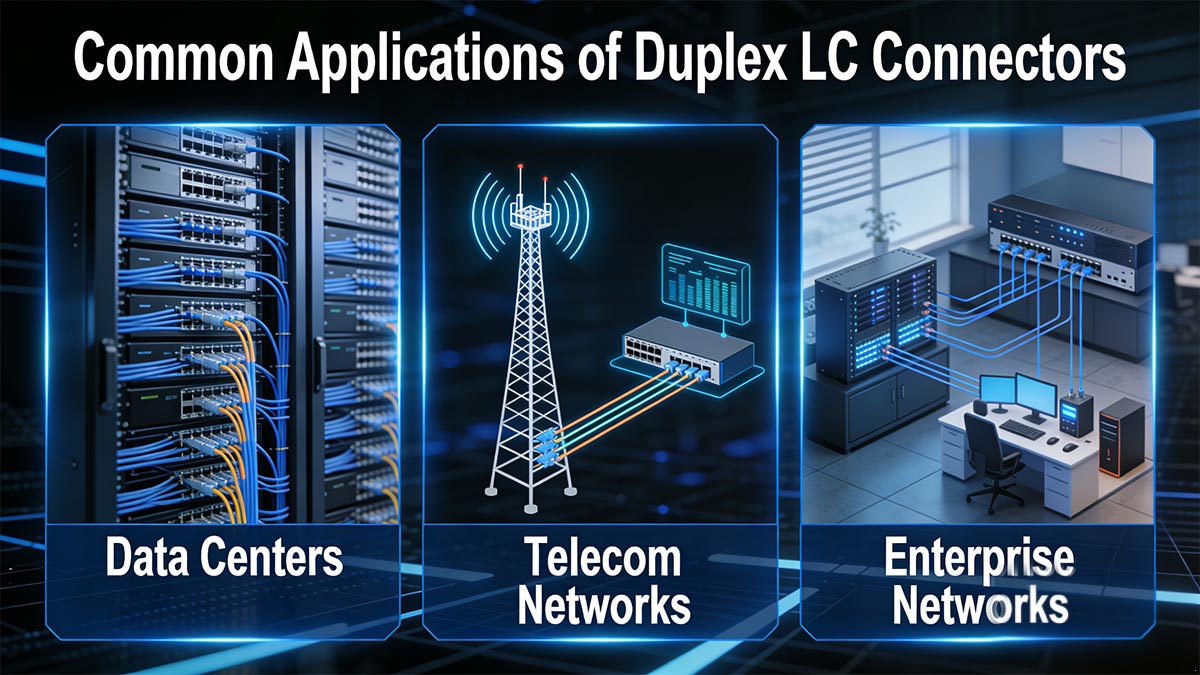
Vous trouverez ci-dessous quelques-uns des environnements les plus courants dans lesquels les connecteurs LC duplex sont utilisés.
Centres de données
Dans les centres de données modernes, les équipements réseau nécessitent une densité de ports élevée et une connectivité optique haut débit fiable. Grâce à leur faible encombrement, les connecteurs LC permettent aux commutateurs et aux serveurs de prendre en charge un grand nombre de ports optiques dans un espace de rack restreint.
Parmi les applications courantes des centres de données, on peut citer :
Liaisons entre commutateurs au sein d'architectures de type « agrégation » ou « spine-leaf »
Connectivité serveur utilisation de liaisons montantes par fibre optique pour les charges de travail nécessitant une bande passante élevée
Liaisons à courte portée utilisant des composants optiques multimodes tels que 10GBASE-SR or 25GBASE-SR
Ces déploiements utilisent généralement des câbles de raccordement LC multimode duplex pour relier les émetteurs-récepteurs optiques entre les commutateurs et les serveurs.
Réseaux de télécommunications
Les connecteurs LC duplex sont également largement utilisés dans réseaux de transport de télécommunications, en particulier lorsque des modules optiques de type SFP sont utilisés.
Parmi les applications typiques dans le domaine des télécommunications, on peut citer :
Liaisons du réseau de métro raccordement des équipements d'agrégation et d'accès
Liaisons optiques longue distance à l'aide d'une fibre monomode
les systèmes DWDM, où des connecteurs LC duplex relient les émetteurs-récepteurs à des équipements passifs de multiplexage en longueur d'onde
Dans ces environnements, les connecteurs LC duplex offrent une interface fiable pour les modules optiques fonctionnant à des longueurs d'onde telles que 1310 nm ou 1550 nm.
Réseaux d'entreprise
De nombreux réseaux de campus d'entreprise s'appuient sur des liaisons de dorsale en fibre optique entre les bâtiments ou entre les couches de distribution et de commutation centrale. Les connecteurs LC duplex sont couramment utilisés dans ces environnements, car ils prennent en charge les normes Ethernet largement répandues tout en restant compatibles avec les panneaux de brassage en fibre optique standard.
Parmi les applications d'entreprise courantes, on peut citer :
Les liaisons dorsales inter-bâtiments entre les bâtiments
Infrastructure de commutation centrale au sein des réseaux d'entreprise
Liaisons montantes par fibre optique reliant les commutateurs d'accès aux commutateurs d'agrégation ou aux commutateurs centraux
Dans ces cas de figure, les connecteurs LC duplex sont généralement raccordés à câbles de raccordement en fibre optique monomode ou multimode lié à émetteurs-récepteurs optiques SFP dans les commutateurs réseau.
Que ce soit dans les centres de données, les réseaux de télécommunications ou les environnements d'entreprise, l'interface LC duplex continue de jouer un rôle essentiel pour garantir une connectivité optique fiable et normalisée au sein des réseaux de fibre optique modernes.
▶️ FAQs About SFP Duplex LC Connectors
1. Qu'est-ce qu'un connecteur LC duplex ?
A connecteur LC duplex est une configuration de connecteur à fibre optique qui combine deux connecteurs LC sur une seule interface appariée. Chaque connecteur est relié à une fibre optique, ce qui permet de disposer de voies distinctes pour la transmission et la réception des signaux optiques.
Dans la plupart des réseaux optiques :
Une fibre transporte le émettre (TX) signal
L'autre fibre transporte le réception (RX) signal
Cette architecture à deux fibres permet communication en duplex intégral, qui est le mode de fonctionnement standard des liaisons optiques Ethernet utilisées dans les commutateurs, les routeurs et les serveurs.
2. Pourquoi la plupart des émetteurs-récepteurs SFP utilisent-ils des connecteurs LC duplex ?
La plupart des émetteurs-récepteurs optiques SFP, SFP+ et SFP28 utilisent des connecteurs LC duplex, car ceux-ci offrent un bon compromis entre taille compacte, alignement optique fiable et compatibilité normalisée avec des câbles de raccordement à fibre optique.
Les raisons principales incluent :
Haute densité de ports – Les connecteurs LC sont plus petits que les anciens modèles, tels que les connecteurs SC, ce qui permet d'intégrer davantage de ports optiques sur les équipements réseau
Couplage optique fiable – the embout de 1,25 mm assure un alignement précis des fibres pour une transmission stable du signal
Architecture Ethernet normalisée – la plupart des normes optiques Ethernet s'articulent autour de fibres d'émission et de réception distinctes
Grâce à ces avantages, l'interface LC duplex est devenue la type de connecteur par défaut pour de nombreux 1G, 10G, and 25G émetteurs-récepteurs optiques utilisées dans les réseaux modernes.
3. Un connecteur LC duplex peut-il fonctionner avec une fibre monomode ?
Oui. Les connecteurs LC duplex sont compatibles à la fois avec la fibre monomode (SMF) et la fibre multimode (MMF).
Le connecteur lui-même sert simplement d'interface mécanique pour la terminaison de la fibre optique. Le type de fibre et longueur d'onde optique sont déterminées par le module optique et le câble de raccordement utilisés.
Par exemple :
Applications monomodes : 1000BASE-LX, 10GBASE-LR, 10GBASE-ER
Applications multimodes : 1000BASE-SX, 10GBASE-SR, 25GBASE-SR
Tant que le câble de raccordement en fibre optique et l'émetteur-récepteur optique sont conformes à la norme requise, les connecteurs LC duplex peuvent être utilisés dans l'un ou l'autre de ces environnements.
4. Quelle est la différence entre le mode duplex et le mode simplex sur une liaison LC ?
La principale différence entre des connecteurs LC duplex and LC simplex les connecteurs, c'est le nombre de fibres utilisées pour la communication.
Type de connecteur | Teneur en fibres | Mode de communication |
|---|---|---|
LC duplex | 2 fibres | Canaux d'émission (TX) et de réception (RX) distincts |
Simplex LC | 1 fibre | Transmission bidirectionnelle sur une seule fibre optique |
Utilisation des connecteurs LC duplex deux fibres, ce qui permet la transmission et la réception simultanées. Cette conception est utilisée dans la plupart des modules optiques Ethernet.
Les connecteurs Simplex LC sont généralement utilisés dans Émetteurs-récepteurs optiques BiDi, qui utilisent différentes longueurs d'onde pour envoyer et recevoir des signaux via une seule fibre optique.
5. Une fibre optique peut-elle remplacer un connecteur LC duplex ?
Dans certains cas, Oui, mais uniquement avec des modules optiques spécialisés.
Les émetteurs-récepteurs optiques standard nécessitent deux fibres et utilisent donc des connecteurs LC duplex. Cependant, Émetteurs-récepteurs optiques BiDi (bidirectionnels) sont conçus pour fonctionner sur une fibre unique.
Ces modules utilisent multiplexage en longueur d’onde (WDM) technologie, où :
Une seule longueur d'onde est utilisée pour la transmission
Une longueur d'onde différente est utilisée pour la réception
Par exemple, un module peut émettre à 1 310 nm et réception à 1 550 nm, tandis que le module opposé utilise les longueurs d'onde inverses.
Bien que les solutions à fibre unique permettent de réduire la consommation de fibre, les connexions LC duplex restent la configuration la plus courante et la plus largement prise en charge dans les réseaux optiques Ethernet.
▶️ Conclusion: Understanding the Role of Duplex LC Connectors in Optical Networks
Les connecteurs LC duplex sont désormais les interface optique standard pour de nombreux émetteurs-récepteurs modernes car ils allient un format compact, un alignement précis des fibres et une prise en charge fiable de la communication en duplex intégral. Grâce à l'utilisation de deux fibres — l'une dédiée à la transmission des signaux optiques et l'autre à leur réception —, les connecteurs LC duplex offrent une architecture simple et très stable pour les liaisons optiques Ethernet et de télécommunications.
Their format compact et conception avec ferrule de 1,25 mm permettent une forte densité de ports sur les commutateurs, les routeurs et les serveurs, tout en garantissant un alignement précis de la fibre optique et une faible perte d'insertion. Ces caractéristiques rendent les connecteurs LC duplex particulièrement adaptés à Émetteurs-récepteurs optiques SFP, SFP+ et SFP28, qui sont largement utilisés aussi bien dans les réseaux à fibre multimode à courte portée que dans les réseaux à fibre monomode à longue portée.
Dans les environnements réseau modernes, notamment centres de données, les réseaux de transport de télécommunications et les infrastructures de campus d'entreprise : les connecteurs LC duplex jouent un rôle essentiel pour garantir une connectivité par fibre optique fiable. Leur compatibilité avec les câbles de raccordement en fibre optique standard et les normes optiques Ethernet assure un déploiement simple et une interopérabilité à long terme entre différentes plateformes réseau.
Alors que les réseaux optiques continuent de gagner en bande passante et en densité de ports, le connecteur LC duplex reste l'une des interfaces les plus répandues et les plus fiables pour les communications par fibre optique.
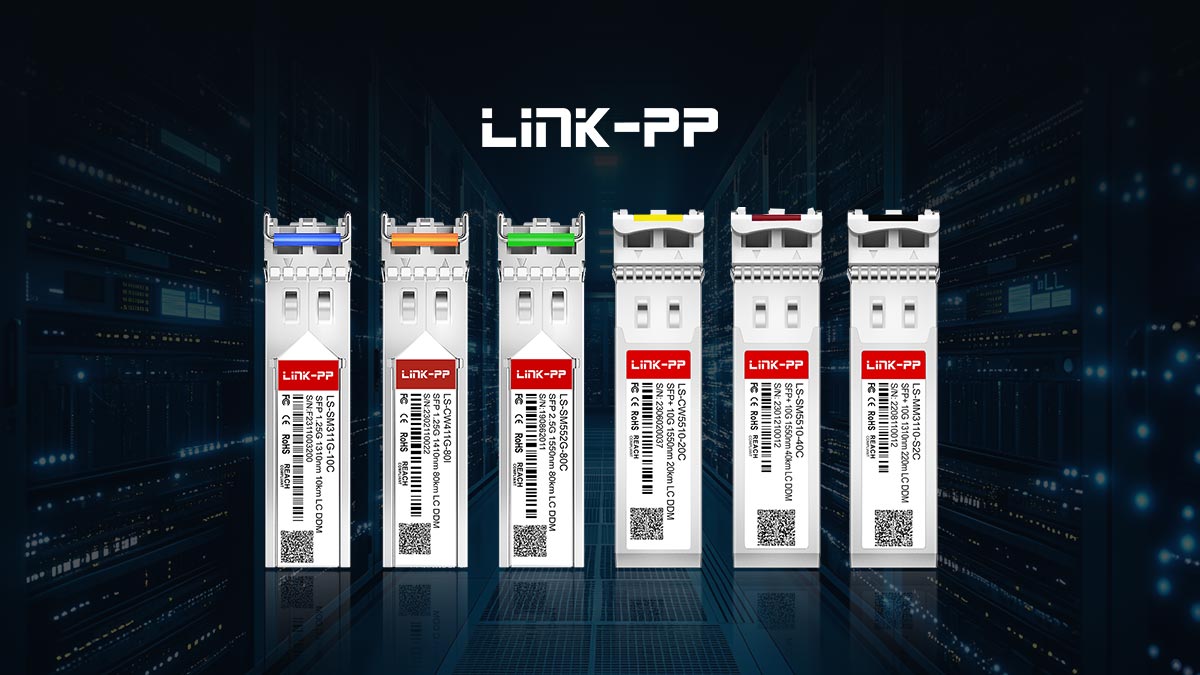
Découvrez la haute performance Émetteurs-récepteurs optiques SFP dotés d'interfaces LC duplex conçu pour offrir des réseaux fibre optique fiables et évolutifs au niveau de la Boutique officielle LINK-PP, et découvrez des solutions optimisées pour les applications modernes des centres de données et des télécommunications.