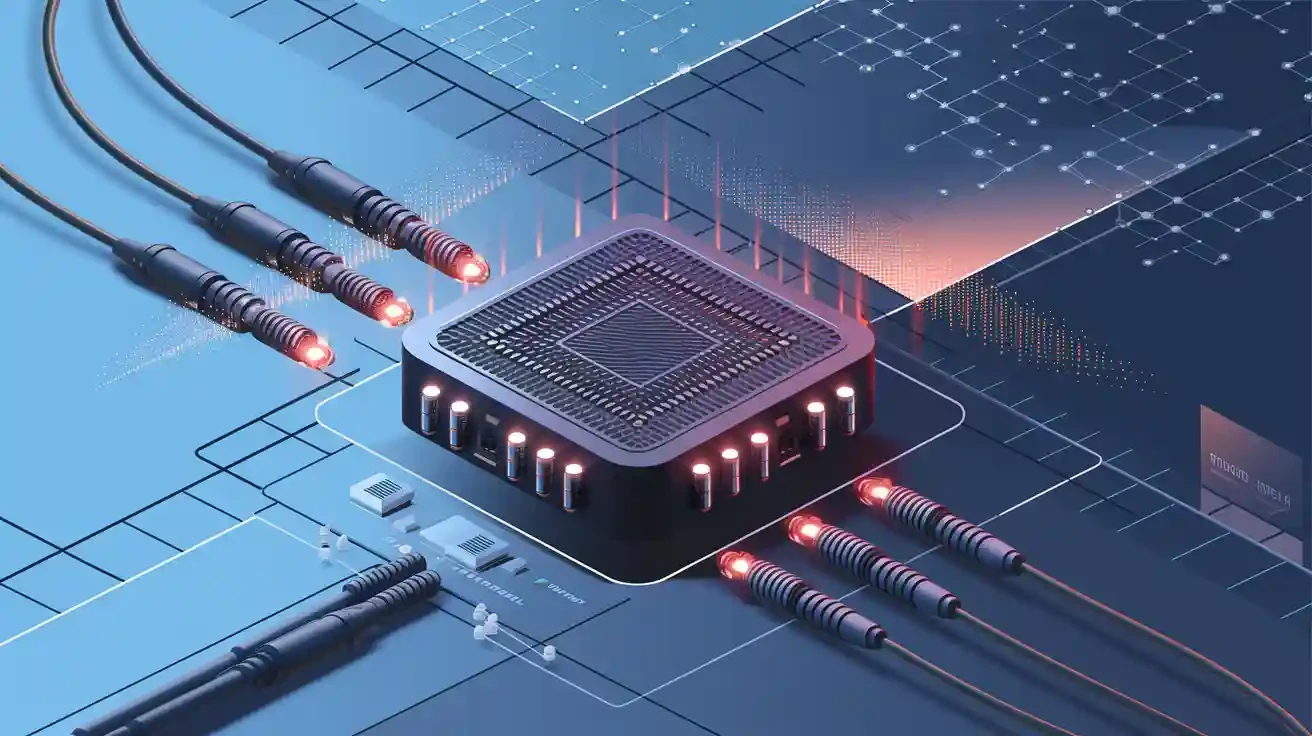

















In an era defined by data explosion—from streaming 4K video and IoT devices to massive cloud computing and AI workloads—network bandwidth is the lifeblood of modern business. While 10G and 40G Ethernet have served us well, they are increasingly becoming bottlenecks. Enter Ethernet de 100 gigabits (100GbE), the high-speed backbone that is redefining network infrastructure for hyperscale data centers, telecommunications, and enterprise networks.
This isn’t just an incremental upgrade; it’s a fundamental shift. Understanding 100GbE is crucial for anyone involved in network planning, data center management, or IT infrastructure. This guide will demystify 100 Gigabit Ethernet, covering its core technology, undeniable benefits, and the critical components that make it work, including a deep dive into the essential optical modules. We’ll also explore how choosing the right partners, like LINK-PP, can ensure a smooth and successful implementation.
📁 Key Takeaways
Ethernet de 100 gigabits moves data very fast. It is great for new data centers and big networks.
Businesses can work better with 100 Gigabit Ethernet. Files move faster and video calls are smoother.
You need the right tools, like QSFP28 ports and CAT7 or fiber optic cables. These help 100 Gigabit Ethernet work its best.
This technology lets networks get bigger. It does not lose speed or trust when growing.
Upgrading to 100 Gigabit Ethernet gets your network ready for the future. It helps with new needs and new technology.
📁 What is 100 Gigabit Ethernet?
Ethernet de 100 gigabits (100GbE) is a standard defined by the IEEE 802.3ba and subsequent amendments that supports data transfer rates of 100 gigabits per second (Gbps). To put that into perspective, it’s about 10,000 times faster than a standard broadband connection, allowing you to transfer the entire contents of a Blu-ray disc in under a second.
Unlike its predecessors that often used a single lane of data, 100GbE achieves its staggering speed by aggregating multiple lanes. Common configurations use 4 lanes of 25Gbps or 10 lanes of 10Gbps. This parallel architecture is key to its performance and efficiency, making it the de facto choice for handling the immense traffic of modern infraestructura de red de alta velocidad.
📁 Key Benefits and Applications of 100G Ethernet
Why is the industry rapidly adopting 100G? The advantages are clear and impactful.
Unprecedented Bandwidth: The most obvious benefit. It eliminates network congestion, ensuring smooth operation for data-intensive applications.
Improved Scalability and Density: 100GbE switches and routers offer higher port density, meaning you can connect more devices at a higher speed within the same physical space, reducing both capital and operational expenses.
Latencia reducida: Critical for real-time applications like financial trading, online gaming, and scientific simulations.
Futuro-Prueba: Investing in 100G technology prepares your network for emerging trends like backhaul 5G, 8K video streaming, and large-scale AI model training.
Aplicaciones principales:
Interconexiones entre centros de datos (DCI): Connecting servers within and between data centers.
Service Provider Core Networks: The backbone for internet service providers and telecommunications companies.
Clústeres de computación de alto rendimiento (HPC): For research institutions and enterprises running complex simulations and big data analytics.
Enterprise Network Aggregation: Consolidating multiple lower-speed links into a high-capacity 100G backbone.
📁 A Technical Deep Dive: How 100G Works
En su esencia, 100 GbE relies on specific capa física (PHY) standards and interface form factors. The most common form factor you’ll encounter is the QSFP28 (Quad Small Form-factor Pluggable 28), which is designed specifically for 100G applications and is both compact and power-efficient.
100G can run over different media, each with its own reach and use case:
Conexión directa de cobre (DAC): Short-range, cost-effective cables for top-of-rack switching.
Active Optical Cables (AOC): Similar to DAC but with optical fibers for slightly longer reaches within a data hall.
Optical Transceivers with Fiber: The most flexible and common solution for most deployments, especially over longer distances. This is where optical modules become indispensable.
The following table compares the common 100G physical media:
Tipo de medio | Formato | Recorrido | Mejor caso de uso |
|---|---|---|---|
Conexión directa de cobre (DAC) | QSFP28 | Up to 5 meters | Short server-to-switch connections |
Cable óptico activo (AOC) | QSFP28 | Hasta 100 metros | Intra-rack and inter-rack connectivity |
Multimode Fiber (SR4) | QSFP28 | Hasta 100 metros | Data center premises, campus networks |
Single-mode Fiber (LR4/ER4) | QSFP28 | 10km to 40km | Interconexiones de larga distancia entre centros de datos |
📁 The Heart of 100G: Optical Transceiver Modules
You can’t talk about Ethernet de 100 gigabits without highlighting módulos transceptores ópticos. These small, hot-pluggable devices are the workhorses that convert electrical signals from the network equipment into optical signals for transmission over . Necesitan ser cuidadosamente grabados sobre una señal portadora para viajar grandes distancias. Este proceso se llama, and vice-versa. Choosing high-quality, reliable modules is paramount for network performance and uptime.
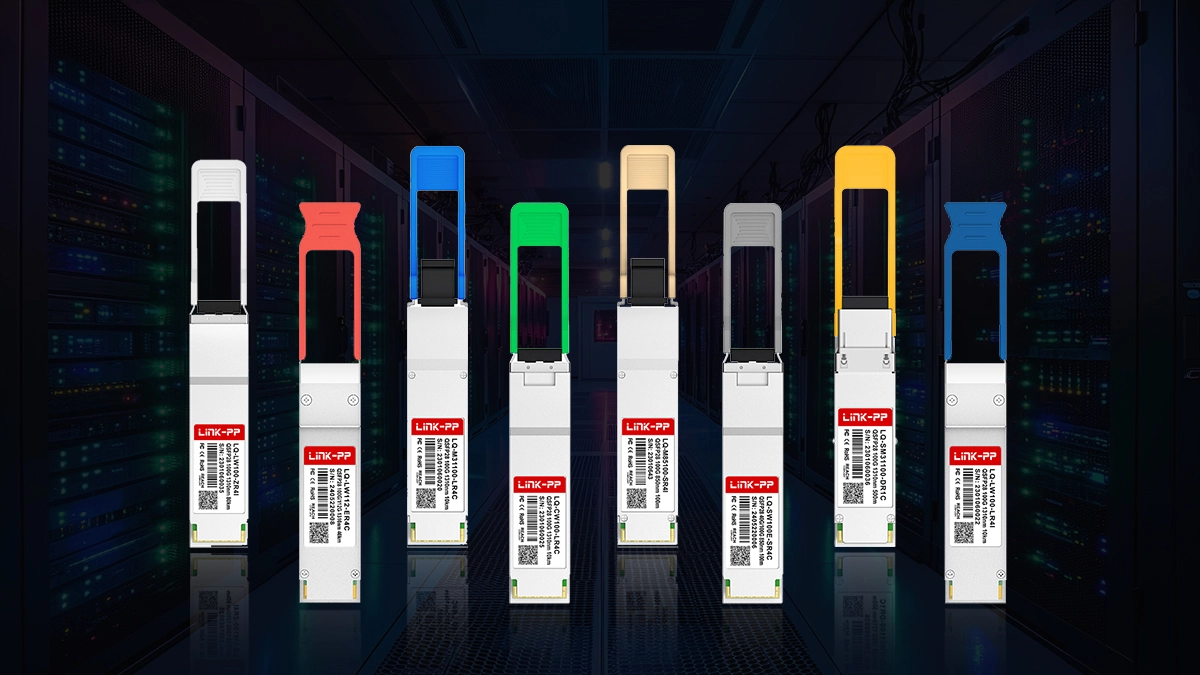
For 100G, the factor de forma QSFP28 is the industry standard. Key types include:
100G-SR4: Uses multimode fiber for short reaches (~100m). It transmits over four parallel fibers in each direction.
100G-LR4
: Uses single-mode fiber for long reaches (~10km). It uses Wavelength Division Multiplexing (WDM) to transmit four wavelengths over a single pair of fibers.100G-ER4: An extended reach version for distances up to 40km.
When sourcing these critical components, compatibility, performance, and warranty are key. This is where a trusted manufacturer like LINK-PP stands out. Their modules are designed to be fully interoperable with major switch vendors, ensuring a seamless integration into your existing data center switching fabric.
Por ejemplo, el LINK-PP QSFP28-100G-LR4 optical module is a premium solution for long-haul connections. It offers robust performance over 10km on single-mode fiber, low power consumption, and comprehensive funciones de monitoreo digital de diagnóstico (DDM) capabilities. Integrating such high-quality components from LINK-PP is a strategic move for building a resilient and high-performance infraestructura de red de 100 G.
📁 100G vs. The Predecessors: A Clear Comparison
Is 100G really that much better? Let’s look at the numbers. This comparison highlights why upgrading is more than just a speed boost—it’s an efficiency game.
Métrica | Ethernet de 10 Gigabit | Ethernet de 40 Gigabits | Ethernet de 100 gigabits |
|---|---|---|---|
Velocidad de datos | 10 Gbps | 40 Gbps | 100 Gbps |
Factor de forma común | SFP+ | QSFP+ | QSFP28 |
Caso de uso típico | Server access, LAN core | Data center aggregation, HPC | Data center spine, DCI, core network |
Bandwidth per Rack Unit | Lower | Medio | , Agotamiento de Fibra |
Cost per Gigabit | Superior | Medio | Lowest (over time) |
Eficiencia energética | Menos eficiente | Moderada | Most Efficient |
Como muestra la tabla, 100G provides the lowest cost per gigabit and the highest density, making it the most economically sensible choice for scaling modern networks. This is a critical consideration for anyone planning a data center upgrade or network expansion.
Implementing 100G: Key Considerations
Planning a move to 100G? Here are some critical factors to keep in mind:
Infrastructure Audit: Assess your current fiber plant. Do you have enough single-mode or multimode fibers? What about the physical space and power in your racks?
Switch and Router Selection: Choose core and spine switches that support QSFP28 ports and offer the necessary throughput.
Budgeting for Optics: Remember that the cost of optical transceivers can be a significant part of the total investment. Partnering with a third-party manufacturer like LINK-PP can lead to substantial cost savings without compromising on quality or performance.
Skill Set: Ensure your IT team is trained on the specifics of 100G troubleshooting and management. Exploring 100G Ethernet best practices is a great starting point.
📁 Conclusion: The Future is 100G and Beyond
Ethernet de 100 gigabits is no longer a technology of the future; it is the foundation of today’s most demanding network environments. Its unparalleled speed, density, and efficiency are solving the bandwidth challenges posed by our data-driven world. From understanding the core technology to selecting the right transceptores ópticos, a successful deployment hinges on careful planning and choosing reliable components.
The transition to 100G is a significant step towards even faster technologies like 400G and 800G. Building your network on a solid 100G foundation today ensures you are well-positioned for the next wave of innovation.
📁 FAQ
What is 100 Gigabit Ethernet used for?
100 Gigabit Ethernet helps move lots of data fast. It works well in data centers and big networks. Many devices can connect and get quick speeds.
What equipment do you need for 100 Gigabit Ethernet?
You need switches, routers, and network cards for 100G. Look for QSFP28 ports on your devices. Use CAT7 or fiber optic cables for best speed.
What makes 100 Gigabit Ethernet different from older standards?
100 Gigabit Ethernet sends data much faster than 10G or 40G. You get better speed and more reliable connections. More users and devices can work at once.
What should you check before upgrading to 100 Gigabit Ethernet?
Check if your equipment supports 100G speeds. Make sure your cables and ports fit the new standard. You might need to buy new hardware.