















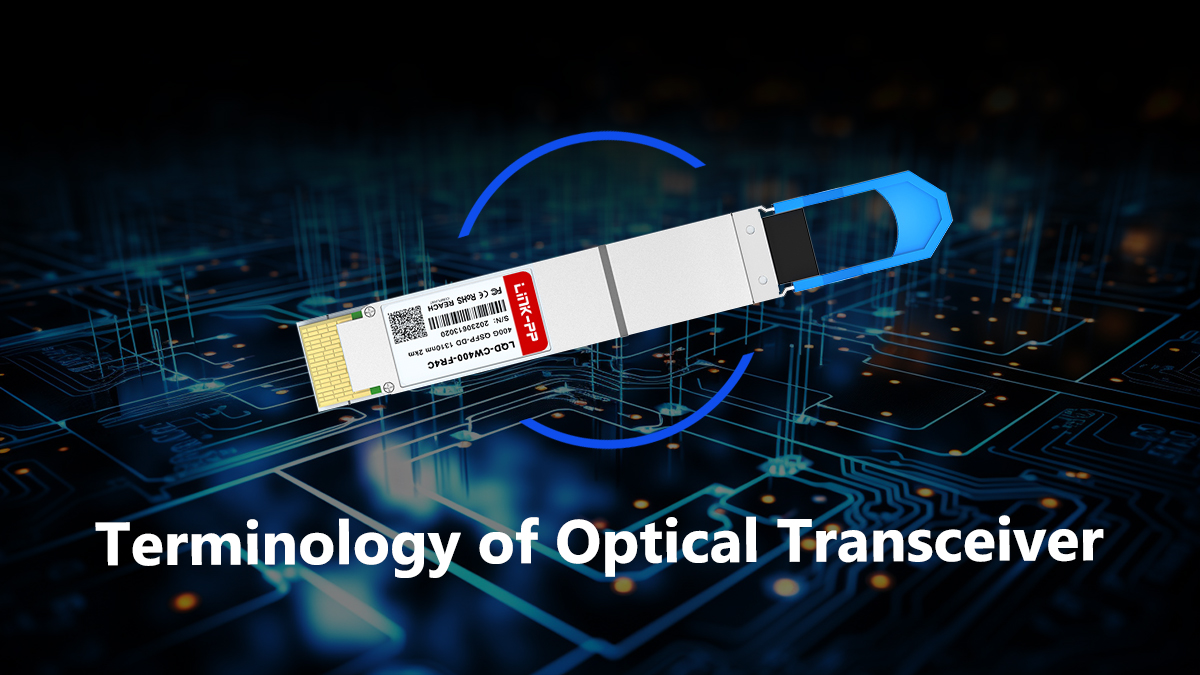
١٩. وحدات الإرسال والاستقبال الضوئية are the backbone of modern high-speed communication networks, enabling data transmission across data centers, telecom systems, and enterprise infrastructures. To navigate this complex field, understanding industry-specific terminology is critical. We will learn many essential terms related to optical modules in this blog.
Key Optical Transceiver Types & Form Factors
٩. SFP (وحدة قابلة للتوصيل بعامل شكل صغير)
A compact, hot-swappable transceiver supporting speeds up to 4.25 Gbps, widely used in Ethernet and Fibre Channel.
٦١. SFP+
An enhanced version of SFP, supporting 10 Gbps with improved EMI resistance and tighter cage designs.
QSFP+ (Quad Small Form-factor Pluggable)
A four-channel module for 40 Gbps applications, ideal for data center interconnects.
٤٤. QSFP28
Designed for 100 Gbps, QSFP28 modules use 25 Gbps per channel, offering higher density and lower power consumption.
١. QSFP-DD (حزمة صغيرة الشكل الرباعية ذات الكثافة المزدوجة)
Doubles lane capacity to enable 400G/800G in backward-compatible designs.
OSFP (Octal Small Form-Factor Pluggable)
Designed for 800G and beyond, this emerging form factor supports higher thermal efficiency.
١٠. CFP (عامل الشكل القابل للتوصيل من النوع C)
A larger module for 100G/400G metro and long-haul networks.
Technical Parameters and Performance Metrics
٧. معدل نقل البيانات
The transmission speed (e.g., 10G, 25G, 100G, 400G). Higher rates demand advanced ٨. PAM4 (تضمين سعة النبضة بمستويات أربعة) signaling.
١٣. الطول الموجي
Measured in nanometers (nm), common wavelengths include 850nm (multimode), 1310nm (single-mode), and 1550nm (long-haul DWDM).
٨. نوع الواجهة
Network-Side Physical Interface. Such as ٣٠. LC, MPO/MTP, SC, RJ45.
Reach (Distance)
٢٦. SR (وصول قصير): Short distance transmission. Typically up to 100–300 meters.
٢٧. LR (وصول طويل): Longer distance transmission. Up to 10km.
٢٨. ER (وصول ممتد): Extended distance transmission. Up to 40km.
ZR (Zetta Reach): Ultra long-haul transmission. Up to 80–120km.
٢٤. القدرة البصرية
١٧. قوة الإرسال: The average light intensity emitted by the module .
٢٠. حساسية المستقبِل: The minimum optical power required for error-free reception (typically -14 dBm to -28 dBm) .
Overload Power: The maximum optical power the receiver can handle without damage.
١٦. استعادة الساعة والبيانات (CDR)
A circuit that extracts timing and data signals from high-speed transmissions, reducing jitter.
١٢. مراقبة التشخيص الرقمي (DDM)
A feature enabling real-time monitoring of temperature, voltage, and optical power in modules like مُحَوِّلات الضوء LINK-PP.
MSO (Multi-Source Agreement)
Standards (e.g., MSA for QSFP28) ensuring compatibility across vendors.
١٠. معدل خطأ البت (BER)
The ratio of erroneous bits to total transmitted bits; lower BER indicates higher signal integrity.
٣. التشتُّت اللوني (CD)
Signal distortion caused by varying light speeds in fiber; mitigated via dispersion-shifted fiber.
٢. تشتُّت وضع الاستقطاب (PMD)
Another distortion type, critical in >100Gbps systems.
Optical Components in Optical Transceiver
٧. ليزر VCSEL: ٦. ليزر الانبعاث العمودي من الغرفة الرأسية
٣٧. FP: Fabry-Pérot Laser
DFB: Distributed Feedback Laser
EML: Electro-Absorption Modulated Laser
PIN: PIN Photodiodes
APD: Avalanche Photodiodes
Wavelength Division Multiplexing (WDM) Technologies
WDM enables multiple wavelengths to coexist on a single fiber, maximizing bandwidth:
٢٥. التعدد بالتقسيم الطولي الخشن (CWDM): Uses wider channel spacing (20nm) for cost-effective metro networks.
٤١. التعدد بالتقسيم الطولي الكثيف (DWDM): Combines multiple wavelengths (C-band or L-band) on a single fiber for high-capacity transport.
Protocols & Standards
IEEE 802.3 Standards
Standards governing Ethernet 400G (802.3bs), FlexE, ٢٩. ، و CAUI-4 interfaces. LINK-PP’s 400G SR8 optical transceiver adheres to IEEE 802.3bs for cloud infrastructure.
٤. MSA (اتفاقية المصادر المتعددة)
Industry agreements ensuring interoperability, such as ٣٠. اتفاقية مصنعي وحدات QSFP-DD (QSFP-DD MSA) ١٧. و OSFP MSA. وحدات الإرسال والاستقبال الضوئية من LINK-PP are MSA-compliant, guaranteeing plug-and-play compatibility with major switch vendors (Cisco, Juniper, etc.).
Emerging Trends & Innovations
LPO (Linear Pluggable Optics): Eliminates DSP chips to reduce power consumption, gaining traction for AI/ML workloads.
CPO (Co-Packaged Optics): Integrates optics with ASICs, slashing power use in hyperscale data centers.
Silicon Photonics: Combines silicon chips with optical components for cost-effective, high-volume production.
٢٨. الخلاصة
Mastering optical transceiver terminology empowers professionals to design resilient, high-speed networks. Whether evaluating DWDM compatibility or selecting PAM4-enabled modules, precision in terminology ensures optimal deployments. Choosing ٧. محولات ضوئية من نوع LINK-PP can meet your demands of 5G, cloud computing, and AI-driven infrastructures.
١٧.: الأسئلة الشائعة
What is the difference between single-mode and multi-mode fiber?
Single-mode fiber supports long-distance communication with minimal signal loss. Multi-mode fiber works best for short distances and is more cost-effective. Single-mode is ideal for applications like metropolitan networks, while multi-mode suits data centers and local area networks.
What does “hot-swappable” mean for optical transceivers?
Hot-swappable transceivers allow you to replace or upgrade them without shutting down the network. This feature ensures minimal downtime and uninterrupted operations, making it convenient for maintaining or scaling your infrastructure.
What factors should you consider when choosing an optical transceiver?
Focus on distance requirements, data rate, and compatibility with your existing hardware. Also, consider the type of fiber (single-mode or multi-mode) and the transceiver’s power consumption to optimize performance and cost-efficiency.
What are the common applications of optical transceivers?
Optical transceivers are used in data centers, telecommunications, enterprise networks, and metropolitan area networks. They enable high-speed data transmission for cloud computing, IoT devices, and 5G infrastructure.
٢٨.: انظر أيضًا
٨. أهمية المراقبة الرقمية في محولات الإرسال والاستقبال الضوئية
٥. استكشاف وحدة الإرسال الضوئي المدمجة (TOSA) في الوحدات الضوئية وأهميتها
٦. فهم تقنية التعدد بالتقسيم على الطول الموجي (WDM) ودورها في الشبكات